


Narrative structure: the key to clear communication
TL;DR:
- Narrative structure guides how information is organized to create meaning and engagement.
- Choosing the right framework depends on message length, audience, and desired transformation.
- Using clear storytelling techniques boosts audience understanding, trust, and conversion rates.
Most people assume that a compelling story is just a sequence of interesting events placed one after another. That assumption is exactly why so many business websites, marketing emails, and creative pitches fall flat. Without a deliberate framework shaping how information unfolds, even the most fascinating content loses its grip on the audience. Narrative structure is not a literary luxury reserved for novelists and screenwriters. It is the invisible architecture that makes communication persuasive, memorable, and clear. Understanding what it is, how it works, and how to apply it can change the way you connect with customers, collaborators, and readers.
Table of Contents
- Defining narrative structure: Frameworks and fundamentals
- Major narrative structures: Comparing common frameworks
- Why narrative structure boosts engagement and conversions
- Applying narrative structure to your messaging
- Why most experts overcomplicate narrative structure—and what actually works
- Advance your storytelling: Next steps with Stonington Media
- Frequently asked questions
Key Takeaways
| Point | Details |
|---|---|
| Structure shapes impact | A good narrative framework makes any story or message clearer and more persuasive. |
| Choose the right model | Selecting a structure that fits your goal gives your story focus and improves results. |
| Boost engagement easily | Applying simple narrative frameworks can significantly upgrade business and creative communication. |
| Avoid overcomplication | Keep your structure simple for memorable and actionable messages. |
Defining narrative structure: Frameworks and fundamentals
Narrative structure is often confused with plot, but the two are not the same thing. Plot is the specific sequence of events you choose to show your audience. Narrative structure is the broader framework that governs how those events are organized, emphasized, and paced to create meaning.
Narrative structure is the framework organizing a story’s events, distinguishing story (chronological events) from plot (presentation order), guiding reader perception through sequence, emphasis, and pacing.
Think of it this way. Two people can tell the same story about a product launch. One starts with the problem, builds tension through obstacles, and resolves with a triumphant solution. The other just lists what happened in order. The first version pulls you in. The second one reads like a shipping manifest.
The difference lies in three core tools:
- Sequence: The order in which information is revealed shapes what the audience expects and feels at each moment.
- Emphasis: Lingering on certain details signals what matters most, directing emotional and intellectual attention.
- Pacing: The rhythm of revelation, fast or slow, creates tension, relief, or momentum depending on the effect you want.
For a deeper story structure overview, these tools are not abstract concepts. They are practical levers you can adjust to control how your audience experiences your message. A well-structured narrative does not just inform. It guides perception, builds anticipation, and earns the reader’s trust before asking them to act.
This is why structure matters as much in a homepage headline as it does in a screenplay. When your communication lacks a clear framework, readers feel disoriented. They cannot tell what is important, what comes next, or why they should care. Structure solves that problem before it starts.
Major narrative structures: Comparing common frameworks
With foundational terms clear, let’s explore the structures you can use in practice. Narrative structures like the three-act structure and beat sheets provide frameworks that shape how events are organized for audience impact. Each one has distinct strengths depending on your medium, message length, and audience.
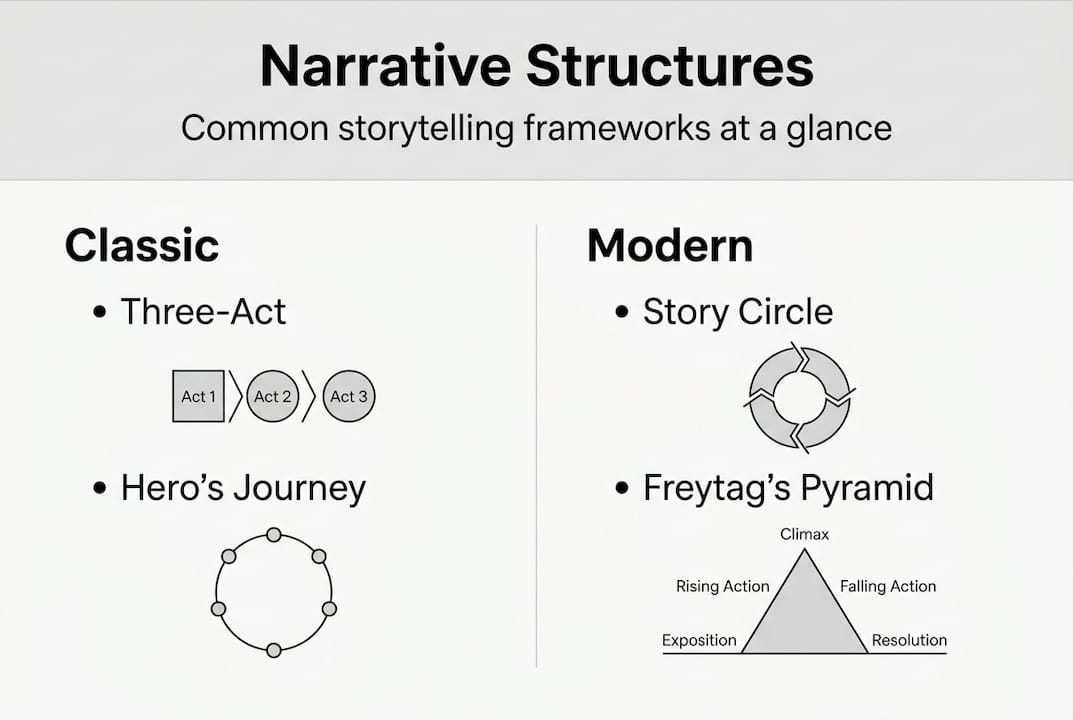
Here is a quick comparison of four widely used frameworks:
| Framework | Best for | Core strength |
|---|---|---|
| Three-act structure | Long-form content, pitches | Clear beginning, middle, end |
| Beat sheets | Screenplays, campaign narratives | Precise emotional pacing |
| Story circle | Short content, brand stories | Character-driven transformation |
| Freytag’s pyramid | Classical drama, case studies | Tension arc with clear climax |
Choosing the right framework depends on what you are trying to accomplish. Here is a practical way to think through the decision:
- Identify your message length. Short emails and social posts suit the Story Circle. Longer campaigns or scripts benefit from beat sheets or the three-act structure.
- Consider your audience’s emotional state. If they are skeptical, start with their problem (three-act). If they are already engaged, build tension quickly (Freytag’s pyramid).
- Define the transformation you want. Every strong narrative moves someone from one state to another. Pick the framework that maps most naturally to that arc.
- Test and observe. Apply the structure, measure engagement, and adjust emphasis or pacing based on real response.
Pro Tip: You do not need to follow any framework rigidly. The best communicators understand the rules well enough to bend them purposefully. Start with one structure, learn its rhythm, and then adapt it to fit your voice and audience.
Each of these frameworks has been refined through decades of storytelling practice. They are not formulas that flatten creativity. They are pressure charts that help you know where tension should rise, where relief should land, and where your audience needs a moment to breathe.
Why narrative structure boosts engagement and conversions
Armed with your chosen structure, let’s see why it matters for your audience and outcomes. A well-organized narrative guides reader perception, influences engagement, and increases clarity and impact. That is not a soft claim. It reflects how human cognition actually works.

Our brains are wired to follow cause and effect. When information arrives in a structured sequence, we process it faster, retain it longer, and feel more confident acting on it. When it arrives without structure, we spend cognitive energy just trying to orient ourselves, and we disengage before we ever reach the call to action.
Consider what structured storytelling does to key communication metrics:
| Communication type | Without structure | With narrative structure |
|---|---|---|
| Homepage messaging | High bounce rate, low clarity | Clearer value, longer time on page |
| Email campaigns | Low open-to-click ratio | Higher engagement, better response |
| Sales pitches | Confusion, lost interest | Clear arc, stronger close rate |
| Case studies | Flat, forgettable | Emotionally resonant, persuasive |
The practical effects show up quickly when you apply even simple structural changes:
- Opening with the problem rather than the solution immediately signals relevance to the reader.
- Building toward a resolution creates anticipation that keeps people reading.
- Ending with a clear next step converts engagement into action.
For anyone working on creative projects, script analysis tips reveal the same pattern. Scripts that follow a clear emotional trajectory hold attention. Those that meander lose the audience in the first ten pages. Business communication is no different.
The emotional trajectory of a message matters as much as its information content. A customer who feels understood, then curious, then confident is far more likely to act than one who simply received a list of features. Structure creates that emotional journey, and that journey is what converts attention into trust.
Applying narrative structure to your messaging
You’ve seen the benefits. Here’s how to directly apply these tools for your next message or campaign. Sequence, emphasis, and pacing are tools to tailor narratives for strategic business or creative results. The following steps work whether you are writing a homepage, a pitch deck, or a short email.
- Start with the audience’s problem. Before you say anything about your product or idea, name the tension your reader is already feeling. This earns immediate attention.
- Introduce a shift. Show that something can change. This is your inciting moment, the point where the reader sees a path forward.
- Build through evidence or story. Use examples, data, or narrative to show how the transformation happens. This is where trust is built.
- Reach a resolution. Bring the reader to the point where the problem is solved. Make it feel earned, not rushed.
- End with a clear call to action. The resolution should naturally lead somewhere. Tell the reader exactly what to do next.
Customization matters here. A message aimed at a skeptical customer needs more time in the problem stage. A pitch to an investor can move faster to the transformation. A note to a creative collaborator might lean into character and voice over data.
Pro Tip: Before writing anything, write one sentence that describes the transformation you want your reader to experience. “They go from confused to confident” or “They move from hesitant to ready.” That sentence is your structural compass.
Common pitfalls to avoid:
- Skipping the problem entirely and leading with your solution. This feels tone-deaf to readers who haven’t yet felt understood.
- Overloading the middle with too much information, which dilutes pacing and buries the resolution.
- Weak endings that trail off instead of directing the reader toward a clear next step.
For a more thorough look at how these principles apply to creative work, the story development guide breaks down how professional writers use structure to keep audiences locked in from the first page to the last.
Why most experts overcomplicate narrative structure—and what actually works
Here is an uncomfortable truth about how narrative structure gets taught. Most instructors and consultants bury the concept under layers of terminology, competing frameworks, and theoretical debate. The result is that people walk away feeling like structure is something only trained professionals can use. That is simply not accurate.
The most effective communicators, whether they are writing screenplays or service pages, tend to use simple story models rather than elaborate systems. They know their audience’s starting point, they know where they want that audience to end up, and they build a clear path between those two points.
The beat sheet approach is a good example. At its core, it is just a map of emotional beats. You do not need to memorize every label to use it. You just need to ask: where does the reader feel tension, where do they feel relief, and where do they feel ready to act?
Overstuffing your message with structural complexity is just as damaging as having no structure at all. Clarity is the goal. Structure is the tool. Keep that order of priority clear, and narrative structure becomes one of the most practical skills you can develop.
Advance your storytelling: Next steps with Stonington Media
Understanding narrative structure is one thing. Putting it to work in your actual website copy, email campaigns, and marketing messages is where the real shift happens.

Stonington Media specializes in exactly that kind of practical application. Whether you are looking to sharpen your homepage messaging or restructure a pitch that isn’t landing, the story structure resources on the site give you a strong foundation to build from. For business owners ready to see how structure translates directly into leads and conversions, the website messaging guide is a natural next step. And if you want expert support applying these ideas to your specific communication challenges, the marketing communications experts at Stonington Media are ready to help you close the gap between what you mean and what your audience actually hears.
Frequently asked questions
What is narrative structure in simple terms?
Narrative structure is the framework that organizes how a story’s events are presented, shaping the audience’s experience from beginning to end.
How does narrative structure differ from plot?
Narrative structure is the overall organizing system, while plot is the specific sequence of events your audience sees. Story and plot are distinct, with structure governing how plot choices create meaning.
Why is narrative structure important for business communication?
A clear structure grabs attention, builds emotional connection, and guides readers toward action. Narrative structure influences engagement in ways that unstructured messaging simply cannot match.
Which narrative structure should I use for my marketing messages?
Choose based on message length, audience mindset, and the transformation you want to create. Frameworks like three-act or beat sheets each offer distinct advantages depending on your specific communication goal.
Recommended



Additional Reading:
- What is professional screenplay coverage (and do you actually need it?)
- What is professional screenplay coverage, really?
- How to Know If Your Screenplay Concept Is Strong Enough
- Why Most Second Acts Collapse (And How Coverage Detects It)
- How Professional Readers Evaluate Character Arcs
- Is Your Script Marketable?
Indexes: