


What is story development? Expert guide for screenwriters
Many screenwriters believe story development is a rigid formula that stifles creativity. In reality, screenplay structures provide guidelines for timing actions, building drama, and holding audience attention without limiting your unique voice. This guide clarifies essential story development concepts, explores flexible frameworks you can adapt, and shows how to apply these tools to strengthen your scripts in 2026.
Table of Contents
- Understanding Story Development And Its Purpose
- Core Story Structures Used In Screenwriting
- Beyond Basic Structures: Complexities In Story Development
- Applying Story Development In Contemporary Film And Tv Writing
- Enhance Your Screenplay With Expert Support From Stonington Media
Key takeaways
| Point | Details |
|---|---|
| Story development shapes script structure and pacing | It guides plot progression, character arcs, and dramatic tension throughout your screenplay. |
| Common structures include three-act and Freytag’s Pyramid | These frameworks offer proven blueprints for organizing narrative elements effectively. |
| Plot versus character debates oversimplify storytelling | Successful scripts blend both approaches rather than choosing one over the other. |
| Early script analysis predicts audience engagement | Machine learning models can forecast viewer interest based on structural elements. |
| Flexible frameworks enhance originality | Treating structures as guidelines rather than rules preserves creative freedom. |
Understanding story development and its purpose
Story development is the process of planning and shaping narrative elements before and during screenplay writing. It encompasses plot progression, character growth, pacing decisions, and how dramatic tension builds across your script. Screenplay structures provide guidelines for story development, advising writers on the timing of actions, building drama, and holding audience attention.
These structures serve as creative tools, not creative cages. You maintain full control over character voice, thematic depth, and stylistic choices while benefiting from proven organizational principles. Many emerging writers mistakenly believe that following a story structure means sacrificing originality or writing by numbers.
The reality is quite different. Structures help you avoid common pitfalls like sagging middles, unmotivated climaxes, or unclear character motivations. They provide a roadmap you can modify based on your specific narrative needs. Think of story development as architectural planning: you need solid foundations and load-bearing walls, but the interior design remains entirely yours.
Consider these benefits of embracing flexible story development frameworks:
- Clear dramatic progression that keeps audiences invested
- Efficient use of screenplay real estate for maximum impact
- Strategic placement of reveals and reversals for emotional payoff
- Built-in mechanisms for escalating stakes and tension
- Professional polish that signals industry readiness
Pro Tip: Study how successful screenplays in your genre adapt traditional structures. Notice where they follow conventions and where they innovate. This analysis reveals which structural elements are negotiable and which are essential for audience satisfaction.
Core story structures used in screenwriting
Several foundational structures have shaped screenwriting for decades, each offering distinct advantages for organizing narrative flow. Beginning, middle, and end is a fundamental narrative framework that divides stories into setup, confrontation, and resolution phases. This deceptively simple structure provides the backbone for nearly every screenplay.
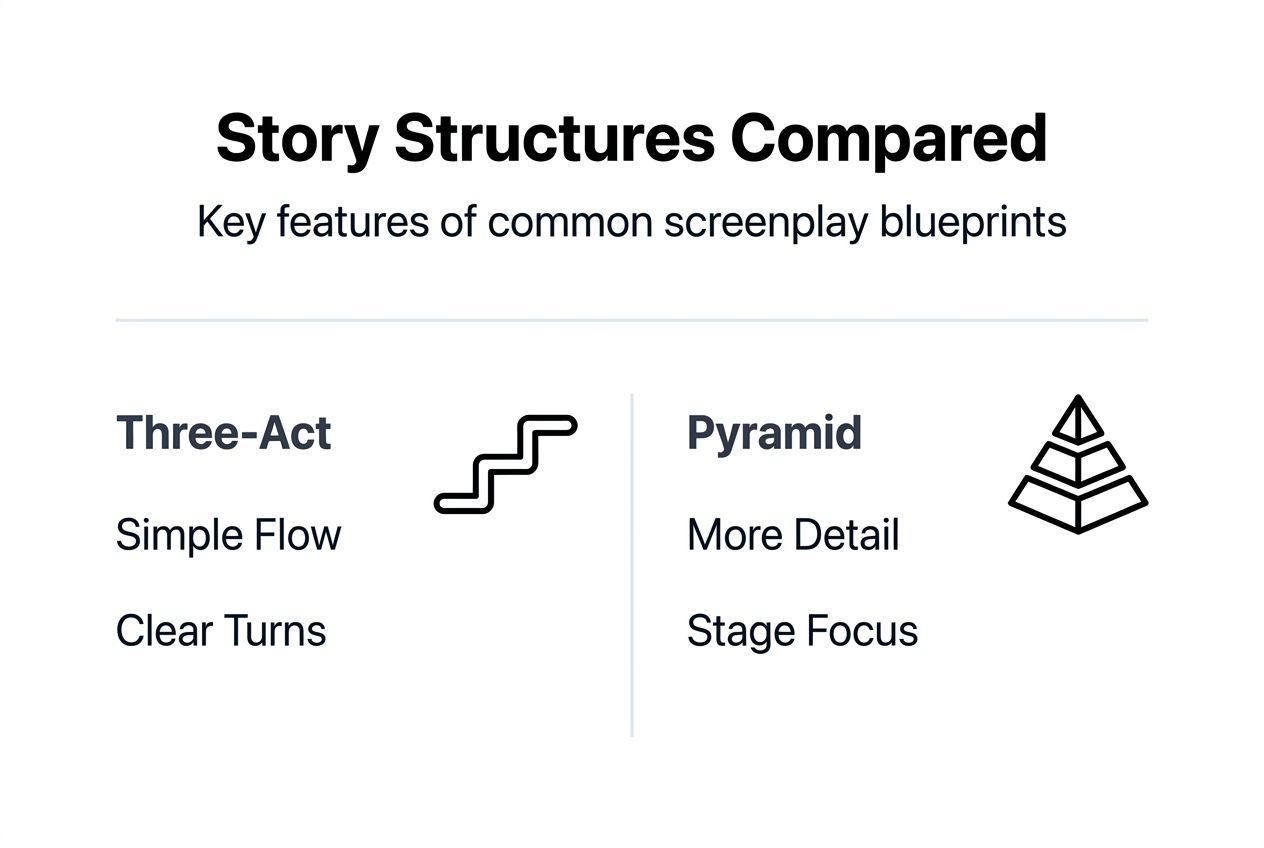
The three-act structure is the standard narrative blueprint for most mainstream movies, refining the beginning-middle-end framework into more specific beats. Act One establishes your world and protagonist while introducing the inciting incident. Act Two comprises roughly half your screenplay, escalating conflict through complications and setbacks. Act Three delivers the climax and resolution, answering story questions raised earlier.

For a more detailed approach, Freytag’s Pyramid breaks down storytelling into exposition, rising action, climax, falling action, and resolution. This five-part structure, adapted from dramatic theory, maps the rise and fall of dramatic tension throughout your narrative. The climax sits at the pyramid’s peak, representing maximum tension before the story resolves.
Here’s how these structures compare:
| Structure | Key Features | Primary Strength | Best Used For |
|---|---|---|---|
| Beginning-Middle-End | Three broad phases | Simplicity and flexibility | All genres and formats |
| Three-Act | Setup, confrontation, resolution with specific beat timing | Industry standard with clear pacing guidelines | Feature films and television pilots |
| Freytag’s Pyramid | Five stages mapping tension arc | Detailed dramatic progression | Complex narratives with multiple reversals |
Each structure offers different granularity for planning your screenplay. The three-act structure works particularly well for feature films because it aligns with typical 90 to 120 minute runtimes. Freytag’s pyramid excels when you need to map emotional peaks and valleys across ensemble casts or interweaving plotlines.
Pro Tip: Don’t commit to a single structure before understanding your story’s natural shape. Outline your major plot points first, then see which framework best supports your narrative’s organic flow. You may discover that hybrid approaches serve your specific story better than pure adherence to one model.
Beyond basic structures: complexities in story development
The screenwriting community often debates whether scripts should be plot-driven or character-driven, but this framework is a limiting binary in story development, often implicitly tied to gendered frameworks. Plot-driven stories supposedly emphasize external events, action, and cause-and-effect chains. Character-driven stories allegedly prioritize internal change, relationships, and emotional journeys.
This division creates false choices that restrict storytelling possibilities. Real-world successful screenplays integrate both dimensions seamlessly. External plot events reveal character nature while character decisions drive plot consequences. Separating these elements artificially weakens both aspects rather than strengthening either one.
The plot versus character debate also carries hidden assumptions about which stories matter most. Action-heavy narratives get labeled masculine and plot-focused, while relationship-centered stories get tagged feminine and character-focused. These classifications diminish both categories by suggesting they cannot coexist or that one approach is inherently superior.
Consider these additional limiting dichotomies that oversimplify story development:
- Power versus compassion as mutually exclusive character traits
- Intellectual versus emotional storytelling approaches
- Commercial versus artistic screenplay ambitions
- Genre conventions versus experimental narrative techniques
Authentic story development embraces complexity rather than forcing artificial choices. Your protagonist can pursue external goals while undergoing profound internal transformation. Your screenplay can deliver commercial genre satisfaction while exploring meaningful thematic questions. The most resonant scripts often succeed precisely because they refuse to choose sides in these false binaries.
Flexible, interdisciplinary approaches to story development yield richer narratives. Draw from psychology for character motivation, sociology for world-building, philosophy for thematic depth, and journalism for authentic detail. Character craft examined longing shows how desire drives both plot and character simultaneously, proving these elements are inseparable in practice.
Applying story development in contemporary film and TV writing
Translating structural knowledge into practical screenplay work requires systematic application. Start by identifying your story’s core dramatic question and the answer your climax will provide. This clarity ensures every scene contributes to your narrative’s through-line. Next, map your major plot points to your chosen structure’s key beats, adjusting timing based on your specific script’s needs.
Follow this process to integrate story structures into your drafts:
- Write a one-page synopsis covering your complete story arc from beginning to end
- Identify where major structural beats naturally fall in your narrative
- Adjust scene placement to align emotional peaks with structural expectations
- Test each scene’s necessity by asking what it reveals about character or advances plot
- Revise pacing by expanding or condensing sections based on dramatic importance
Recent advances in predictive frameworks for TV scripts offer unprecedented insight into how structural choices affect audience engagement. A predictive framework was developed to estimate television episode viewership using machine learning and natural language processing on over 25,000 scripts. This research demonstrates that early-stage analysis can forecast viewer interest with remarkable accuracy.
The study analyzed how screenplay elements correlate with actual viewership numbers across different genres and series types:
| Genre | Prediction Accuracy | Key Structural Factors | Sample Size |
|---|---|---|---|
| Drama Series | 52% variance explained | Character dialogue complexity, scene transitions | 8,400 episodes |
| Comedy Series | 48% variance explained | Joke density, subplot integration | 6,200 episodes |
| Crime/Thriller | 54% variance explained | Reveal timing, suspense escalation | 5,800 episodes |
| Science Fiction | 46% variance explained | World-building exposition, concept clarity | 4,600 episodes |
“Our models explained approximately 50% of the variance in viewership, with structural elements like act breaks, scene count, and dialogue distribution serving as significant predictors of audience engagement across all tested genres.”
This data doesn’t mean you should write by algorithm. Instead, use these insights to understand which structural choices historically resonate with audiences in your genre. If you’re writing crime thrillers, pay special attention to reveal timing and suspense escalation patterns. For comedy series, study how successful shows integrate subplots without diluting main narrative thrust.
Pro Tip: Evaluate your screenplay concept strength and script marketability using both traditional story development principles and data-informed insights. Balance creative intuition with structural awareness to maximize your screenplay’s impact without sacrificing artistic vision.
Enhance your screenplay with expert support from Stonington Media
Applying story development principles effectively requires both knowledge and objective perspective on your work. Professional screenplay coverage delivers honest, industry-grade feedback from experienced story analysts who understand how structure, character, and marketability intersect.

Stonington Media specializes in helping screenwriters strengthen their scripts through comprehensive evaluation and actionable guidance. Access detailed story structure resources including beat sheets, structural breakdowns, and analysis of proven screenplay models. Whether you’re refining your first draft or preparing for industry submission, expert feedback clarifies what’s working and identifies specific improvements that will elevate your screenplay’s market readiness.
FAQ
What is the difference between plot-driven and character-driven stories?
Plot-driven stories emphasize external events, action sequences, and cause-and-effect chains that propel the narrative forward. Character-driven stories focus on internal change, relationships, and emotional journeys that reveal who characters truly are. However, this binary is limiting because successful screenplays integrate both dimensions seamlessly rather than choosing one over the other.
How can screenplay structure improve audience engagement?
Screenplay structures help time actions, build drama, and hold audience attention by providing proven pacing guidelines. Well-timed structural beats create anticipation, deliver satisfying payoffs, and maintain narrative momentum throughout your script. Research demonstrates that structural elements significantly predict viewer retention and engagement across different genres and formats.
What are the key stages in Freytag’s Pyramid?
Freytag’s Pyramid stages include exposition, rising action, climax, falling action, and resolution, mapping the rise and fall of dramatic tension. Exposition establishes story context, world rules, and character baselines. Rising action escalates conflict through complications and obstacles. Climax represents the story’s turning point and maximum tension. Falling action shows immediate consequences of the climax. Resolution concludes the narrative and answers remaining story questions.
Should I follow story structures strictly or adapt them?
Treat structures as flexible guidelines rather than rigid rules. Study how successful screenplays in your genre adapt traditional frameworks, noting where they follow conventions and where they innovate strategically. The goal is using structural principles to enhance your unique creative vision, not constraining it. Adapt structures based on your specific narrative needs while maintaining the core benefits of clear dramatic progression and strategic pacing.
How early should I apply story development principles?
Begin considering story development principles during your initial concept and outlining phases. Early structural planning helps you avoid common pitfalls like unclear character motivations or sagging midpoints before investing time in full draft pages. However, remain flexible enough to discover new story possibilities during the writing process. Balance upfront planning with openness to organic discoveries that emerge as characters and situations develop on the page.
Recommended
- How to know if your screenplay concept is strong enough
- What Is Professional Screenplay Coverage (And Do You Actually Need It?)
- Story Structure



Additional Reading:
- What is professional screenplay coverage (and do you actually need it?)
- What is professional screenplay coverage, really?
- How to Know If Your Screenplay Concept Is Strong Enough
- Why Most Second Acts Collapse (And How Coverage Detects It)
- How Professional Readers Evaluate Character Arcs
- Is Your Script Marketable?
Indexes: