

Story structure, examined: Save the Cat (and why it feels so practical)
Save the Cat didn’t grow out of theory. It grew out of development rooms, where people were trying to figure out why one script felt tight, while another drifted. It’s not obsessed with symbolism. It’s focused on the audience. When does the story really begin? When does it shift? When does it finally pay off what it set up?
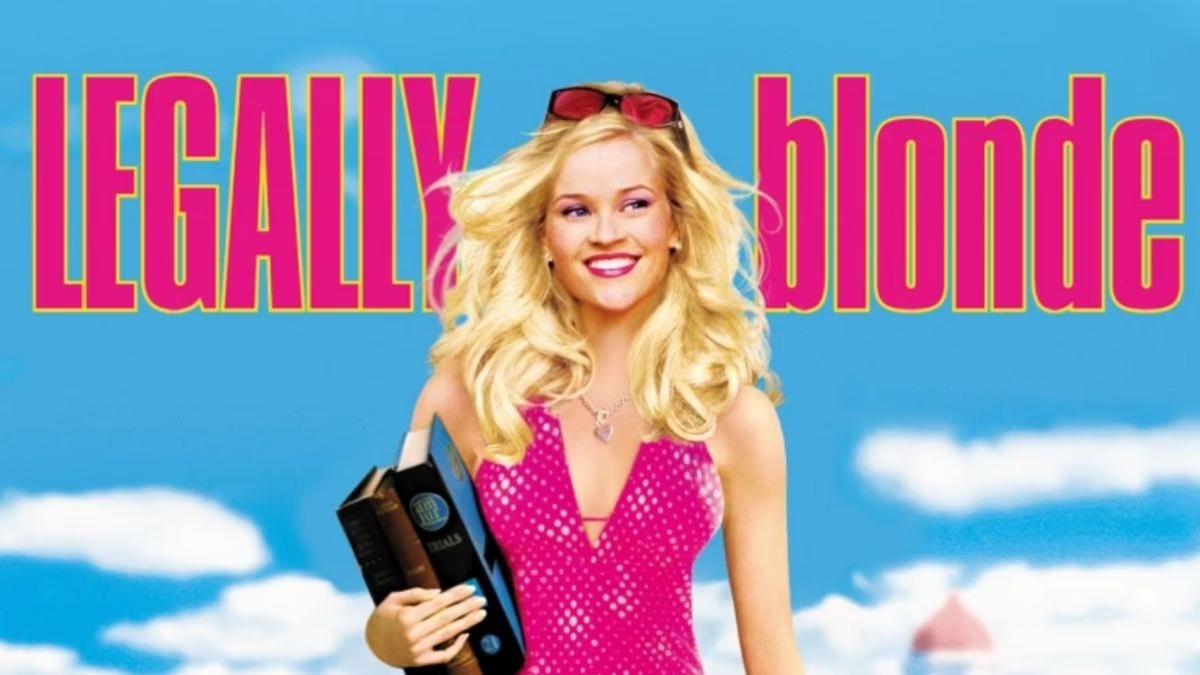
If you want to see it working in a clean, visible way, Legally Blonde is a great example.
What Save the Cat is actually tracking
At its simplest, Save the Cat is a beat map.
Not a map of themes. Not a deep psychological diagram. A map of story moments.
It lays out the turns that tend to appear in satisfying mainstream films. Some of those turns are plot events. Some are emotional pivots. What ties them together is timing. The assumption is that audiences feel stories in waves. Curiosity builds. Pressure increases. Doubt creeps in. Relief follows.
Save the Cat puts names on those waves so writers can spot them.
It isn’t asking what your story means. It’s asking whether it’s moving.
How Legally Blonde fits the pattern
The film opens with a clear “before.”
Elle Woods is confident and completely at ease in her world. The tone is bright. The stakes feel personal but contained. The movie quietly tells us what kind of ride we’re about to take.
Then the disruption hits.
Warner breaks up with her and tells her she isn’t serious enough for his future. It stings. More importantly, it creates a goal. Harvard becomes the target. The story now has direction.
In Save the Cat language, this is setup. It matters because it establishes identity and desire. Without those, there’s nothing to challenge.
The real commitment happens when Elle actually gets into Harvard and leaves home.
At that point, the movie can’t drift back. The fish-out-of-water premise locks in. We’re no longer watching a breakup story. We’re watching someone step into a world that doesn’t take her seriously.
The middle does what this framework expects it to do: it delivers on the promise.
Awkward classes. Social misfires. Small wins. Gradual competence. This stretch is often called the “fun and games” section, and that label can sound light, but it’s important. The audience came to see how Elle would survive Harvard. The movie gives us that experience.
Then the tone shifts.
There’s a midpoint where the goal quietly evolves. Harvard stops being about impressing Warner and starts being about proving something to herself. The pressure changes shape. The stakes get more personal.
Eventually, the low point arrives.
Elle considers quitting. Doubt returns. The confidence we saw at the beginning feels fragile again. This is the moment where the story tests whether she can carry what she’s learned.
The final stretch tightens.
Elle uses her intelligence and attention to detail in the courtroom. Earlier setups pay off. The resolution answers the original wound. She no longer needs Warner’s approval. The ending echoes the beginning, but she isn’t the same person.
That’s the beat map at work.
What Save the Cat helps writers notice
What I’ve found useful about this framework is its clarity.
It helps you see whether the central goal is clear. Whether the middle actually escalates instead of looping. Whether the ending pays off what the beginning promised.
It also gives development teams a shared language. Instead of saying “something feels off,” you can ask whether a turn is missing or arriving too late.
That doesn’t make it rigid. It makes it practical.
Where it sits among other structures
Three-act structure organizes time.
Beat sheets track engagement moment by moment.
Save the Cat bundles those instincts into a named sequence that’s easy to discuss.
It doesn’t replace models that focus on internal change, like the Story Circle. It doesn’t aim for mythic symbolism the way the Hero’s Journey does. Its focus is pace and payoff.
It keeps coming back to a simple question: if the audience leans forward at the start, does the story keep rewarding that attention?
Closing
Save the Cat can feel mechanical because it labels the machinery.
But machinery isn’t the enemy of emotion. It’s what keeps the engine from stalling halfway through.
Used thoughtfully, this framework doesn’t tell you what your story should be about. It simply helps you see whether the story you’re telling delivers on its own promises. In something as cleanly built as Legally Blonde, you can watch those promises being made, tested, and finally kept.
Next in the series:
If three acts organize time and Save the Cat organizes beats, five acts organize pressure. Some stories don’t climb once and resolve. They tighten in waves. You can see it clearly in Breaking Bad, where tension rises, shifts, recalibrates, and then rises again. We’ll look at how that rhythm works, and why some stories need more than one long middle to do their job.



Additional Reading:
- What is professional screenplay coverage (and do you actually need it?)
- What is professional screenplay coverage, really?
- How to Know If Your Screenplay Concept Is Strong Enough
- Why Most Second Acts Collapse (And How Coverage Detects It)
- How Professional Readers Evaluate Character Arcs
- Is Your Script Marketable?
Indexes: