

Small business SEO strategies to boost leads and visibility
TL;DR:
- Effective small business SEO requires clear goal setting, targeted keyword strategies, and optimized messaging to attract qualified leads.
- Success depends on measuring key metrics, refining messaging, and focusing on local or niche opportunities rather than broad keywords.
You have a real product, a real service, and a real business. But when potential customers search online, they find your competitors instead of you. This is one of the most frustrating realities for small business owners who have already invested in a website, social media, and even paid ads. The problem often isn’t your offering. It’s visibility. Organic search drives 53% of all website traffic, which means SEO is one of the most cost-effective channels you can build. This guide walks you through a clear, step-by-step process to attract qualified leads and grow your online presence through proven SEO techniques.
Table of Contents
- Clarifying your SEO goals and prerequisites
- Keyword strategies for small business success
- Optimizing pages and messaging for search visibility
- Leveraging local SEO and Google Business Profile
- Measuring and refining your SEO efforts
- The uncomfortable truth: SEO value isn’t just about rankings
- Next steps: Elevate your messaging and lead generation
- Frequently asked questions
Key Takeaways
| Point | Details |
|---|---|
| Organic search drives results | Over half of website traffic comes from organic search, making SEO essential for small businesses. |
| Target long-tail keywords | Choosing specific, low-competition keywords helps you rank faster and attract qualified leads. |
| Measure what matters | Leads and conversions are the most important metrics, so track results using GSC and GA4. |
| Page messaging boosts SEO | Optimizing website messaging for buyer intent directly increases visibility and lead generation. |
| Continuous improvement is key | Refine your SEO strategies consistently for sustainable growth and higher online visibility. |
Clarifying your SEO goals and prerequisites
Now that you understand why SEO is critical, the next step is to clarify your goals and what you need to measure for meaningful growth.
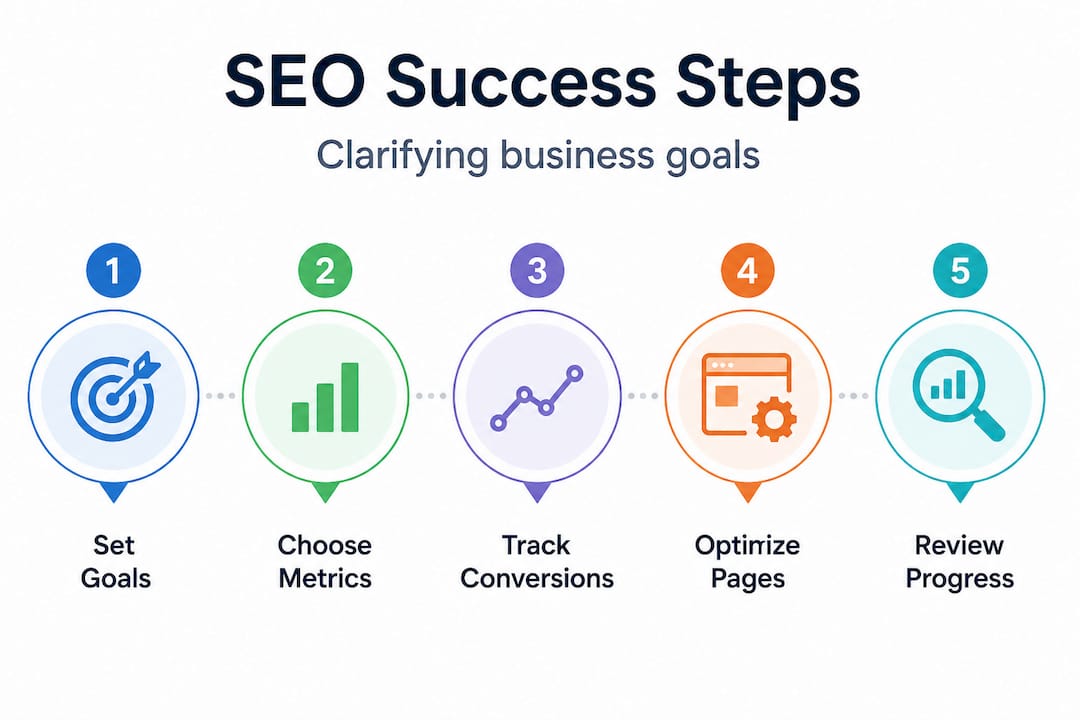
Most small businesses jump into SEO without defining what success actually looks like. They chase rankings and celebrate traffic spikes, but when the quarterly review comes around, the revenue needle hasn’t moved. That disconnect is avoidable. Before you optimize a single page, you need to know what outcome you’re working toward.
Define your business goals first. Are you trying to generate leads through a contact form? Book more appointments? Drive product sales? Each of these requires a different page strategy and a different way of measuring results. A service business looking for consultation requests will prioritize very different conversions than an e-commerce store counting checkouts.
Once your goal is defined, you can work backward to identify the SEO metrics that actually matter. Traffic is one signal, but it’s incomplete on its own. The metrics worth tracking closely include organic sessions (how many people land on your site from search), click-through rate or CTR (how often your listing gets clicked in search results), and conversion rate (how many of those visitors take the action you want). You can pull all of this data from two free tools: Google Search Console (which tracks impressions, clicks, and CTR) and GA4, which is Google Analytics 4 (which tracks on-site behavior and conversion events).
Here’s a meaningful distinction many guides skip. Ranking on page one for a search term is not the same thing as generating leads and revenue. You can rank highly for terms that attract visitors who have no intention of buying. Lead generation requires matching search intent with the right page, the right message, and the right call to action. Ranking is a means to that end, not the destination.
Pro Tip: Set up conversion tracking in GA4 before you begin any optimization work. Tag your thank-you pages, form submissions, and phone call clicks as conversion events. Without this step, you’re navigating without a map.
One area that ties directly into measurable SEO outcomes is effective business messaging. When your pages communicate clearly, visitors are more likely to take action, which improves both your conversion rate and your bounce rate. Both of those signals feed back into your overall SEO performance over time.
| Metric | What it measures | Best tool |
|---|---|---|
| Organic sessions | Total visits from search | GA4 |
| Click-through rate (CTR) | How often your listing is clicked | Google Search Console |
| Keyword rankings | Position in search results | Google Search Console |
| Conversions | Leads, form fills, sales | GA4 with conversion events |
| Bounce rate | Visitors who leave without engaging | GA4 |
Setting realistic expectations also matters here. SEO is not a short-term play. Most small businesses begin seeing measurable improvement within three to six months of consistent effort. Sustainable growth takes longer. That timeline can feel discouraging, but it’s also why many of your competitors give up before results arrive.
Keyword strategies for small business success
With your goals and metrics set, let’s dive into how to choose keywords that actually drive results.
Keyword selection is where many small business SEO efforts quietly fall apart. The instinct is to go after the biggest, broadest terms in your industry. A landscaping company wants to rank for “landscaping.” A bookkeeper wants to rank for “accounting services.” These are understandable goals, but they’re almost always the wrong starting point for a small business with limited time and budget.
Broad, high-volume keywords are dominated by large national brands, industry directories, and sites with years of authority built up. Competing against them head-on is like entering a sprint race in dress shoes. The effort isn’t the problem. The playing field is.
The more effective approach is to focus on long-tail keywords, which are search phrases that are more specific, typically three to five words or longer. Targeting high-intent long-tail keywords with 100 to 1,000 monthly searches and a keyword difficulty score under 30 leads to faster rankings and significantly better lead quality. A landscaping company targeting “residential lawn care service Atlanta” will rank faster and attract more qualified visitors than one targeting “landscaping.”
Here is a practical process you can follow to identify your best keyword targets:
- Start with a list of 10 to 15 phrases your ideal customer would type into Google to find your service or product.
- Plug those phrases into a free tool like Google’s own search bar and review the autocomplete suggestions. These are real searches.
- Use Google Search Console to review which terms your site already appears for, even if you’re not ranking well yet.
- Check a keyword research tool like Ubersuggest, Ahrefs, or Semrush to confirm search volume and difficulty scores.
- Filter your list down to terms with clear buyer intent, moderate search volume, and low to medium competition.
- Group related keywords by topic so each page on your site can target one clear theme.
Pro Tip: Look at the top three ranking pages for each keyword you’re considering. If you see national brands and high-authority sites dominating all three spots, that keyword is likely too competitive for now. If you see small local businesses or thin content, that’s a real opportunity.
A useful way to think about keyword intent is to separate keywords into categories. Informational keywords attract people doing research. Transactional keywords attract people who are ready to buy or hire. For lead generation, transactional and commercial investigation keywords are your priority.
| Keyword example | Monthly searches (est.) | Keyword difficulty | Intent |
|---|---|---|---|
| “accountant” | 90,000+ | Very high | Broad/informational |
| “small business bookkeeper” | 2,400 | Medium | Commercial |
| “affordable bookkeeper for LLC” | 320 | Low | Transactional |
| “quarterly tax filing service near me” | 170 | Low | Transactional |
Competitor research adds another layer to this process. Review the pages that rank for your target keywords and note what topics they cover, what questions they answer, and what they leave out. Gaps in their content are your opportunity. You can cover the topic more thoroughly or address a specific angle they missed. Building website visibility strategies around these gaps accelerates your ability to capture search traffic your competitors are leaving on the table.
Optimizing pages and messaging for search visibility
With the right keywords in hand, your next step is to optimize each page and your business messaging for maximum search visibility.

Page optimization is both technical and creative. The technical elements tell search engines what a page is about. The creative elements convince human visitors to stay, engage, and convert. You need both working together for SEO to generate real leads.
On the technical side, every page should have the following elements thoughtfully crafted:
- Title tag: This is the blue headline that appears in search results. It should include your target keyword and be written in a way that earns a click. Keep it under 60 characters.
- Meta description: This is the short summary below the title tag in search results. It should reinforce the page’s value and include a subtle call to action. Around 155 characters is the sweet spot.
- H1 heading: Every page should have a single, clear H1 heading that includes the target keyword and communicates the page’s purpose directly.
- Body content: Use your keyword and related terms naturally throughout the page. Aim for content that answers the searcher’s question completely and moves them toward a decision.
- Internal links: Connect your pages to each other with relevant anchor text. This distributes authority and helps visitors explore related content.
For online-only businesses, the priority should be service and product pages optimized to match buyer intent rather than location-based optimization. This means crafting content that meets visitors at their specific stage of research and guides them clearly toward conversion.
“Ranking without converting is just expensive tourism. Visitors who don’t take action don’t pay the bills.”
This is where messaging clarity becomes a performance variable, not just a branding concern. A page that ranks but fails to communicate its value proposition clearly will have a high bounce rate and low conversion rate. Both of those outcomes signal to search engines that the page isn’t meeting user needs, which can eventually hurt the ranking itself.
Think of each page as having a single job to do. A service page’s job is to convince a qualified visitor to contact you. An appointment booking page’s job is to reduce friction and get the form filled. A landing page for a specific offer has one call to action and nothing else competing for attention.
Pro Tip: Before publishing any optimized page, test the messaging by reading it aloud and asking whether it clearly answers the visitor’s likely question within the first three sentences. If the value isn’t immediately clear, rewrite the opening before worrying about keywords.
Applying narrative techniques for messaging to your pages creates a subtle but powerful effect. When your content follows a problem-solution-outcome structure, visitors feel understood and are more naturally guided toward taking the next step. This approach improves both dwell time and conversions, two factors that reinforce your SEO investment over time.
Leveraging local SEO and Google Business Profile
Now, let’s focus on tactics for businesses with a local presence, an area that’s often neglected.
If your business serves customers in a specific geographic area, local SEO is one of the highest-return strategies available to you. Most local businesses underinvest here, which creates real opportunity. A well-optimized Google Business Profile (GBP) can place your business in the local map pack, which appears above the organic search results for most location-based queries.
Setting up and maintaining your GBP effectively requires consistent attention to several key details:
- Claim and verify your Google Business Profile at business.google.com if you haven’t already.
- Complete every section of the profile fully, including business name, address, phone number, website URL, and business hours.
- Select the most accurate primary and secondary categories for your business.
- Write a keyword-rich business description that communicates your core value proposition clearly.
- Upload high-quality photos of your location, team, products, or services on a regular basis.
- Enable messaging so potential customers can contact you directly from your profile.
The essential details your GBP must include at all times:
- Business name (consistent with your website and other listings)
- Physical address or service area
- Primary phone number
- Website URL
- Business hours including holiday hours
- Services or product listings
- Customer Q and A responses
Reviews are another critical factor. Organic search drives 53% of website traffic, but for local businesses, the local map pack can deliver an even higher share of qualified nearby visitors. Reviews both attract those visitors and influence whether they choose you once they arrive.
Pro Tip: Respond publicly to every review, including negative ones. This signals to both Google and prospective customers that your business is attentive and trustworthy. Thoughtful responses to criticism can actually build more confidence than a string of perfect five-star ratings.
Local citations (mentions of your business name, address, and phone number on directories like Yelp, Apple Maps, and industry-specific sites) reinforce your local relevance to Google. Inconsistencies across citations can quietly hurt your local rankings. Audit your citations periodically and correct any discrepancies in how your business name or address appears.
Explore detailed GBP optimization methods if you want to go deeper into maximizing your local search presence and converting profile visitors into actual leads.
Measuring and refining your SEO efforts
Finally, let’s make sure you know how to verify your progress and continue improving for lasting results.
Many small businesses invest in SEO for a few months and then stop because they don’t see results. Often, the problem isn’t that the strategy failed. It’s that they stopped before the results arrived, or they were measuring the wrong things entirely. A structured reporting process solves this.
Here is a practical reporting routine you can follow:
- Log into Google Search Console weekly to review impressions, clicks, and CTR for your top pages.
- Open GA4 monthly to check organic session volume, conversion events completed, and bounce rate trends.
- Note which pages are gaining or losing impressions and investigate why.
- Review your top-converting keywords and look for related terms to target with new content.
- Identify pages with high traffic but low conversions and update the messaging or call to action.
- Track your progress against your original business goals, not just rankings.
“Businesses that measure success by leads and revenue, not rankings, make smarter optimization decisions and see more durable growth.”
Pro Tip: Set calendar reminders for quarterly SEO reviews. During each quarterly review, compare your current organic traffic and leads to the same period last year. Seasonal patterns become visible, and you can plan content and optimization work around predictable search behavior.
Common mistakes are worth cataloging because many of them are invisible until they’ve already slowed your progress.
| Common mistake | Why it hurts | How to fix it |
|---|---|---|
| Targeting keywords with no buyer intent | Drives traffic that doesn’t convert | Audit your keyword list and refocus on transactional terms |
| Missing or thin meta descriptions | Lowers CTR from search results | Write compelling meta descriptions for every indexed page |
| No conversion tracking set up | Can’t measure lead outcomes | Configure conversion events in GA4 |
| Ignoring page load speed | Increases bounce rate | Compress images and use caching tools |
| Inconsistent NAP (name, address, phone) | Hurts local rankings | Audit all directory listings and correct discrepancies |
| Publishing content without a target keyword | Content doesn’t attract organic traffic | Assign one primary keyword per page before writing |
You can explore more detailed SEO measurement insights to build out a reporting framework that connects your SEO activity directly to business outcomes rather than vanity metrics.
The uncomfortable truth: SEO value isn’t just about rankings
To go beyond step-by-step tactics, here’s what years of small business SEO optimization actually reveal.
There is a seductive quality to ranking reports. Watching a keyword move from position 18 to position 6 feels like progress, and it is. But many businesses celebrate that movement and discover the phone still isn’t ringing. That gap between ranking and results is where the real work lives, and most SEO guides quietly skip over it.
The core issue is this: SEO drives visitors to your pages, but your messaging determines what those visitors do next. If a potential customer lands on your site and can’t immediately understand what you offer, who it’s for, and what they should do next, they leave. That departure shows up as a bounce, which can erode the ranking you worked hard to build.
Ranking without converting is, to borrow a phrase, just expensive tourism.
What years of working with small businesses actually reveals is that small, deliberate improvements to messaging clarity almost always outperform dramatic increases in traffic volume. A business with 400 monthly organic visitors and a 5% lead conversion rate generates 20 leads. That same business with 800 visitors and a 1% conversion rate generates 8. More traffic built on weak messaging produces less business, not more.
This is why the framework for SEO success isn’t just technical. It’s communicative. Your pages need to be found and understood. The search engine is a gatekeeper that sends visitors your way. Your messaging is what turns those visitors into conversations, opportunities, and revenue.
Aligning your messaging for sales growth with your SEO strategy means thinking about both dimensions simultaneously. Every page you optimize for search should also be evaluated for how clearly and compellingly it communicates its value to the person who actually lands on it.
That dual focus is what separates SEO strategies that generate consistent leads from ones that generate impressive-looking traffic reports with disappointing business outcomes.
Next steps: Elevate your messaging and lead generation
Your SEO strategy only reaches its full potential when the messaging behind it is just as strong as the technical foundation. Visitors who arrive through organic search need to be met with pages that are clear, compelling, and built to convert.
At Stonington Media, we help small businesses close the gap between search visibility and actual lead generation. Whether your website needs a full messaging review or targeted page rewrites, our approach connects storytelling principles with SEO strategy. If you’re ready to turn your content into a lead generation system, start by exploring how clear messaging increases sales, then look at how story-driven branding for leads can sharpen your competitive edge. You can also review our website storytelling strategies to see how narrative structure improves conversion on every page.
Frequently asked questions
How long does it take for small business SEO results to show?
Most small businesses see initial SEO improvements within three to six months, though consistent lead generation through organic search typically requires ongoing optimization over a longer period.
What’s the best way to track SEO success for my business?
Use Google Search Console and GA4 to monitor your organic traffic and conversions, tracking leads and revenue rather than rankings as your primary success metrics.
Should I focus more on local SEO or product pages?
If your business has a physical location, prioritize local SEO and your Google Business Profile. Online-only businesses should focus their energy on optimizing service and product pages to match buyer intent.
Are broad keywords worth targeting for small business SEO?
No. Targeting long-tail keywords with low competition and high buyer intent delivers faster rankings and better lead quality than chasing high-volume broad terms your competitors have already locked down.
Recommended


Additional Reading:
- What is professional screenplay coverage (and do you actually need it?)
- What is professional screenplay coverage, really?
- How to Know If Your Screenplay Concept Is Strong Enough
- Why Most Second Acts Collapse (And How Coverage Detects It)
- How Professional Readers Evaluate Character Arcs
- Is Your Script Marketable?
Indexes: