


How to revise a screenplay for stronger storytelling
Revising your screenplay can feel overwhelming after multiple drafts that still miss the mark. Many screenwriters struggle to identify what needs fixing and how to approach revisions systematically. Effective revision is the bridge between a rough draft and a polished, marketable script that captivates readers and audiences. This guide walks you through a proven, structured process to revise your screenplay efficiently, focusing on storytelling craft and character development that elevates your work to professional standards.
Table of Contents
- Prepare Your Revision Foundation: Outlines, Beat Sheets, And Mindset
- Use Structured Passes To Tackle Your Screenplay Systematically
- Minimize Revisions With Strategic Breaks And Feedback Loops
- Measuring Success: Benchmarks And Iterative Refinement For Screenplay Excellence
- Streamline Your Revisions With Expert Screenplay Coverage
Key takeaways
| Point | Details |
|---|---|
| Structured revision passes | Tackle different screenplay elements in focused stages to improve revision clarity and effectiveness. |
| Preparation reduces rewrites | Creating outlines or beat sheets before revising minimizes costly structural overhauls later. |
| Surgical versus systemic changes | Distinguishing minor tweaks from major rewrites helps prioritize your revision efforts efficiently. |
| Fresh perspectives matter | Taking breaks and gathering feedback exposes blind spots that strengthen story and character arcs. |
| Iterative refinement works | Modern data shows repeated refinement cycles measurably enhance script quality and audience engagement. |
Prepare your revision foundation: outlines, beat sheets, and mindset
Before diving into revisions, solid preparation saves you from endless rewrites and frustration. Creating detailed outlines or beat sheets before you revise keeps your story structure clear and helps you spot weaknesses early. Beat sheets track your plot progression scene by scene, revealing pacing issues, redundant moments, or missing emotional beats that weaken your narrative.
Adopting the right revision mindset transforms how you approach your screenplay. Focus on iterative improvement rather than chasing perfection in one pass. Rewriting as you draft reduces the scale of later revisions because you catch structural problems early. This approach means fewer massive overhauls when you reach the revision stage.
Regularly revisiting your foundational story elements keeps your revisions aligned with your core themes and character goals. Your story structure beat sheets serve as your roadmap, ensuring every revision decision supports your overall narrative vision. When you know where your story is headed, you make smarter choices about what to cut, expand, or reshape.
Pro Tip: Print your beat sheet and keep it visible during revisions. Physical reference points help you maintain story coherence when you’re deep in scene-level edits.
Your preparation checklist should include:
- Updated outline reflecting your current story vision
- Beat sheet with scene-by-scene breakdown
- Clear understanding of protagonist goals and obstacles
- List of core themes you want to emphasize
- Notes on major story questions that need resolution
This groundwork creates a safety net. When you feel lost during revisions, your outline and beat sheet guide you back to your story’s essential structure and purpose.
Use structured passes to tackle your screenplay systematically
Revising your entire screenplay at once leads to overwhelm and missed problems. Structured revision passes break the work into manageable stages, ensuring every element receives proper attention. Each pass targets specific aspects of your screenplay, from big-picture structure down to final polish.
- Start with big-picture revisions focusing on your logline clarity, core themes, and overall plot structure. Does your premise hook readers immediately? Do your themes resonate throughout the story? Is your three-act structure solid with clear turning points? Fix these foundational elements first because they affect everything downstream.
- Refine character arcs by examining protagonist agency and meaningful change. Your main character must drive the story through active choices, not passive reactions. Evaluating character arcs reveals whether your protagonist transforms in ways that feel earned and emotionally satisfying. Supporting characters should also serve clear purposes that advance plot or illuminate themes.
- Conduct detailed scene analysis to eliminate redundancies and ensure proper pacing. Every scene must reveal character, advance plot, or both. Cut scenes that repeat information or stall momentum. Cinematic pacing techniques help you balance quiet character moments with plot-driven action, creating rhythm that keeps audiences engaged.
- Focus your dialogue revision by reading every conversation aloud. Hearing your words exposes unnatural phrasing, repetitive speech patterns, and pacing problems that silent reading misses. Tighten conversations by cutting unnecessary pleasantries and ensuring each line reveals subtext or pushes the scene forward. Film script analysis tips emphasize that strong dialogue sounds natural while being more purposeful than real conversation.
- Finish with polish passes covering grammar, formatting consistency, and small tweaks that enhance readability. Check for typos, formatting errors, and inconsistent character or location names. These details matter because they signal professionalism to readers and executives.
Pro Tip: Complete each pass fully before moving to the next. Jumping between different revision types dilutes your focus and makes you less effective at spotting issues.
“The first draft is just you telling yourself the story. Revision is where you tell it to everyone else.” This mindset shift helps you approach each pass with fresh purpose.
Structured passes prevent the paralysis that comes from trying to fix everything simultaneously. You make measurable progress and maintain creative energy throughout the revision process.

Minimize revisions with strategic breaks and feedback loops
Taking intentional breaks refreshes your perspective and helps you catch errors that fatigue blinds you to. Stepping away from your screenplay for days or weeks lets you return with objectivity similar to a first-time reader. You spot plot holes, pacing issues, and character inconsistencies that were invisible when you were immersed in daily writing.
Gathering feedback from trusted readers exposes blind spots in your story and character development. Choose readers who understand screenwriting craft and can articulate specific problems rather than vague impressions. Their fresh eyes identify confusing moments, unsatisfying character choices, or thematic inconsistencies you’ve become too close to see.
Reading dialogue aloud remains one of the most effective revision techniques for catching unnatural phrasing and rhythm problems. Your ear detects awkward constructions and repetitive patterns that look fine on the page. Record yourself reading and listen back to hear how your dialogue flows in real time.
Understanding the difference between surgical revisions and systemic rewrites helps you prioritize your revision time efficiently. Surgical revisions are small fixes: tweaking dialogue, adjusting scene descriptions, correcting formatting. Systemic rewrites involve major overhauls: changing your premise, restructuring acts, reimagining character arcs, or altering your protagonist’s journey.
Prioritize issues affecting story premise and protagonist agency before addressing surface details. A perfectly polished script with a weak premise still fails. Fix your foundation first, then work toward the surface. This hierarchy ensures you don’t waste time perfecting scenes you might cut during deeper structural revisions.
Proofread multiple times to catch residual errors and refine language. Each proofing pass should focus on different elements: one for typos, another for formatting, a third for consistency in character details and timeline.
- Schedule breaks of at least one week between major revision passes
- Select feedback providers who represent your target audience or industry professionals
- Create a revision hierarchy that addresses premise before polish
- Use multiple proofing passes with specific focus areas
- Document feedback patterns to identify recurring weaknesses
The combination of breaks and feedback leads to higher quality final drafts with less wasted effort. You avoid the trap of endless tinkering because external perspectives tell you when your script is ready.
| Revision Type | Focus Area | When to Apply |
|---|---|---|
| Systemic Rewrite | Premise, protagonist agency, story escalation | Early revision stages, major structural problems |
| Surgical Revision | Dialogue polish, scene descriptions, formatting | Late revision stages, after structure is solid |
| Feedback Integration | Reader notes, blind spots, unclear moments | After each major pass, before final polish |
Measuring success: benchmarks and iterative refinement for screenplay excellence
There is no magic number of drafts that signals your screenplay is ready. Success is measured by alignment of story quality with professional reader feedback rather than counting revisions. Black List evaluations demonstrate 73.8% agreement within one point on overall quality between independent readers, showing that strong scripts generate consistent positive responses across evaluators.
Modern tools offer new approaches to screenplay refinement. AI-driven iterative refinement improves script quality by 53.4% at the script level and 66.7% at the scene level according to recent studies. Predictive models explain up to 50% of viewership variance based on dialogue features alone, highlighting the critical role of sharp, purposeful dialogue in audience engagement.
Learn to recognize when your script consistently meets story and character goals across different reader perspectives. If multiple trusted readers identify the same strengths and no longer flag major structural concerns, you’re approaching readiness. Script marketability assessment helps you understand whether your screenplay aligns with current industry standards and audience expectations.
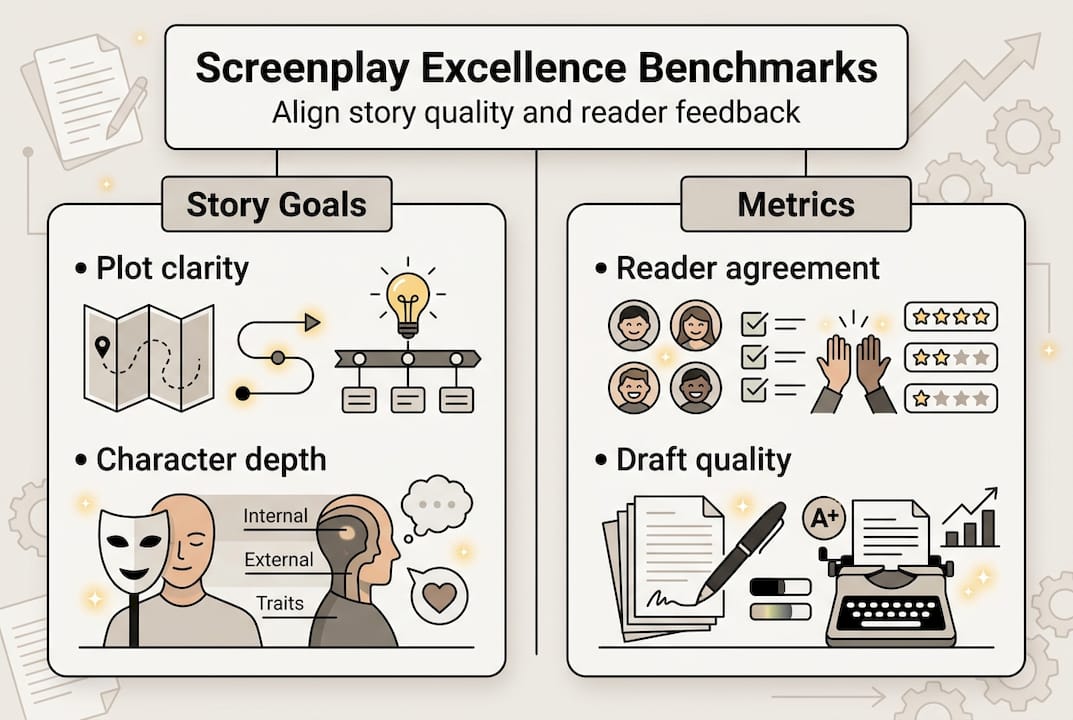
Continue iterative refinement focusing on measurable improvements rather than indefinite rewriting. Each revision cycle should address specific, identified weaknesses with clear goals. Track your progress by noting which issues you’ve resolved and which remain. This data-driven approach prevents revision paralysis and helps you recognize diminishing returns.
Employ AI insights and data-driven feedback as supplements to traditional revision methods, not replacements. Technology can identify patterns in dialogue quality, pacing inconsistencies, and structural weaknesses faster than manual analysis. However, human creative judgment remains essential for evaluating emotional resonance, thematic depth, and character authenticity.
- Strong agreement among professional readers indicates script readiness
- Iterative refinement cycles produce measurable quality improvements
- Dialogue quality significantly predicts audience engagement and viewership
- Data-driven tools complement traditional revision methods effectively
- Track specific improvements across revision cycles to measure progress
| Quality Metric | Benchmark | Significance |
|---|---|---|
| Reader Agreement | 73.8% within 1 point | Indicates consistent professional quality perception |
| Script-Level Improvement | 53.4% via iterative refinement | Shows substantial quality gains from systematic revision |
| Scene-Level Improvement | 66.7% via targeted refinement | Demonstrates effectiveness of focused scene work |
| Dialogue Impact | Explains 50% viewership variance | Highlights critical importance of dialogue quality |
Recognize that revision is not about reaching perfection but achieving professional quality that resonates consistently with readers. When your screenplay generates strong, aligned responses from multiple evaluators and addresses the core elements of compelling storytelling, you’ve succeeded.
Streamline your revisions with expert screenplay coverage
Revising your screenplay becomes more efficient when you combine your structured approach with professional screenplay coverage. Expert readers provide detailed notes that identify story weaknesses and strengths you might overlook, even after multiple self-revision passes. Coverage services help you prioritize which revisions matter most, saving time and enhancing story clarity by focusing your efforts where they’ll have maximum impact.

Accessing expert feedback complements your own revision work with fresh, industry-informed perspectives. Professional coverage shows you how producers and development executives will respond to your script, revealing blind spots in character motivation, plot logic, or marketability. Review a screenplay coverage example to see how detailed analysis breaks down your script’s strengths and improvement areas with actionable specificity.
Understanding the screenplay coverage workflow helps you integrate professional feedback into your revision cycles at the right stages. Submit for coverage after you’ve completed your major structural revisions but before final polish, maximizing the value of expert insights. Story development expertise guides you through using coverage notes to make strategic revision choices that align with 2026 market trends and industry expectations. Combining coverage insights with your structured revision process produces the strongest possible final draft.
FAQ
What is the typical number of screenplay revisions writers go through?
No fixed draft number exists for screenplay success. Quality is judged by story strength and professional reader alignment rather than revision quantity. Black List data shows 73.8% agreement among readers on strong scripts, indicating that consistent positive feedback matters more than draft count. Focus on measurable improvements and reader consensus instead of arbitrary revision targets.
How can I know which parts of my screenplay need systemic rewrites versus minor tweaks?
Systemic rewrites affect premise, protagonist agency, or story escalation at fundamental levels. Minor tweaks focus on dialogue polish, formatting consistency, and surface fixes that don’t alter story structure. Prioritize systemic issues first to maintain a solid story foundation, then address surgical revisions once your structure is sound. This hierarchy prevents wasting time perfecting scenes you might later cut during deeper structural changes.
What strategies improve dialogue during revisions?
Reading dialogue aloud reveals unnatural phrasing and pacing issues your eyes miss on the page. Feedback from trusted readers helps identify clunky or unrealistic lines that don’t match character voice. Use focused dialogue passes separate from other revision work to sharpen character voice and conversational clarity. Dialogue refinement techniques emphasize that great dialogue sounds natural while being more purposeful than real conversation.
How does AI help in screenplay revision today?
AI iterative refinement improves script quality by 53.4% at the script level and 66.7% at the scene level according to recent studies. Predictive models explain up to 50% of viewership variance based on dialogue features, showing AI’s ability to identify patterns affecting audience engagement. Use AI tools as supplements to traditional revision methods, combining technological analysis with human creative judgment for best results.
Recommended


Additional Reading:
- What is professional screenplay coverage (and do you actually need it?)
- What is professional screenplay coverage, really?
- How to Know If Your Screenplay Concept Is Strong Enough
- Why Most Second Acts Collapse (And How Coverage Detects It)
- How Professional Readers Evaluate Character Arcs
- Is Your Script Marketable?
Indexes: