


Screenplay Coverage Example: How Coverage Works
If you're a screenwriter trying to understand what happens when someone reads your script professionally, looking at a screenplay coverage example is the fastest way to learn. Coverage is the process by which industry professionals evaluate scripts, and seeing a real example helps you understand what readers look for, how they organize their thoughts, and what kind of feedback you might receive. Whether you're submitting to production companies, contests, or development studios, knowing the anatomy of coverage gives you an advantage.
What screenplay coverage looks like
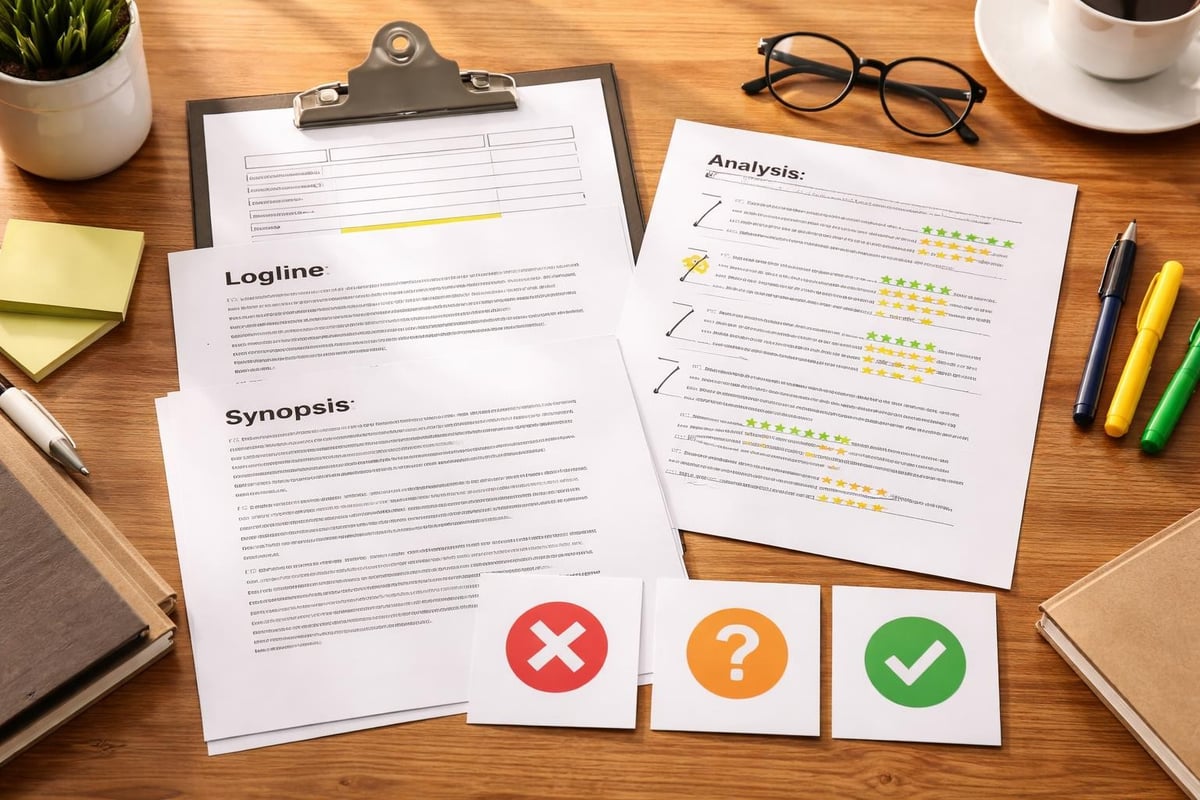
Most professional coverage follows a standard format that makes it easy for executives to scan quickly. At the top, you'll find basic information about the script: title, author, genre, page count, and the date of the coverage. This header section also includes the reader's name and sometimes their contact information.
The first substantive element is usually a logline. This one or two sentence summary captures the basic story in its most compressed form. A good logline identifies the main character, their goal, and the central conflict. For example: "A retired hitman must rescue his kidnapped dog from Russian mobsters, reigniting a war he thought he'd left behind."
After the logline comes a synopsis. This section runs anywhere from half a page to a full page and tells the story from beginning to end. Unlike a logline, the synopsis reveals major plot points, character arcs, and the ending. It's written in present tense and follows the script's structure beat by beat.
The rating grid
Most screenplay coverage examples include a rating grid or scoring system. This grid evaluates different aspects of the script on a scale, typically from poor to excellent. Common categories include:
- Premise/concept: How original and compelling is the basic idea?
- Story structure: Does the script follow a logical three-act structure?
- Character development: Are characters well-defined and do they change?
- Dialogue: Does it sound natural and reveal character?
- Pacing: Does the story move at the right speed?
- Visual storytelling: Does the writer show rather than tell?
Some coverage formats use numerical scores (1-10), while others use qualitative ratings like "weak," "fair," "good," or "excellent." The Wikipedia entry on script coverage explains how different studios and readers approach these evaluation criteria differently.
Breaking down the comments section
The heart of any screenplay coverage example is the comments section. This is where readers provide detailed analysis and explain their ratings. Professional coverage typically divides comments into several subsections.
Strengths
This section highlights what works well in the script. Even if a reader ultimately passes on a project, they identify positive elements. Maybe the dialogue crackles with energy. Perhaps the opening sequence hooks readers immediately. The concept might be fresh and marketable.
Good coverage doesn't just say "the dialogue is strong." It provides specific examples from the script. A reader might write: "The banter between Sarah and Tom in the bar scene (pp. 23-25) reveals their competitive history while moving the plot forward naturally."
Weaknesses
Here readers address problems they encountered. Common issues include:
- Unclear character motivations
- Predictable plot developments
- Thin supporting characters
- Inconsistent tone
- Pacing problems in the second act
- Unearned emotional moments
Like the strengths section, good coverage supports criticism with examples. Instead of writing "the second act drags," a thorough reader explains exactly where momentum slows and why.
| Coverage Element | Purpose | Typical Length |
|---|---|---|
| Logline | Capture story in 1-2 sentences | 1-2 sentences |
| Synopsis | Summarize full plot | 0.5-1 page |
| Strengths | Highlight what works | 1-2 paragraphs |
| Weaknesses | Identify problems | 1-3 paragraphs |
| Character Analysis | Evaluate character development | 1-2 paragraphs |
Character analysis
Many screenplay coverage examples include dedicated analysis of the main characters. Readers evaluate whether protagonists are active or passive, whether they have clear goals, and whether they undergo meaningful transformation.
This section might examine the antagonist's motivations, the complexity of supporting characters, or relationship dynamics. Strong coverage connects character analysis to the story's themes and emotional impact.

The recommendation and what it means
At the end of coverage, readers provide a recommendation. The three standard options are:
- Pass: The script isn't ready or isn't right for this company
- Consider: The script has merit but needs work or might not fit current needs
- Recommend: This script deserves serious attention from decision makers
Some coverage systems add gradations like "low consider" or "strong consider." A few use different language entirely, such as "decline" instead of "pass."
Understanding these categories matters because they directly affect whether your script moves forward. According to industry practice, only about 1-3% of scripts receive "recommend" ratings. "Consider" ratings happen more frequently but still represent scripts that stood out.
When you examine a screenplay coverage example from professional services, you'll notice that recommendations are always supported by the analysis that came before. Readers don't just say "recommend." They explain why this script deserves attention despite any flaws.
Common coverage formats across the industry
Different organizations format their coverage differently, but the core elements remain consistent. Production companies often use streamlined formats that executives can read in five minutes or less. Development studios might create more detailed coverage with extensive notes.
Studio coverage tends to be brief and focused on commercial viability. Does this script fit the company's current slate? Can it attract talent? What's the budget range? Studio readers consider market factors alongside creative quality.
Development coverage goes deeper into storytelling craft. These reports might span several pages and include scene-by-scene notes. Development coverage often suggests specific revisions and explains why certain changes would strengthen the script.
Contest coverage varies widely. Some competitions provide minimal feedback. Others offer detailed analysis similar to professional development coverage. Looking at examples of script coverage across different genres shows how approach changes based on purpose.
Educational coverage templates
Film schools and writing programs use coverage to teach analysis skills. Academic formats often emphasize learning objectives over commercial considerations. You can see this approach in script coverage templates used in university settings.
These templates walk students through evaluating every story element systematically. They're more prescriptive than industry coverage but teach the same fundamental skills.
What makes coverage useful for writers
The best screenplay coverage example teaches writers how to improve their craft. Generic praise like "good pacing" doesn't help much. Specific observations do.
When coverage identifies a problem like "the protagonist's goal shifts unexpectedly on page 67 without explanation," the writer knows exactly where to focus revision efforts. When it highlights a strength like "the subplot involving Marco's sister adds emotional depth and ties into the theme of redemption," the writer knows what's working and can amplify those elements.
Good coverage answers several questions:
- Does the story hook readers early?
- Are plot developments surprising yet logical?
- Do characters behave consistently with their established traits?
- Does dialogue sound like real people talking?
- Does the script maintain momentum throughout?
- Is the ending satisfying and earned?
Professional readers understand story structure deeply. They recognize when beats hit at the right moments and when pacing falters. Their analysis often references fundamental story structure principles that help writers see how their script aligns with or deviates from proven models.
Reading between the lines of coverage
Sometimes what coverage doesn't say matters as much as what it does. If a screenplay coverage example spends three paragraphs on dialogue strengths but barely mentions plot, that imbalance tells you something. The reader found the story structure weak but didn't want to be harsh.
Watch for language patterns. Words like "ambitious" or "complex" can be diplomatic ways of saying "confusing." When readers write "the concept is interesting but the execution needs work," they're usually passing.
Positive signals include phrases like "fresh take on," "compelling protagonist," or "emotionally resonant." When readers get specific about what moved them or surprised them, they're genuinely engaged.
The difference between coverage and notes
Coverage is an evaluation document. Notes are prescriptive guidance. Some services blur this line, but understanding the distinction helps.
Coverage tells you what works and what doesn't from a reader's perspective. It's diagnostic. Notes tell you what to change. They're prescriptive. Professional coverage might include light suggestions, but full development notes go much further, often providing scene-by-scene revision ideas.
How to use a screenplay coverage example to improve your script
When you receive coverage on your own work, resist the urge to defend your choices. Instead, ask whether the reader's confusion or criticism points to something you can clarify on the page.
If a reader misunderstands a character's motivation, that's not the reader's fault. It means you haven't made that motivation clear enough in the script. If they find a subplot confusing, you need to strengthen how it connects to the main story.
Steps for applying coverage feedback:
- Read the coverage completely without reacting emotionally
- Identify patterns in the criticism (multiple comments about similar issues)
- Check whether the reader's observations match your intentions
- Prioritize addressing the biggest structural issues first
- Use specific examples from coverage to guide targeted revisions
Many writers find it helpful to examine how professional analysts approach script evaluation to understand the mindset behind the feedback they receive.

Elements that separate great coverage from mediocre coverage
Not all screenplay coverage examples are equally useful. The best coverage demonstrates deep story knowledge, provides specific examples, and maintains objectivity while being honest.
Great coverage includes:
- Concrete examples from specific page numbers
- Analysis that connects elements (how character flaws drive plot complications)
- Recognition of the script's apparent intentions
- Constructive suggestions even when passing
- Acknowledgment of market realities
Weak coverage relies on:
- Vague generalizations without supporting details
- Personal taste masquerading as objective analysis
- Contradictory observations
- Missing major story elements in the synopsis
- Subjective judgments about commercial potential without explanation
The quality of coverage depends heavily on the reader's experience and training. Looking at examples from different coverage services reveals significant variation in depth and usefulness.
Common issues found in screenplay coverage examples
After reading hundreds of coverage reports, certain problems appear repeatedly. These patterns reveal what mistakes writers make most often.
Passive protagonists top the list. Many scripts feature main characters who react to events rather than driving the story forward. Coverage frequently notes when protagonists lack clear goals or fail to make active choices.
Muddled second acts plague screenplays at every level. The middle section often loses focus, repeats beats, or meanders without building tension. Readers consistently identify pacing problems in this section.
Underwritten antagonists weaken many scripts. Coverage regularly points out villains who lack clear motivations or compelling reasons for their opposition.
| Common Problem | How It Appears in Coverage | Impact on Rating |
|---|---|---|
| Passive protagonist | "Main character reacts rather than acts" | Usually Pass |
| Weak second act | "Story loses momentum around page 50" | Consider or Pass |
| Unclear theme | "Script doesn't seem to know what it's about" | Consider or Pass |
| On-the-nose dialogue | "Characters state emotions directly" | Lowers dialogue rating |
| Unearned ending | "Resolution feels rushed and unearned" | Usually Pass |
Industry perspectives on coverage value
Different industry professionals view coverage differently. Producers use it to filter submissions. Agents use it to decide which clients to sign. Writers use it to improve their craft.
Production companies receive hundreds of script submissions monthly. Coverage helps them identify the few worth serious consideration. An executive might read only coverage at first, requesting the full script only if the coverage is positive.
Writers sometimes resist coverage, viewing it as an obstacle. But understanding how screenplays are judged based on their coverage helps you prepare scripts that survive this filtering process.
Development executives see coverage as the beginning of a conversation. Even a "consider" rating can lead to development deals if the underlying concept is strong and the writer shows willingness to revise.
What to look for when comparing coverage services
If you're seeking professional feedback, examining a screenplay coverage example from different services helps you choose the right fit.
Ask these questions:
- How detailed is the analysis?
- Do they provide specific page references?
- Is the synopsis accurate and complete?
- Do they explain ratings with supporting evidence?
- Does the coverage offer actionable feedback?
Some services assign coverage to experienced screenwriters. Others train readers specifically in analysis. Still others use industry professionals who read for studios. Each approach has strengths. Professional coverage templates show you what comprehensive analysis includes.
Price often correlates with depth, but not always. Some expensive services provide generic feedback. Some affordable options deliver thoughtful analysis. Reading sample coverage before purchasing helps set expectations.
How coverage has evolved with the industry
The basic format of screenplay coverage hasn't changed much in decades, but digital tools have transformed the process. Readers once typed coverage on paper. Now they use templates and databases that production companies can search and filter.
Some companies use standardized questions that readers must answer. This ensures consistency across different readers but can feel formulaic. Other companies give readers more freedom to focus on what matters most in each specific script.
The rise of screenplay competitions has democratized access to coverage. Writers who can't get representation can still receive professional feedback by entering contests that provide detailed coverage to all entrants.
Digital submission platforms now track coverage history, creating permanent records. This makes quality even more important, since poorly written coverage might follow a script as it makes the rounds.
The relationship between coverage and development
Coverage is often just the first step. When a script receives a "recommend" rating, it enters active development. That's when more detailed notes appear, often from multiple sources.
Development notes differ from coverage in scope and specificity. Where coverage might say "the second act needs tightening," development notes identify exactly which scenes to cut, combine, or expand. They might suggest dialogue changes, character adjustments, or structural overhauls.
Writers should view coverage as a map showing where their script stands, not as the final word on their work. A "pass" from one reader doesn't mean the script is worthless. It means that particular reader at that particular company didn't connect with it.
Using coverage to understand your audience
One overlooked benefit of screenplay coverage examples is learning how readers think. When you see how professionals analyze scripts, you start to internalize their perspective while writing.
You begin asking yourself reader questions: Is my protagonist's goal clear by page 10? Does this subplot connect to the main theme? Am I showing conflict visually or just talking about it?
This doesn't mean writing to please coverage readers. It means understanding the basics of professional storytelling well enough that your script communicates clearly with any reader.
The best writers use coverage strategically. They get feedback early enough to revise substantially. They seek out readers who understand their genre. They view criticism as information rather than judgment.
Looking at a screenplay coverage example demystifies the evaluation process and shows you exactly what industry professionals examine when reading scripts. Understanding coverage structure, rating systems, and analysis methods helps you prepare stronger work and interpret feedback constructively. If you're ready to receive professional coverage that provides clear, honest feedback about your screenplay's strengths and areas for improvement, Stonington Media LLC offers experienced analysis that helps writers develop their scripts with confidence and direction.
Article written using RankPill.


Additional Reading:
- What is professional screenplay coverage (and do you actually need it?)
- What is professional screenplay coverage, really?
- How to Know If Your Screenplay Concept Is Strong Enough
- Why Most Second Acts Collapse (And How Coverage Detects It)
- How Professional Readers Evaluate Character Arcs
- Is Your Script Marketable?
Indexes: