


Internet marketing for plumbers: Proven strategies to grow local leads
TL;DR:
- Local SEO, paid ads, and website optimization are essential for consistent plumbing leads.
- Combining multiple marketing channels and tracking results is key to success.
- Responsive customer service and review management significantly boost online reputation and conversions.
Running a plumbing business means you are exceptional at fixing leaks, clearing drains, and keeping homes running smoothly. But competing online against bigger firms with larger budgets? That is a different kind of pressure entirely. Many plumbing companies rely on word-of-mouth or pay for leads through third-party directories, only to find those sources inconsistent and expensive. The good news is that internet marketing, when structured properly, creates a steady and predictable flow of high-quality local leads. This article walks through local SEO, paid advertising, website optimization, content strategy, and multi-channel outreach so you can understand what actually works and why each piece matters for your business.
Table of Contents
- Optimizing your plumbing business for local SEO
- Using Google Local Services Ads and PPC for immediate leads
- Building a plumber website that converts leads
- Content marketing, reviews, and multi-channel outreach
- Balancing marketing investments and tracking results
- Why most plumbing marketers miss the mark — and how to win
- Ready to boost your leads? Next steps for plumbing businesses
- Frequently asked questions
Key Takeaways
| Point | Details |
|---|---|
| Local SEO is essential | Optimizing your Google Business Profile and reviews drives steady local leads for plumbing businesses. |
| Paid ads deliver fast results | Google LSAs and PPC campaigns generate immediate, high-intent plumbing leads when set up correctly. |
| Website design matters | A mobile-friendly, clear website with testimonials and service pages converts more visitors into quality leads. |
| Reviews and retention boost reputation | Managing reviews, content, email, and social ensures trust, repeat customers, and steady growth. |
| Track and adapt for best ROI | Blending channels, tracking booked jobs, and leveraging automation maximizes marketing return. |
Optimizing your plumbing business for local SEO
Local SEO (Search Engine Optimization) is the practice of making your business visible when nearby customers search for services like yours. For plumbers, this almost always starts with Google Business Profile (GBP), the free listing that controls whether you appear in Google Maps and the Map Pack, which is that cluster of three local results at the top of a search page.
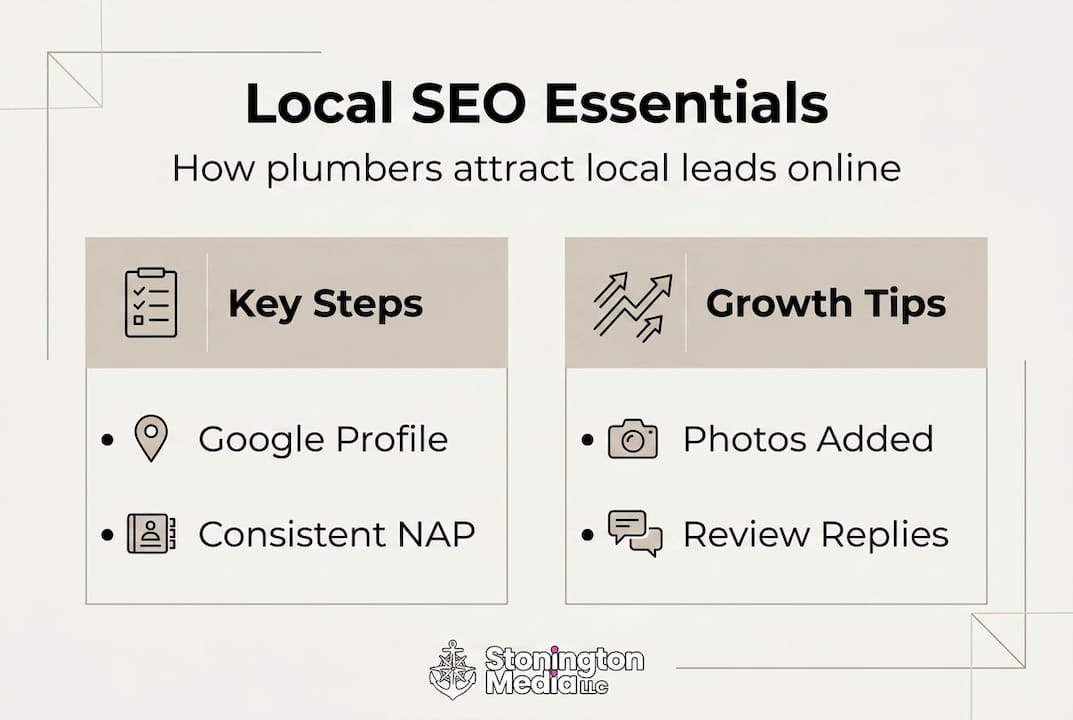
GBP optimization is foundational for plumbers, covering complete profiles, consistent NAP (Name, Address, Phone), photos, services listed, and reviews earned, all of which help you rank in the Map Pack and drive direct calls. Every detail matters. A profile with an incomplete address or an old phone number sends mixed signals to both Google and potential customers.
Consider these local search realities before moving on:
| Benchmark | Statistic |
|---|---|
| Consumers who search locally weekly | 80% |
| Lift in conversion if you respond in under 5 minutes | 21x more likely |
| Customers who check reviews before hiring | 80% |
These numbers clarify something important: being found online is only half the challenge. How you respond and what customers read about you determines whether they call.
For each neighborhood or city you serve, consider building a dedicated service page. A page titled “Emergency plumber in [City Name]” tells Google exactly where you work and what you do. That specificity is what local SEO for small businesses rewards over time. Generic pages rarely earn top local rankings.
Here is what a complete GBP profile should include:
- Business name, address, and phone number matching your website exactly
- All service categories selected accurately
- High-quality photos of your team, trucks, and completed jobs
- A business description that mentions your key services and service area
- At least 10 to 20 recent reviews with responses from you
Pro Tip: After every completed job, send a simple text message asking the customer to leave a Google review. Make it easy by including a direct link. Businesses that do this consistently outpace competitors who wait for reviews to happen organically.
Responding to every review, including the negative ones, signals professionalism and trust. Customers reading your responses often care more about how you handle complaints than whether you ever received one.
Using Google Local Services Ads and PPC for immediate leads
Local SEO builds a foundation, but paid advertising fills the pipeline while that foundation cures. Two options dominate: Google Local Services Ads (LSAs) and Pay-Per-Click (PPC) Google Ads.
LSAs offer top placement with a Google Guaranteed badge, a pay-per-lead model (typically $6 to $90 per lead), and higher conversion rates than standard PPC. The badge matters. It tells customers that Google has verified your license, insurance, and background check. That trust signal is visible before they even click.
Setting up LSAs involves a verification process with Google, after which your profile appears above even regular paid ads for qualifying searches. To optimize your LSA performance:
- Complete your profile with every service type you offer
- Set your service area as precisely as possible
- Respond to every lead within 5 minutes when possible
- Mark leads accurately as booked, not booked, or invalid
- Collect reviews specifically tied to your LSA profile
“Leads convert 21x more likely when responded to in under 5 minutes. Speed is not just courtesy; it is your competitive edge.”
PPC campaigns, or Google Ads, work differently. You bid on keywords and pay per click rather than per lead. High-intent keywords like “emergency plumber near me” carry cost-per-click (CPC) rates of $8 to $50 and lead costs of $20 to $75. They also attract customers who are ready to hire immediately.
Here is a clear comparison to guide your thinking:
| Factor | LSA | PPC (Google Ads) |
|---|---|---|
| Cost model | Pay per lead ($6 to $90) | Pay per click ($8 to $50 CPC) |
| Trust signal | Google Guaranteed badge | No badge |
| Setup time | 1 to 2 weeks (verification) | 1 to 3 days |
| Best for | High conversions, new businesses | Specific services, seasonal spikes |
| Targeting control | Limited | Extensive (geo, keyword, device) |
For PPC, use geo-targeting for local leads to restrict your ads to only the zip codes or cities you serve. Pair this with negative keywords to filter out searches that never convert, such as “DIY plumbing” or “plumbing school.”
Pro Tip: During peak seasons when everyone runs more ads and bids climb sharply, consider pulling back PPC spending and leaning harder into LSAs instead. LSA costs tend to remain more stable because they are managed by Google and not purely auction-based.
Service-specific landing pages, not your homepage, should be the destination for every PPC click. A customer searching for water heater repair should land on a page dedicated entirely to that service, complete with pricing context, testimonials, and a clear call to action. These pages dramatically improve the share of clicks that become actual calls.
Paired together, home services marketing strategies that combine LSAs and PPC create both volume and quality, giving you control over when and where your budget is working hardest.
Building a plumber website that converts leads
Your website is not a brochure. It is the hardest-working member of your sales team, available 24 hours a day, seven days a week, ready to answer questions, build credibility, and prompt visitors to call. But only if it is built to do that job.

A well-designed plumbing website must be mobile-responsive, fast-loading, and built with clear calls to action (CTAs), click-to-call functionality, service-specific pages, and genuine customer testimonials. Consider that the majority of local service searches happen on phones. If your site is slow or awkward on mobile, you lose the lead before they even read a word.
Here is what a high-converting plumbing website must have:
- A click-to-call phone number visible at the top of every page
- Mobile load speed under 3 seconds (use Google PageSpeed Insights to test)
- A homepage headline that clearly states who you serve and what you fix
- Individual service pages for each major offering (drain cleaning, water heaters, leak detection, etc.)
- Customer testimonials that mention specific jobs and locations
- An easy-to-find contact form for non-urgent requests
The 24/7 lead generation reality: A plumber’s website that is properly optimized continues working at 2:00 in the morning when someone wakes up to a burst pipe. It presents your services, answers common questions, and prompts action without you needing to be awake. That is the compounding value of investing in your website.
Pro Tip: Use localized testimonials whenever possible. A review that reads “Fixed our broken water heater in under two hours in the Eastside neighborhood” performs better than a generic five-star comment. It speaks directly to other customers in that area and builds relevance.
Before-and-after photos also do quiet but powerful work on a plumbing website. Customers are not always sure what “professional plumbing” looks like compared to a quick patch job. Showing the difference builds confidence.
The language on your site matters as much as the design. Effective business messaging tips center the customer’s problem, not your credentials. Instead of “We have been in business for 20 years,” try “We get your plumbing fixed fast, so your home gets back to normal.” One is about you; the other is about them.
Content marketing, reviews, and multi-channel outreach
Content marketing refers to creating useful information, whether blog posts, short videos, or social media updates, that attracts customers before they even need a plumber urgently. Done well, it builds trust over time and keeps your business top of mind.
Consistent content on topics like frozen pipe prevention, water heater warning signs, or seasonal maintenance creates genuine authority. It also earns long-tail keyword traffic, which is the kind of search that comes from someone typing a specific question rather than just “plumber near me.” These searchers are curious, often close to a hiring decision, and more likely to trust a business that already answered their question.
Review management runs alongside content as an equally important trust signal. Given that 80% of customers check reviews before choosing a local service provider, your review strategy cannot be passive. Respond to every review. Thank positive reviewers by name. Address negative reviews calmly and with a solution-oriented tone.
Social media plays a supporting role, not the lead. Platforms like Facebook, Instagram, and Nextdoor are strong channels for before-and-after photos, short job walkthrough videos, seasonal tips, and customer spotlights. Nextdoor in particular can be powerful for neighborhood-level awareness.
Email and SMS outreach ties everything together for customer retention. Sending seasonal reminders about pipe inspections, water heater flushes, or drain maintenance keeps your business in front of past customers. And email marketing ROI consistently benchmarks at $42 returned for every $1 spent, which makes it one of the most efficient marketing channels available.
A proven home services marketing approach layers these channels together. A customer might find you through a blog post, check your reviews on Google, follow you on Facebook, and then receive an email reminder six months later for a seasonal inspection. Each touchpoint builds familiarity and trust.
Balancing marketing investments and tracking results
Knowing what to spend and where is one of the harder parts of marketing a plumbing business. The conventional wisdom is to allocate 10 to 15% of annual revenue toward marketing, with an additional 15 to 20% of that budget reserved for agency fees if you hire professional help.
Here is how different tactics stack up in terms of cost and timeline:
| Channel | Cost range | Time to results |
|---|---|---|
| Local SEO | $500 to $2,000/month | 3 to 6 months |
| Google LSAs | $6 to $90 per lead | Immediate |
| PPC (Google Ads) | $8 to $50 per click | 1 to 2 weeks |
| Email marketing | Low cost, high return | Ongoing |
| Content marketing | $300 to $1,500/month | 4 to 9 months |
SEO builds a long-term asset that lowers your cost per lead to as little as $5 to $15 over time. PPC provides immediate visibility but costs more per lead and requires constant budget input. Blending both is the smart approach for most plumbing businesses.
For tracking, shift your focus away from vanity metrics like clicks and impressions. What matters is booked jobs and return on ad spend (ROAS). A click that never becomes a call is not a win. Track booked jobs and ROAS as your core performance indicators, not traffic.
Here is a simple tracking framework to follow:
- Connect Google Analytics to your website and set up conversion goals (calls, form fills)
- Use call tracking software to attribute phone calls to specific campaigns
- Review your LSA and PPC dashboards weekly for lead quality, not just volume
- Ask every new customer how they found you and log the answer
- Calculate cost per booked job monthly, not just cost per click
Automation tools like AI-powered chat widgets and automated review request sequences make it possible to maintain this system without adding hours to your week. A chatbot that qualifies leads at midnight and a text that requests a review 2 hours after job completion are both examples of automation working as an invisible team member.
Pro Tip: Set a calendar reminder each quarter to review digital marketing ROI tips and compare your cost per booked job across channels. Over time, this data tells you exactly where to put more budget and where to cut.
Why most plumbing marketers miss the mark — and how to win
Here is the uncomfortable truth most marketing guides skip: the majority of plumbers who struggle with lead generation are not struggling because they picked the wrong channel. They are struggling because they picked only one channel and expected it to carry everything.
A business that runs LSAs but ignores its website sends warm leads to a poor landing experience. A business that invests in SEO but never collects reviews ranks without converting. And a business that runs PPC without tracking booked jobs is spending money without any real map of where it is going.
The home services marketing lessons that emerge from successful plumbing businesses are remarkably consistent: multi-channel synergy, fast lead response, and disciplined tracking of real outcomes are what separate the top earners from the rest. It is not about which tactic is newest or cheapest. It is about integration.
For new businesses, LSAs and PPC are the right priority because they generate leads quickly while a brand is still being established. For established businesses, doubling down on SEO and content creates a compounding return that reduces dependence on paid spend over time.
Adaptation also matters more than most people acknowledge. Marketing plans that worked two years ago may not perform the same today. Algorithm updates, rising PPC competition, and shifts in customer search behavior all require periodic recalibration. The businesses winning in local markets are not those with the biggest budgets. They are the ones watching their numbers and willing to adjust.
Ready to boost your leads? Next steps for plumbing businesses
Understanding the strategy is one thing. Executing it consistently while running a full-service plumbing business is another challenge entirely.
Stonington Media works with plumbing and home services businesses to build the kind of marketing infrastructure that generates leads without constant manual effort. From online marketing ideas that clarify your offer to clear website messaging that turns visitors into callers, we help translate strategy into action. If your current marketing feels scattered or your website is not pulling its weight, the issue is often not your services. It is the way they are being communicated. Strong website storytelling techniques can change that, giving your business the kind of clear and compelling voice that earns trust before a customer ever picks up the phone.
Frequently asked questions
How much should a plumbing company budget for internet marketing?
Industry benchmarks recommend allocating 10 to 15% of annual revenue for marketing, with an additional 15 to 20% for agency support if you are working with professional help.
What is the fastest way to get plumbing leads online?
Google Local Services Ads and PPC campaigns drive leads quickly and are especially effective for new businesses or emergency service promotions.
How important are reviews for a plumbing business’s online marketing?
Reviews are critical because 80% of customers check them before hiring, and responding quickly to leads converts them 21x more likely than slow follow-up.
Which channels should I use: SEO, PPC, social, email, or all?
The most effective approach blends SEO, PPC, reviews, and retention channels like email, since multi-channel synergy consistently outperforms any single tactic on its own.
Recommended


Additional Reading:
- What is professional screenplay coverage (and do you actually need it?)
- What is professional screenplay coverage, really?
- How to Know If Your Screenplay Concept Is Strong Enough
- Why Most Second Acts Collapse (And How Coverage Detects It)
- How Professional Readers Evaluate Character Arcs
- Is Your Script Marketable?
Indexes: