


What search engine optimization means for small businesses
Most business owners think search engine optimization is just about stuffing keywords into web pages or paying to rank higher on Google. That view misses the bigger picture. SEO is a strategic approach to making your website more visible to people actively searching for what you offer, which directly impacts how many visitors become customers. This guide clarifies what SEO really means, how search engines decide which sites to show, and which practical strategies can help your small business attract more qualified traffic and improve conversion rates.
Table of Contents
- Key takeaways
- What is search engine optimization?
- How search engines determine rankings
- Common SEO strategies for small businesses
- Measuring SEO success and improving your site
- Boost your storytelling and marketing with Stonington Media
- FAQ
Key Takeaways
| Point | Details |
|---|---|
| Technical and content | SEO combines site technical work with content that answers real customer questions. |
| User intent and quality | Rankings rely on relevance and site quality rather than keyword density or paid advertising. |
| Speed and mobile | Faster loading and mobile friendly design improve user experience and search rankings. |
| Set goals first | Define clear business goals before selecting SEO tactics to ensure strategies drive revenue. |
What is search engine optimization?
Search engine optimization is the process of improving your website so it ranks higher in search engine results when people look for products, services, or information related to your business. Unlike paid advertising, SEO generates organic traffic, meaning visitors find you naturally through search results rather than through ads you pay for each time someone clicks.
The meaning of SEO extends beyond simply inserting keywords into your content. Search engine optimization is a multi-faceted process involving both technical and content strategies to improve a site’s organic visibility. This includes optimizing how search engines read your site structure, ensuring pages load quickly, making sure your content answers real questions your audience asks, and building credibility through links from other reputable websites.
For small businesses, SEO matters because it levels the playing field. You can compete with larger companies by targeting specific searches where your expertise shines. The key aspects you should focus on include:
- Keyword research to understand what terms your customers actually use when searching
- Site speed optimization so pages load in under three seconds
- Mobile-friendliness since over 60% of searches happen on phones
- Quality content that directly addresses customer questions and concerns
- Clear site structure that helps both visitors and search engines navigate easily
Pro Tip: Start by defining specific business goals before diving into SEO tactics. Do you want more phone calls, email signups, or product purchases? Your goals shape which SEO strategies matter most and help you avoid wasting time on metrics that don’t drive revenue.
The technical side of SEO involves making your website easy for search engines to crawl and index. The content side focuses on creating valuable information that matches what people search for. Both work together. A technically perfect site with weak content won’t convert visitors. Great content on a slow, broken site won’t rank well enough for anyone to see it.
How search engines determine rankings
Search engines like Google use sophisticated algorithms that evaluate hundreds of factors to decide which pages deserve top positions for any given search query. Understanding these ranking factors helps you prioritize your SEO efforts and avoid common myths that waste resources.
Search engines evaluate hundreds of ranking factors but prioritize relevance, site quality, and user experience. The algorithms assess whether your content actually answers the searcher’s question, how well your site performs technically, and whether other credible sites link to your pages as references. No single factor guarantees high rankings, which is why balanced optimization across multiple areas produces the best results.

| Ranking Factor | What It Measures | Impact Level |
|---|---|---|
| Keyword Relevance | How well content matches search intent | High |
| Site Speed | Page load time and performance | High |
| Mobile Usability | How well site functions on phones | High |
| Backlink Quality | Credibility signals from other sites | Medium to High |
| Content Quality | Depth, accuracy, and usefulness | High |
| User Experience | Navigation, layout, and engagement | Medium |
Several misconceptions persist about how rankings work. Understanding what doesn’t influence rankings saves you from wasting effort:
- Rankings depend only on keywords: Search engines now prioritize overall content quality and user intent over keyword density
- Paid ads influence organic ranking: Advertising spend has zero direct impact on where your site ranks in organic results
- SEO delivers overnight results: Meaningful ranking improvements typically require months of consistent optimization
- More content always ranks better: Ten mediocre pages lose to three excellent pages that thoroughly address user needs
The algorithm’s goal is matching searchers with the most helpful, relevant, and trustworthy content available. Sites that load quickly, work well on mobile devices, provide clear answers, and earn links from respected sources naturally rise in rankings. This means your SEO strategy should focus on genuinely improving your site’s usefulness rather than trying to game the system with shortcuts that often backfire.
Search engines also consider how users interact with your site after clicking through from results. If visitors immediately return to search results, that signals your page didn’t meet their needs. If they stay, read multiple pages, and complete actions like filling out contact forms, those positive signals reinforce your rankings over time.
Common SEO strategies for small businesses
Implementing effective SEO doesn’t require a massive budget or technical expertise, but it does demand consistent effort and a strategic approach. Small businesses can compete successfully by focusing on tactics that directly support both search visibility and customer conversion.
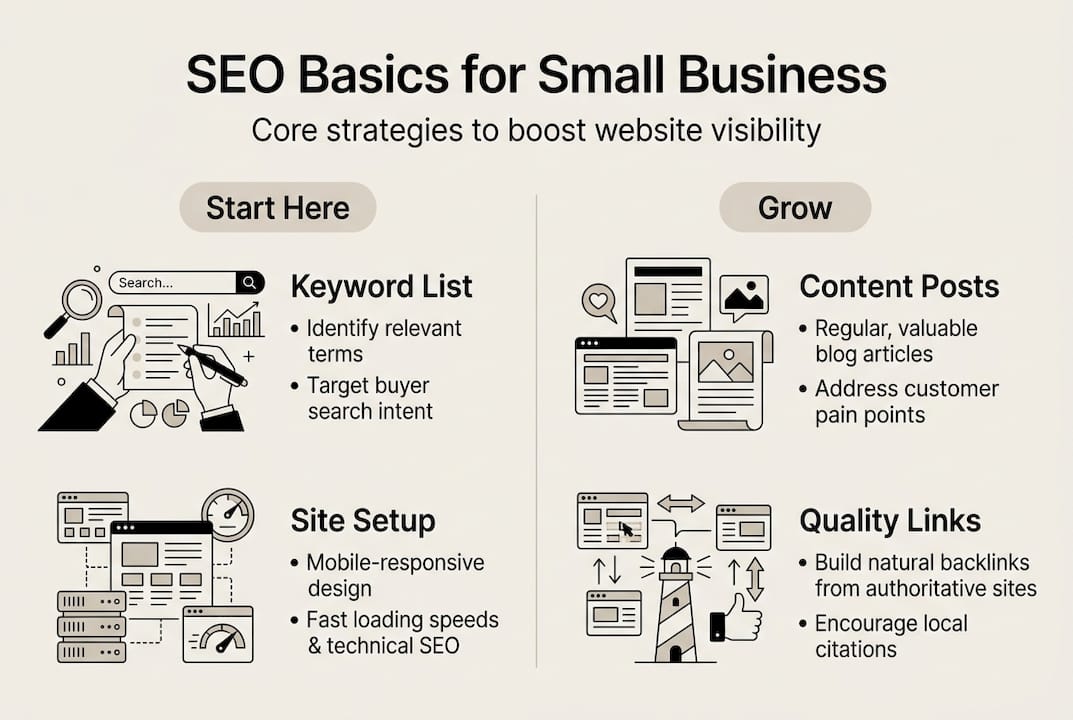
Consistent content updates and quality optimization increase organic traffic and conversion rates. The most effective SEO strategies work together as a system rather than isolated tactics. Here’s a practical sequence for implementing SEO improvements:
- Conduct keyword research to identify terms your target customers actually search for, focusing on specific phrases rather than broad generic terms
- Optimize existing pages by improving title tags, meta descriptions, and heading structure to match target keywords while maintaining natural readability
- Fix technical issues like slow load times, broken links, and mobile responsiveness problems that prevent search engines from properly indexing your site
- Create valuable content that answers specific customer questions, solves real problems, and demonstrates your expertise in your field
- Build quality backlinks by earning mentions from industry publications, local business directories, and partner organizations
- Monitor performance metrics to identify what’s working and where you need to adjust your approach
Keyword research forms the foundation because it reveals the exact language your potential customers use. Tools like Google Keyword Planner, Ubersuggest, or AnswerThePublic show search volume and competition levels for different terms. Focus on long-tail keywords, which are longer, more specific phrases that indicate strong purchase intent even though they have lower search volume.
On-page optimization means structuring your content so search engines clearly understand what each page covers. Use your target keyword in the page title, first paragraph, and at least one heading. But write for humans first. Awkward keyword stuffing makes content unreadable and actually hurts rankings.
Pro Tip: Clear, direct messaging on your website serves double duty by improving both SEO performance and conversion rates. When visitors immediately understand what you offer and how it helps them, they stay longer and take action more often, which sends positive signals to search engines.
Content marketing through blog posts, guides, and resources attracts visitors at different stages of the buying process. Someone searching for basic information might not be ready to buy today, but providing helpful content builds trust so they return when they’re ready to make a decision.
Link building remains important but quality matters far more than quantity. One link from a respected industry publication carries more weight than dozens of links from random directories. Focus on creating content worth linking to and building genuine relationships with complementary businesses and industry contacts.
Measuring SEO success and improving your site
Tracking the right metrics tells you whether your SEO efforts actually drive business results or just vanity numbers that look good but don’t increase revenue. Small business owners should focus on measurements that connect directly to customer acquisition and sales.
Tracking metrics like organic traffic, keyword rankings, and conversion rates guides effective SEO improvements. The most important metrics include organic traffic volume, which shows how many visitors find you through search; bounce rate, which indicates whether visitors find what they expected; keyword rankings for your target terms; and most critically, conversion rate, which measures how many visitors complete desired actions like requesting quotes or making purchases.
| SEO Tool | Key Features | Best For | Cost |
|---|---|---|---|
| Google Search Console | Performance data, indexing status, technical issues | All small businesses | Free |
| Google Analytics | Traffic sources, user behavior, conversion tracking | Understanding visitor actions | Free |
| Ubersuggest | Keyword research, competitor analysis, backlink data | Budget-conscious businesses | Free with paid upgrades |
| SEMrush | Comprehensive SEO audit, rank tracking, content analysis | Serious SEO investment | Paid |
| Ahrefs | Backlink analysis, keyword research, content explorer | Advanced link building | Paid |
Interpreting your data correctly matters as much as collecting it. Here’s how to use metrics for continuous improvement:
- Compare month-over-month trends rather than day-to-day fluctuations to identify real patterns versus normal variation
- Segment traffic by source to understand which SEO tactics drive the most qualified visitors
- Analyze which pages have high traffic but low conversion, then improve calls to action and messaging clarity
- Track rankings for your most important keywords weekly, but don’t panic over small movements that happen constantly
- Monitor technical errors in Search Console and fix crawl issues, broken links, and mobile usability problems immediately
The goal isn’t achieving perfect scores on every metric. Some pages serve informational purposes and shouldn’t be judged by conversion rate. Other pages target bottom-of-funnel searches where conversion matters more than traffic volume. Align your success metrics with each page’s specific purpose within your overall business strategy.
SEO requires ongoing maintenance because search algorithms evolve, competitors improve their sites, and customer search behavior changes over time. Schedule monthly reviews of your key metrics, quarterly content updates to keep information current, and immediate fixes when technical issues appear. Sites that publish fresh content regularly and maintain technical health consistently outperform sites that optimize once and never return to it.
Small improvements compound over time. Increasing your average ranking position from page two to page one can double or triple your traffic. Improving your site speed by two seconds might boost conversion by 10%. These incremental gains add up to significant business impact when sustained over months and years.
Boost your storytelling and marketing with Stonington Media
Effective SEO attracts visitors to your website, but converting those visitors into customers requires clear, compelling messaging that guides people toward action. Combining technical optimization with strong storytelling creates a powerful system for business growth.

Stonington Media specializes in identifying where communication breaks down on websites and fixing it with structured, direct messaging that turns attention into customers. Whether you need a complete website messaging audit, strategic improvements to your marketing communications, or targeted page rewrites that clarify your value proposition, we provide practical solutions that improve both search visibility and conversion rates. Our approach combines story craft principles with business communication to help you present your services clearly and connect with your audience effectively.
FAQ
What is search engine optimization and why is it important?
Search engine optimization is the process of improving your website’s visibility in organic search results by optimizing content, technical performance, and site structure. It’s important because higher search visibility drives more qualified visitors to your site without ongoing advertising costs, and better-targeted traffic typically converts at higher rates than visitors from other sources.
How long does it take to see results from SEO?
Most businesses see meaningful SEO results within three to six months, though competitive industries may require longer. Search engines need time to crawl updated content, evaluate changes, and adjust rankings accordingly. Sustainable success requires ongoing optimization rather than one-time fixes, so patience and consistent effort matter more than quick wins.
Can I do SEO myself or should I hire a professional?
You can handle basic SEO yourself using free tools and educational resources, and many small businesses successfully manage their own optimization. Hiring a professional makes sense when you need advanced technical fixes, lack time to learn and implement strategies consistently, or want faster results through experienced execution. Start with fundamentals yourself, then consider professional help for complex challenges.
What are common SEO mistakes small businesses should avoid?
Avoid keyword stuffing that makes content unreadable, neglecting mobile optimization when most searches happen on phones, ignoring site speed that frustrates visitors, and publishing thin content that doesn’t genuinely help readers. Also avoid buying links from spam sites, copying competitor content, and expecting instant results from long-term strategies. Regular content updates and following search engine guidelines prevent most problems.
Recommended


Additional Reading:
- What is professional screenplay coverage (and do you actually need it?)
- What is professional screenplay coverage, really?
- How to Know If Your Screenplay Concept Is Strong Enough
- Why Most Second Acts Collapse (And How Coverage Detects It)
- How Professional Readers Evaluate Character Arcs
- Is Your Script Marketable?
Indexes: