

Proven marketing for home services: boost leads and conversions
TL;DR:
- Building a strong foundation of website, reviews, referrals, and Google Profile is essential before marketing.
- Focus on 2-3 lead channels based on budget, market size, and time commitment for consistent growth.
- Systematizing referrals and improving website clarity significantly increase trust, conversions, and long-term success.
Running a home service business can feel like riding a wave you never fully control. One month the phone rings constantly, the next it goes quiet and you’re wondering where your next job is coming from. You’ve probably tried a paid ad or two, maybe boosted a Facebook post, and still can’t tell what actually moved the needle. That uncertainty is the real problem. Not the slow season itself, but the absence of a clear, repeatable system that generates qualified leads and turns website visitors into booked appointments. This guide lays out proven, practical strategies for home service business owners who want to stop guessing and start building marketing that works consistently.
Table of Contents
- Assess your marketing foundations
- Choose your lead generation channels
- Systematize referrals and customer reviews
- Optimize your website to convert visitors
- Track, measure, and fine-tune your strategy
- Most home service marketing is backward: Why trust and clarity win
- Accelerate results with expert support
- Frequently asked questions
Key Takeaways
| Point | Details |
|---|---|
| Referrals drive growth | Systematizing referral and review requests turns the best lead source into reliable results. |
| Choose balanced channels | Use a mix of paid ads for fast results and organic strategies for sustainable, lower-cost leads. |
| Website clarity matters | A clear, trust-building site converts more visitors—focus on messaging before scaling traffic. |
| Measure what matters | Track every lead source and customer value to double down on what works and improve marketing ROI. |
Assess your marketing foundations
Before adding any new channel or campaign, you need to know what you’re working with. Think of your marketing strategy as the structural frame of a house. If the frame is shaky, adding more rooms just creates more problems. The goal here is to identify what you already have, what’s missing, and what needs attention before you invest another dollar in promotion.
Every home service business needs four core assets in place:
- A functional website with a clear service description, a visible phone number or contact form, and basic trust signals like photos and a short about section.
- A Google Business Profile that is verified, complete, and actively maintained with current hours, photos, and responses to reviews.
- A steady stream of reviews on Google and, where relevant, Yelp or Houzz. Five-star ratings matter, but volume and recency matter just as much.
- A referral process that is documented and repeatable, not just something that happens when a happy customer mentions you to a neighbor.
That last point deserves emphasis. Referrals are 82% of leads for home service businesses and convert three to five times higher than paid traffic. Yet most owners treat referrals as a happy accident rather than a system. That gap is where real growth hides.
Here is a quick self-check table to see where you stand:
| Asset | Minimum requirement | Quick self-check |
|---|---|---|
| Website | Mobile-friendly, loads in under 3 seconds, clear CTA | Can a stranger understand what you do in 5 seconds? |
| Google Business Profile | Verified, 10+ photos, hours current | Have you posted an update in the last 30 days? |
| Reviews | 20+ Google reviews, average 4.5 or higher | Are you actively asking every satisfied customer? |
| Referral process | Written ask, timing defined, thank-you step included | Do you have a script or template you use consistently? |
Review these marketing essentials for property services to understand how each asset connects to the others. They are not independent checkboxes. They reinforce each other.
Pro Tip: Before launching any new campaign, document your current process for asking for referrals and reviews. Write it down, even if it’s just a few sentences. That documentation becomes the foundation for a repeatable system that runs without you thinking about it every time.
Finally, set up basic tracking now. At minimum, connect Google Analytics to your website and enable call tracking through your Google Business Profile. You cannot improve what you cannot measure, and this step costs nothing but a little setup time.
Choose your lead generation channels
Once your foundation is in place, it’s time to select the channels that match your market conditions. Not every channel is right for every business. A solo plumber in a small town has different needs than a regional HVAC company with a sales team. The goal is to pick two or three channels you can work consistently rather than spreading thin across six.
Here is a comparison of the major lead generation channels available to home service businesses:
| Channel | Cost per lead | Ramp-up time | Conversion rate | Best for |
|---|---|---|---|---|
| Google LSAs | $60-$120 (HVAC) | Immediate | Moderate | Fast lead volume |
| Google PPC | $40-$100 | 1-2 weeks | Moderate | Targeted local intent |
| SEO | Low long-term | 3-6 months | High | Sustainable growth |
| Referrals | Near zero | Ongoing | Very high | Trust-based markets |
| Low | 2-4 weeks | High (warm list) | Repeat and upsell |
Paid ads deliver immediate leads at $60 to $120 per lead for HVAC, but organic channels cost significantly less over time once they gain traction. That tradeoff is worth understanding before you commit budget.
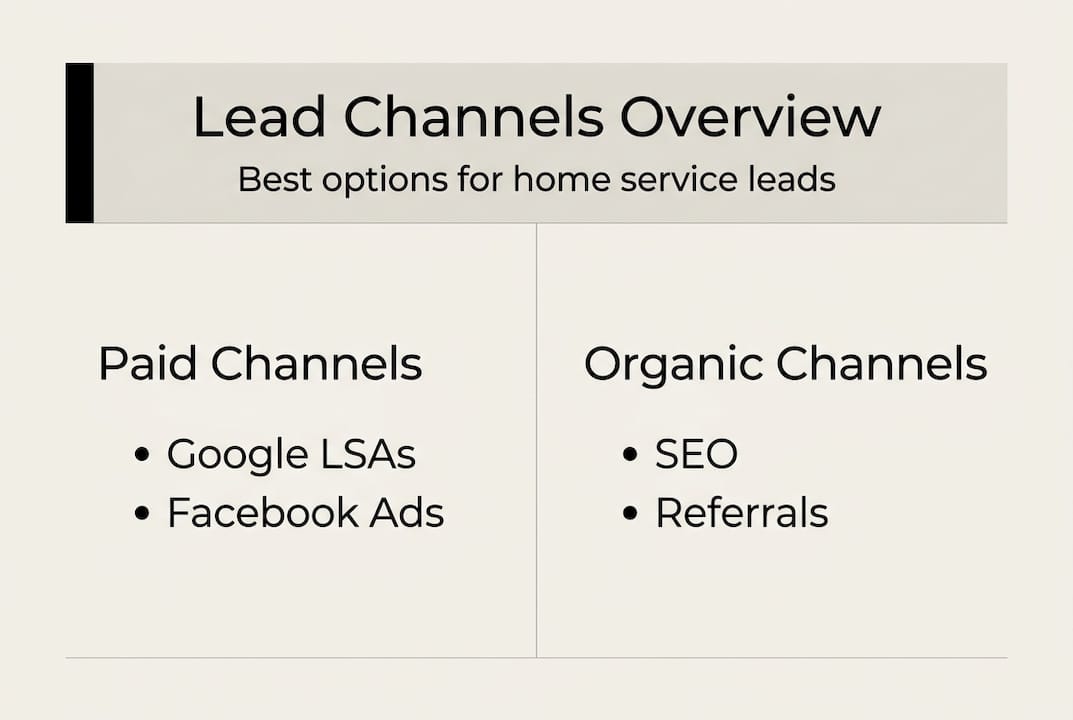
For paid promotion for plumbing and similar trades, Google Local Service Ads are often the fastest path to qualified calls because they show at the very top of search results and include a Google Guarantee badge. They filter for intent. Someone clicking an LSA is not browsing. They need a service now.
To choose your two or three channels, follow this process:
- Assess your budget. If you have less than $500 per month for marketing, start with referrals and SEO. If you have $1,000 or more, add Google LSAs.
- Assess your time. Email and SEO require content and consistency. If you cannot commit to that, start with paid channels while building the organic side slowly.
- Assess your market. In tight-knit communities, referrals and a strong Google Business Profile will outperform paid ads. In larger cities, paid visibility accelerates growth.
- Start narrow. Pick one paid channel and one organic channel. Run them for 90 days before adding anything new.
Understanding SEO for small businesses is worth the time investment. Organic search builds compounding value. A well-optimized service page can generate leads for years without ongoing spend. Pair that with a growing email list and you have a channel that costs almost nothing to maintain while keeping past customers engaged and ready to rebook.
Systematize referrals and customer reviews
With channels chosen, maximizing referral and review volume will amplify all your efforts. Referrals are not just a nice bonus. They are the single highest-converting lead source available to most home service businesses, and yet most owners have no formal process for generating them.
“Referrals are underutilized despite being the primary source for 82% of small businesses. Systematization and genuine appreciation are the keys to turning this into a reliable growth engine.”
The fix is simpler than most people expect. You need three things: a defined moment to ask, a consistent way to ask, and a genuine thank-you when someone delivers.
Here is a repeatable referral and review process you can implement this week:
- Define your ask moment. The best time to ask for a referral or review is immediately after a job is complete and the customer expresses satisfaction. Do not wait for a follow-up email. Ask in person while the positive feeling is fresh.
- Use a simple script. Something like: “We really appreciate your business. If you know anyone who needs [service], we’d love the introduction. And if you have a minute, a Google review would mean a lot to us.” Keep it natural, not scripted-sounding.
- Send a follow-up text or email within 24 hours. Include a direct link to your Google review page. Remove every possible step between the customer and the review box.
- Track who refers you. Keep a simple spreadsheet with the names of customers who have sent you referrals. Review it monthly.
- Show appreciation. A handwritten thank-you card, a small gift card, or even a personal phone call goes a long way. This step is what separates a one-time referral from a customer who becomes a consistent advocate.
Pro Tip: Identify your top three referrers each quarter and do something memorable to show appreciation. It does not need to be expensive. The gesture itself signals that you notice and value their support, which makes them more likely to keep referring.
For improving review conversion, the key insight from referral process insights is that friction kills follow-through. Every extra step between the ask and the action reduces completion rates. Make the path to leaving a review as short as possible.
Optimize your website to convert visitors
By systematizing referrals, you’ve primed new leads. Now ensure your website convinces them to pick you. This is where many home service businesses lose ground. They invest in traffic, whether paid or organic, and then send those visitors to a website that fails to answer the most basic questions quickly enough.
A high-converting home service website needs these elements:
- A clear headline that states what you do, where you do it, and who you serve. “Reliable plumbing services in Austin, TX” is better than a clever tagline no one understands.
- A visible phone number in the top right corner of every page, clickable on mobile.
- Trust signals near the top of the page: years in business, licenses, insurance badges, and a few strong review quotes.
- A simple contact form or booking button that does not require filling out six fields to request a quote.
- Fast load speed. Pages that take more than three seconds to load lose a significant portion of visitors before they ever read a word.
Improving website messaging increases lead conversion rates for service businesses in ways that paid traffic alone cannot replicate. A website with strong messaging turns 3 out of 100 visitors into leads. A weak one turns 1 out of 100. That difference compounds dramatically over time.

Think about your homepage the way a screenwriter thinks about an opening scene. You have seconds to establish context, create interest, and give the visitor a reason to stay. Homepage storytelling follows the same logic as narrative structure: introduce the problem, present yourself as the solution, and make the next step obvious.
For quick wins, start with these three changes. First, rewrite your headline to be specific and location-based. Second, move your phone number to the top of every page. Third, add two or three short customer quotes near your main call to action. These changes take less than an hour and often produce measurable results within days.
Understanding measuring marketing results through attribution models also reveals which top-of-funnel investments are quietly driving conversions that last-click reporting misses entirely.
Track, measure, and fine-tune your strategy
With new leads and conversions flowing, you need a way to keep improving without guesswork. Most home service businesses track almost nothing beyond their bank balance. That makes it nearly impossible to know which channel is working, which is wasting money, and where to focus next.
Start with these core metrics:
- Cost per lead by channel. Divide what you spend on each channel by the number of leads it produces each month.
- Lead source. Ask every new customer how they found you. Record the answer. Even a simple tally sheet works.
- Close rate. Of the leads you receive, what percentage become paying customers? A low close rate often points to a messaging or follow-up problem, not a traffic problem.
- Customer lifetime value. How much does an average customer spend with you over time? This number changes how much you can afford to spend acquiring a new one.
Multi-touch attribution reveals value usually missed by last-click setups. A customer might find you through a blog post, come back through a Google search, and then call after seeing your Google Business Profile. Last-click reporting credits only the final touchpoint. Multi-touch attribution shows the full path, which helps you invest smarter.
Here is a basic KPI tracking template to get started:
| Metric | How to measure | Review frequency | Target |
|---|---|---|---|
| Cost per lead | Ad spend divided by leads | Monthly | Under $80 |
| Lead source breakdown | Ask every new customer | Monthly | 3+ sources |
| Website conversion rate | Google Analytics | Monthly | 2-4% |
| Close rate | CRM or manual log | Monthly | 50%+ |
| Review count growth | Google Business Profile | Monthly | 2+ new per month |
For SEO measurement basics, focus on organic traffic trends and keyword ranking changes over 90-day windows. SEO moves slowly, and short-term fluctuations are normal. What matters is the direction over time.
Review these management marketing ideas for additional perspective on how property-based service businesses structure their measurement systems. The principles translate well to home services.
Most home service marketing is backward: Why trust and clarity win
Here is what most marketing guides will not tell you. The majority of home service businesses do not have a traffic problem. They have a trust and clarity problem. They chase new channels, new platforms, and new ad formats while leaving their referral system unbuilt and their website messaging vague.
Traffic only matters when the destination is ready. Sending a hundred visitors to a homepage that fails to answer basic questions is not a marketing investment. It is a leak. And most businesses are leaking constantly without realizing it.
The uncomfortable truth is that referrals and reviews, the two highest-ROI activities available to any home service business, are almost always under-invested. They feel informal, so owners treat them informally. But the businesses that grow consistently are the ones that have made these activities as structured and repeatable as any paid campaign.
Message clarity converts better than ad spend when the foundation is strong. A website that speaks directly to a visitor’s specific concern, answers their hesitations, and makes the next step obvious will outperform a beautifully designed site with a clever tagline every time.
The practical audit question to ask yourself is this: if a stranger visited your website and then experienced your service, would they feel compelled to tell someone about you? If the answer is uncertain, that is where the work begins. Not in the ad account.
Accelerate results with expert support
The strategies in this guide work. But knowing what to do and having the bandwidth to do it well are two different things. Many business owners understand the problem clearly and still struggle to find the time to fix their website messaging, build out their referral process, and track results consistently.
Stonington Media helps service-based businesses identify exactly where their communication is breaking down and fix it with structured, practical solutions. Whether you need to update your website messaging to convert more visitors, or you want to boost leads and engagement through clearer content, the work starts with a focused audit of what is already there. If you are ready to stop guessing and start building a system that generates leads predictably, explore the marketing communications support options available and take the next step.
Frequently asked questions
What marketing channels generate the most leads for home services?
Referrals and search visibility through SEO and Google Business Profile generate the most high-quality leads, with referrals converting 3-5x better than paid ads and representing the primary source for 82% of small businesses.
How much does it cost to generate home service leads?
Google LSAs cost $60-$120 per lead for HVAC services, while SEO and referral channels cost significantly less over time once the initial setup and system are in place.
How do I get more referrals for my service business?
Standardize when and how you ask, then follow up with genuine appreciation. Systematized referral processes consistently produce more word-of-mouth business than informal or reactive approaches.
Should I spend more on paid ads or improve my website?
Prioritize website clarity and reviews first. Improving website messaging increases conversion rates, which means ads perform better when your site is already built to convert visitors into leads.
How do I know if my marketing is working?
Track lead source, cost per lead, and close rate monthly. Multi-touch attribution reveals the true value of each channel, especially organic and referral sources that last-click reporting tends to undercount.
Recommended


Additional Reading:
- What is professional screenplay coverage (and do you actually need it?)
- What is professional screenplay coverage, really?
- How to Know If Your Screenplay Concept Is Strong Enough
- Why Most Second Acts Collapse (And How Coverage Detects It)
- How Professional Readers Evaluate Character Arcs
- Is Your Script Marketable?
Indexes: