


Website storytelling: boost leads with clear messaging
TL;DR:
- Clear storytelling helps visitors quickly understand your offer and increases conversions.
- Using the StoryBrand Framework, focus on the customer’s problem and outcomes, not company credentials.
- Testing and optimizing website elements like headlines and calls to action improve engagement and results.
Visitors land on your website, glance at the headline, and leave within seconds. Not because your product is weak or your service is overpriced, but because your message didn’t land fast enough. That’s a storytelling problem, and it’s more common than most business owners realize. The good news is that it’s fixable with a structured approach. This guide walks you through a practical, step-by-step process for building clear, conversion-focused website storytelling. You’ll learn how to position your customer as the hero, clarify your message, and organize your pages so visitors understand exactly what you offer and why they should act.
Table of Contents
- Why website storytelling drives leads and conversions
- Prepare: Craft your BrandScript for website clarity
- Execute: Structure your homepage, navigation, and key sections
- Verify: Test, optimize, and build trust with storytelling elements
- The real-world challenge: Clarity is everything, not just narrative
- Enhance your website storytelling with expert guidance
- Frequently asked questions
Key Takeaways
| Point | Details |
|---|---|
| Customer-driven storytelling | Position your customer as the hero and your business as their guide for messaging that drives action. |
| Clarity beats length | Concise, proof-rich stories outperform long narratives for building trust and boosting conversions. |
| Test and optimize CTAs | Regularly test your calls to action and story elements to refine website performance and engagement. |
| Social proof matters | Use visuals and testimonials to fortify trust and demonstrate real-world success quickly. |
| Step-by-step implementation | A repeatable framework applied across homepage, navigation, sections, and CTAs enhances lead generation. |
Why website storytelling drives leads and conversions
Storytelling is not just for novelists or screenwriters. It’s one of the most powerful tools a business can use to earn attention and build trust. When your website tells a clear story, visitors feel understood. That emotional connection is what separates a site that converts from one that simply exists.
But here’s the tension most business owners miss. Trust and loyalty are built through storytelling, yet visitors scan fast and read very few stories in full. That means your story has to work in fragments. A headline here, a benefit bullet there, a testimonial at just the right moment. The story doesn’t need to be long. It needs to be structured.
“Clarity is the most underrated conversion tool on any website. Visitors don’t need to be wowed. They need to understand what you do, who it’s for, and what to do next.”
Think about how major brands use storytelling. Apple doesn’t lead with technical specs. It leads with identity and aspiration. Patagonia doesn’t sell jackets. It sells a philosophy. These brands understand that customers are not buying products. They’re buying outcomes, belonging, and solutions to problems they feel deeply.
For small businesses, the same principle applies at a smaller scale. Your website story should answer three questions immediately: What do you offer? Who is it for? What happens when someone works with you? If any of those answers are buried or unclear, you’re losing leads.
Clear communication on your website is not about being clever. It’s about being direct. The most effective websites are not the most beautifully written. They’re the most clearly organized.
Here’s what story-driven websites do differently:
- They lead with the customer’s problem, not the company’s history
- They use plain language that mirrors how customers describe their own frustrations
- They guide visitors through a logical sequence from awareness to action
- They repeat the call to action at multiple points so no one has to search for the next step
- They use social proof to validate the story’s promise
Prepare: Craft your BrandScript for website clarity
Before you write a single word of website copy, you need a BrandScript. Think of it as your messaging blueprint. It maps out who your customer is, what problem they face, how your business helps, and what success looks like for them. Without it, your website copy will drift. With it, every sentence has a job to do.

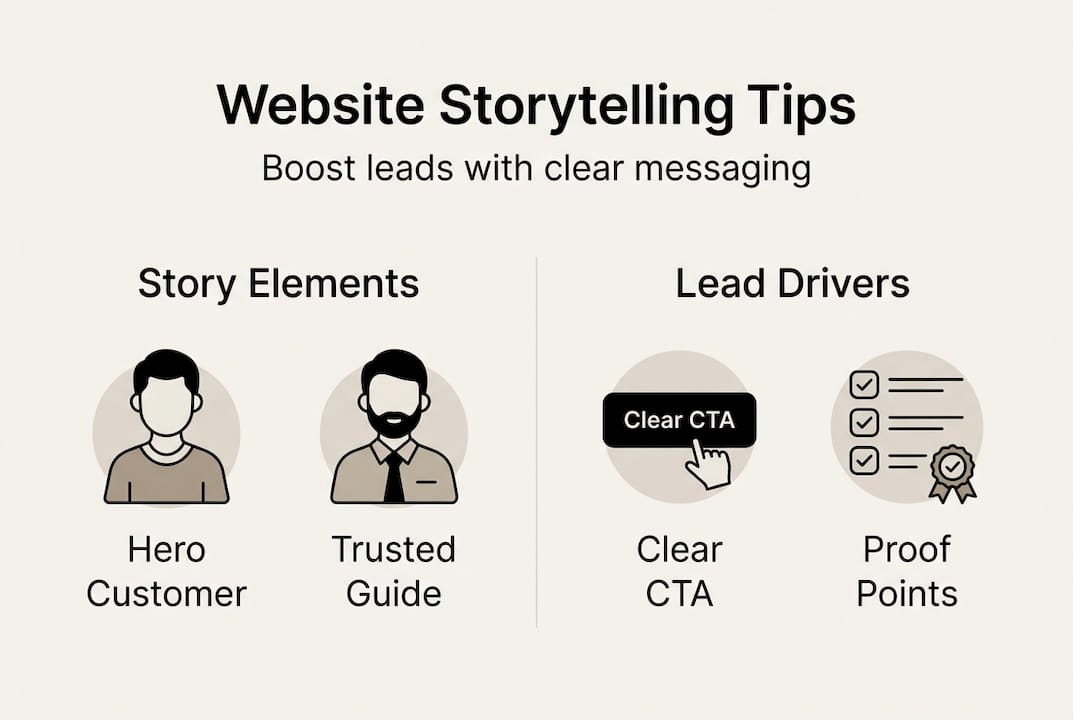
The StoryBrand Framework positions your customer as the hero and your business as the trusted guide. This is a subtle but critical shift. Most business websites lead with the company’s story, credentials, and history. The StoryBrand approach flips that. Your customer is Luke Skywalker. You are Yoda. Your job is not to be impressive. Your job is to be useful.
Here’s how the BrandScript elements compare to traditional website thinking:
| Traditional website thinking | BrandScript approach |
|---|---|
| Lead with company history | Lead with customer’s problem |
| Showcase awards and credentials | Show empathy and authority |
| List all services | Focus on the transformation |
| One generic CTA | Clear direct and repeated CTAs |
| Vague success claims | Specific outcomes and proof |
Building your BrandScript follows a clear sequence.
- Define your character. Who is your ideal customer? What does their day look like before they find you?
- Name the problem. Identify the external problem (the surface issue), the internal problem (how it makes them feel), and the philosophical problem (why it’s unjust or frustrating at a deeper level).
- Position your business as the guide. Show empathy first. Then demonstrate authority with specific proof.
- Lay out the plan. Give customers a simple 3-step process that shows them how working with you unfolds.
- Write your calls to action. One direct CTA (like “Book a call”) and one transitional CTA (like “Download the free guide”).
- Define success. What does life look like after working with you? Be specific.
- Name the failure. What’s at stake if they don’t act? This creates urgency without being manipulative.
This framework is what separates websites that increase sales with messaging from those that simply inform. Once your BrandScript is complete, you have the raw material for every section of your website. Nothing gets written from scratch. Everything flows from the blueprint.
Execute: Structure your homepage, navigation, and key sections
Once your BrandScript is complete, here’s how to bring it to life on your website. The homepage is your most important page. It sets the tone, establishes trust, and either earns the scroll or loses the visitor. Every element above the fold, meaning what’s visible before scrolling, must work immediately.
Follow this website storytelling steps sequence for your homepage:
- Headline: State clearly what you offer and who it’s for. Avoid clever wordplay. Clarity wins.
- Subheadline: Expand on the headline with a one-sentence description of the transformation you deliver.
- Primary CTA: Place a direct call to action button above the fold. “Book a free call” or “Get started” works better than “Learn more.”
- Supporting visual: Use an image or short video that shows a happy customer or a clear outcome, not a stock photo of a handshake.
- Benefit bullets: List three to five outcomes your customer can expect. Focus on results, not features.
- Empathy and authority section: Show you understand the problem, then back it up with credentials, client counts, or case studies.
- The plan: A simple 3-step visual showing how working with you works.
- Testimonials: Place them near your CTA to reinforce the decision at the right moment.
- Closing CTA: Repeat the primary call to action at the bottom of the page.
Navigation deserves special attention. Most websites overload the menu with every service, every page, and every category. That creates decision fatigue. Keep your navigation to five or six main items, and include your primary CTA as a button in the top right corner. Every extra menu item is a distraction from conversion.
Here’s a quick reference for section placement:
| Page section | Primary goal | Key element |
|---|---|---|
| Above the fold | Immediate clarity | Headline plus CTA |
| Benefits section | Show outcomes | Bullet list |
| Empathy block | Build connection | Problem acknowledgment |
| Authority block | Establish trust | Numbers or case studies |
| The plan | Reduce friction | 3-step visual |
| Testimonials | Social proof | Real quotes with names |
| Closing CTA | Drive action | Repeated direct button |
Pro Tip: Write your headline last. Start with the benefit bullets and the plan. Once you know exactly what you’re promising and how you deliver it, the headline almost writes itself.
These steps directly support your ability to boost leads without redesigning your entire site. Often, a few targeted rewrites based on your BrandScript are enough to shift how visitors respond. The story craft resources at Stonington Media offer deeper guidance on each of these structural decisions.
Verify: Test, optimize, and build trust with storytelling elements
After implementing your story-driven structure, ongoing verification and optimization are crucial. A well-structured homepage is a starting point, not a finish line. The most effective websites are the ones that keep improving based on real visitor behavior.
Start with your calls to action. Test different button text, placement, and color. Small changes often produce surprising results. “Book a free call” might outperform “Get started” for one audience and underperform for another. You won’t know until you test. Brands like TOMS and TREK didn’t arrive at their current website messaging by guessing. They test website storytelling elements systematically, refining what works and removing what doesn’t.
Here’s what to focus on during your optimization process:
- CTA performance: Track click-through rates on your primary and secondary CTAs. If fewer than 2% of visitors click, the button text or placement needs work.
- Headline clarity: Ask someone unfamiliar with your business to read your headline and explain what you do. If they struggle, rewrite it.
- Scroll depth: Use tools like Hotjar or Microsoft Clarity to see where visitors drop off. That’s where your story loses them.
- Testimonial placement: Test moving testimonials closer to your CTA. Proximity to the decision point matters.
- Visual alignment: Make sure your images reinforce the story. A photo of a smiling customer outperforms abstract imagery almost every time.
Social proof is one of the most underused storytelling tools in small business websites. A single specific testimonial, one that names the problem, describes the experience, and confirms the outcome, does more conversion work than three paragraphs of brand copy. Specificity is what makes testimonials believable.
Pro Tip: Don’t just collect testimonials. Coach them. Ask clients to answer three questions: What was the problem before working with us? What was the experience like? What’s different now? That structure produces testimonials that tell a complete story.
Balancing story depth with brevity is an ongoing challenge. Visitors scan. They read headlines, bullets, and bold text before they commit to full paragraphs. Your story needs to be legible at the scanning level. If the core message only appears in the third paragraph of a long section, most visitors will never see it.
These customer engagement tips and website messaging strategies work together. Optimization is not a one-time event. It’s a habit.
The real-world challenge: Clarity is everything, not just narrative
Here’s something worth sitting with. Most business owners who struggle with website conversions are not struggling because their story is wrong. They’re struggling because their story is buried. The narrative is there, somewhere in the copy, but it’s wrapped in qualifications, industry language, and well-intentioned but unfocused writing.
The trap is over-writing. When you know your business deeply, it’s tempting to explain everything. Every service nuance, every credential, every reason why your approach is different. But visitors don’t arrive curious. They arrive skeptical and impatient. They need a reason to stay in the first five seconds, not the first five minutes.
Visitors scan sites fast and read very few stories completely, which means clarity and actionable proof matter far more than narrative length. The most effective websites treat every word as a decision. If a sentence doesn’t move the visitor closer to action, it earns removal.
This doesn’t mean stripping your website of personality. It means being disciplined about where personality lives. Save the nuance for your about page and your email list. Your homepage has one job: make the right visitor feel seen and give them an obvious next step.
The narrative structure guide at Stonington Media explores this balance in detail. The takeaway is simple but hard to practice. Test your message against the question: does this help my visitor decide? If the answer is no, cut it or move it. Clarity isn’t a style choice. It’s a conversion strategy.
Enhance your website storytelling with expert guidance
Applying these frameworks on your own is entirely possible. But knowing where your current messaging breaks down is a different challenge. Most business owners are too close to their own work to see the gaps clearly.
At Stonington Media, we specialize in identifying exactly where communication breaks down and fixing it with structured, clear messaging. Whether you need a full website messaging guide to rebuild your homepage story from the ground up, practical steps to boost leads and engagement, or a deeper look at narrative structure solutions that translate storytelling principles into real conversion results, we have the tools and the perspective to help. The work is practical, outcome-focused, and built around your specific business. If something on your website isn’t working, we can tell you why and show you how to fix it.
Frequently asked questions
What is the StoryBrand Framework and how does it work for websites?
The StoryBrand Framework is a 7-part storytelling structure that positions your customer as the hero and your business as the trusted guide, clarifying your messaging to increase conversion. It gives every page element a defined narrative role, from the headline to the closing call to action.
How many navigation menu items should my website have?
Five to six main menu items plus a clear call to action ensure easy navigation and direct users toward your conversion goals. According to the StoryBrand approach, every extra menu item adds friction and dilutes the visitor’s focus.
Why is clarity more important than a detailed story for business websites?
Most visitors scan quickly and read very few stories in full, so concise storytelling and clear proof are far more effective than long narratives in driving leads. A story that only works when read completely is a story that rarely works at all.
How do testimonials and visuals enhance website storytelling?
Testimonials and visuals establish social proof and trust, helping users quickly grasp your credibility and reinforcing conversion-focused messaging. The most effective testimonials follow a problem-experience-outcome structure that mirrors the StoryBrand narrative arc.
What’s a BrandScript and how do I create one?
A BrandScript is a messaging blueprint that outlines your customer’s journey, their challenges, and how your business guides them to success, following the StoryBrand Framework. You build it by defining the character, naming the problem at three levels, positioning your business as the guide, and mapping the path to a clear outcome.
Recommended



Additional Reading:
- What is professional screenplay coverage (and do you actually need it?)
- What is professional screenplay coverage, really?
- How to Know If Your Screenplay Concept Is Strong Enough
- Why Most Second Acts Collapse (And How Coverage Detects It)
- How Professional Readers Evaluate Character Arcs
- Is Your Script Marketable?
Indexes: