


How to write a screenplay in 2026: a professional guide
Writing a screenplay that captures attention in Hollywood requires more than just a great idea. You need dual storylines that interweave external action with internal character transformation, precise structural timing, and professional polish. Most aspiring screenwriters struggle with identifying their story’s core human elements and crafting the inciting incidents that launch both plot and emotional arcs. This guide breaks down proven techniques from successful films, showing you how to prepare, execute, and verify your screenplay using industry-standard approaches that enhance marketability and storytelling impact.
Table of Contents
- Understanding Screenplay Structure Fundamentals
- Preparing Your Screenplay: Crafting Inciting Incidents And Dual Storylines
- Executing Your Screenplay: Techniques To Enhance Storytelling And Structure
- Verifying Your Screenplay: Professional Feedback And Iterative Rewriting
- Enhance Your Screenplay With Expert Coverage And Story Development
Key takeaways
| Point | Details |
|---|---|
| Dual storyline architecture | Professional screenplays weave external plot goals with internal emotional journeys to create compelling narratives. |
| Two inciting incidents | Character-driven scripts launch separate catalysts for external pressure and internal transformation. |
| Structural models from films | Analyzing movies like Good Will Hunting reveals how dual storylines create depth and resonance. |
| Professional feedback focus | Expert script notes identify the irreducible human story that connects audiences emotionally. |
| Iterative rewriting process | Multiple revision cycles guided by industry perspectives strengthen marketability and craft. |
Understanding screenplay structure fundamentals
Before you write a single scene, you need to grasp the architectural elements that separate amateur scripts from professional ones. A screenplay consists of acts that divide your story into major movements, sequences that group related scenes around specific goals, and individual scenes that advance plot or character. These parts of a screenplay work together to create rhythm and momentum.
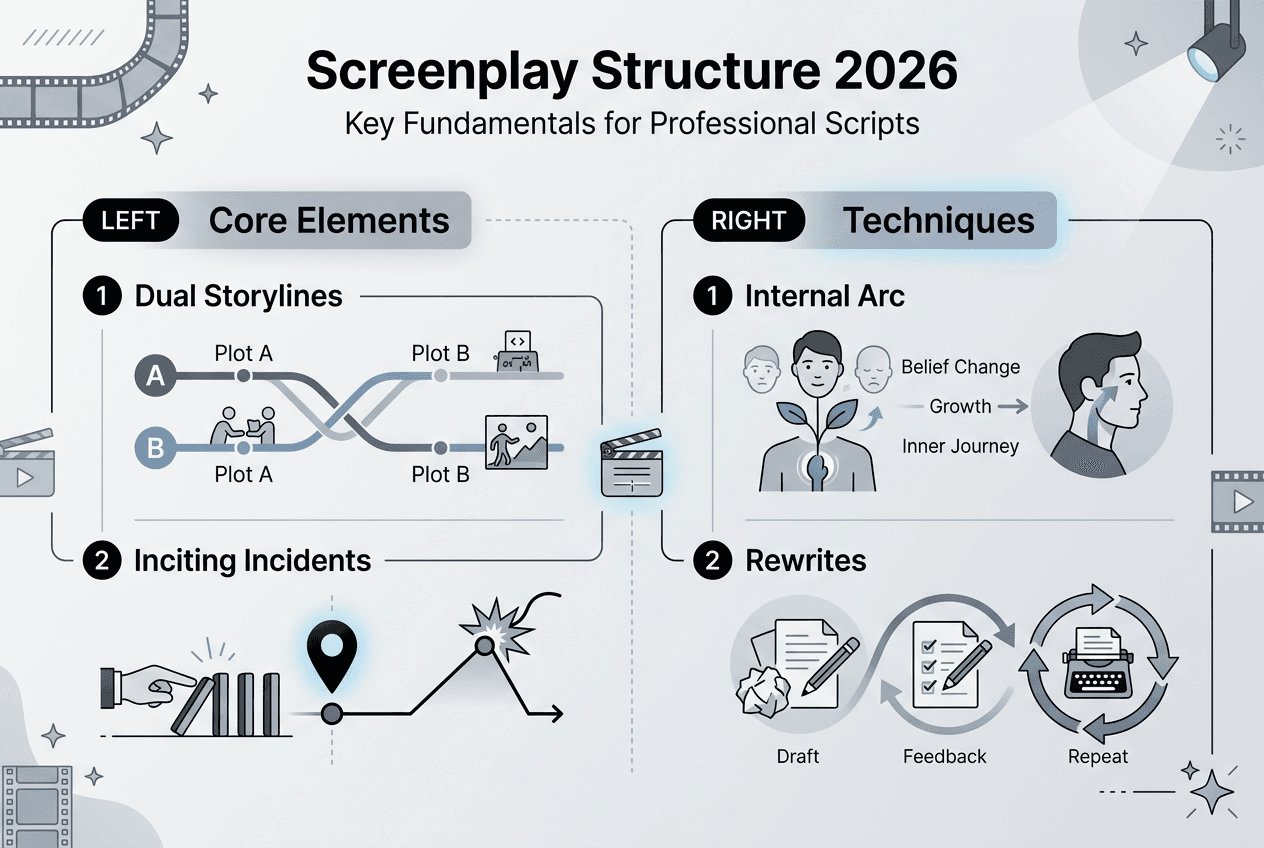
The most powerful screenplays operate on two distinct levels simultaneously. Good Will Hunting utilizes a two-line architecture: an external storyline focused on Will’s mathematical genius and career opportunities, and an internal storyline exploring his fear of intimacy and emotional vulnerability. This dual approach creates richer storytelling because audiences engage both intellectually with plot progression and emotionally with character growth.
Understanding story structure means recognizing that your screenplay needs two inciting incidents. The first launches your protagonist into external conflict or pursuit of a tangible goal. The second triggers internal questioning or emotional stakes that force personal evolution. These dual catalysts create the foundation for layered narratives that resonate beyond surface-level entertainment.
Identifying your story’s core human elements requires stripping away genre trappings and action beats to reveal the emotional truth underneath. Ask yourself what universal experience your protagonist faces: loss, connection, identity, redemption. This human core becomes the gravitational center around which all structural choices orbit.
Pro Tip: Align your character’s internal arc with plot progression by ensuring external obstacles force internal reckoning. When your protagonist faces a plot crisis, it should simultaneously challenge their emotional wound or limiting belief, creating organic integration between both storylines.
Preparing your screenplay: crafting inciting incidents and dual storylines
Inciting incidents are the catalysts that disrupt your protagonist’s ordinary world and propel them into the story’s central conflict. Without clear inciting incidents, your screenplay lacks the focused energy needed to engage readers and audiences. These moments must arrive early, typically within the first 10-15 pages, establishing stakes and direction.
The external inciting incident introduces tangible pressure or opportunity. In Good Will Hunting, Professor Lambeau discovers Will solving an impossible theorem, launching the external storyline about Will’s intellectual future. The internal inciting incident triggers emotional vulnerability or psychological conflict. Will’s two inciting incidents include meeting Sean, the therapist who challenges his emotional defenses and forces him to confront intimacy fears.
Here’s how to identify and incorporate dual inciting incidents in your screenplay:
- Map your protagonist’s external goal (what they want to achieve or obtain)
- Identify the event that forces pursuit of this external objective
- Define your protagonist’s internal wound or limiting belief
- Craft a separate catalyst that exposes this emotional vulnerability
- Ensure both incidents occur in Act One to establish dual storylines early
- Test that each incident creates clear stakes and forward momentum
Common mistakes when defining story catalysts undermine screenplay effectiveness:
- Confusing setup with inciting incident (backstory is not catalyst)
- Creating only one inciting incident that serves both storylines
- Placing inciting incidents too late, losing reader engagement
- Making incidents too subtle or ambiguous for clear recognition
- Failing to connect incidents to protagonist’s specific journey
Examine beat sheets from successful films to see how dual inciting incidents function. Spider-Man: Into the Spider-Verse shows Miles getting bitten (external: superpowers) and witnessing his mentor’s death (internal: responsibility and legacy). These separate catalysts launch distinct but interconnected storylines.
Pro Tip: Maintain thematic coherence across dual storylines by ensuring your external plot metaphorically represents internal conflict. If your protagonist pursues external freedom, their internal journey might involve breaking psychological chains from past trauma, creating resonant parallelism.
Executing your screenplay: techniques to enhance storytelling and structure
Once you’ve established dual storylines, execution requires sophisticated techniques that elevate your screenplay beyond conventional three-act structure. Structural parallelism creates echoes between external and internal journeys, where plot developments mirror emotional revelations. Spider-Man: Into the Spider-Verse employs structural parallelism and narrative fugue to deconstruct superhero conventions while building thematic depth.

Comparing traditional versus innovative screenplay structures reveals options for your storytelling:
| Approach | Characteristics | Best For |
|---|---|---|
| Traditional three-act | Clear setup, confrontation, resolution with single protagonist focus | Genre films, straightforward narratives, commercial appeal |
| Dual storyline architecture | External and internal arcs with separate inciting incidents and climaxes | Character-driven dramas, complex emotional journeys |
| Multiple protagonist threads | Interwoven perspectives with thematic convergence | Ensemble pieces, social commentaries, network narratives |
| Non-linear structure | Fractured chronology revealing character through time manipulation | Psychological thrillers, memory-based stories |
Multiple protagonist threads enrich story stakes by showing how individual journeys intersect around shared themes or events. This approach works when each character represents different facets of your central question. Crash, Magnolia, and Babel demonstrate how separate storylines can amplify emotional impact through thematic resonance rather than plot convergence.
Methods to deepen character arcs and thematic depth include:
- Creating external obstacles that force internal reckoning
- Using supporting characters as mirrors reflecting protagonist’s blind spots
- Establishing visual or dialogue motifs that track emotional evolution
- Designing set pieces where external and internal conflicts converge
- Building false victories that reveal remaining internal work
Balancing artistic risks with audience expectations requires understanding your target market while pushing creative boundaries. Study how your screenplay coverage workflow can identify where innovation serves story versus where it creates confusion. Audiences accept structural experimentation when it enhances emotional truth rather than obscuring it.
Apply film script analysis tips to your own work by watching successful films in your genre and mapping their structural choices. Notice where inciting incidents land, how midpoint reversals function, and when internal and external climaxes occur. These patterns reveal proven frameworks you can adapt to your unique story.
Verifying your screenplay: professional feedback and iterative rewriting
Even the strongest first draft requires objective evaluation from industry professionals who understand what producers and executives seek. Professional screenplay coverage provides detailed analysis of your script’s structure, character development, dialogue, and marketability. This feedback process reveals blind spots that writers inevitably develop when working in isolation on their material.
Signs that your screenplay requires rewrites include unclear protagonist goals, muddy thematic focus, sagging second act momentum, unmotivated character decisions, and dialogue that explains rather than reveals. When multiple readers identify the same issues, you’ve found genuine structural problems rather than subjective preferences. The best script notes point toward the irreducible human story underneath your plot mechanics.
Best practices for receiving and integrating professional notes:
- Read all feedback without defensive reactions before responding
- Look for patterns across multiple readers rather than isolated comments
- Distinguish between symptoms (boring scenes) and root causes (unclear stakes)
- Prioritize structural issues before polishing dialogue or description
- Test proposed solutions against your story’s core emotional truth
- Maintain version control to track changes across revision cycles
Focusing on the core human story increases script impact by ensuring every structural choice serves emotional resonance. When you receive notes about pacing problems or character inconsistencies, drill down to the underlying human experience. If your second act drags, perhaps your protagonist lacks clear internal conflict driving their choices. If supporting characters feel flat, maybe they don’t challenge your protagonist’s emotional wounds effectively.
The importance of rewrites cannot be overstated in professional screenwriting. Studios expect multiple drafts, and most produced films undergo extensive revision during development. Your willingness to embrace this iterative process signals professional maturity and commitment to craft excellence.
Assessing script marketability involves understanding current industry trends, budget realities, and audience demographics. A brilliant screenplay that costs $200 million faces different market challenges than an intimate character study. Professional coverage helps you position your work realistically while maintaining artistic integrity.
Pro Tip: Maintain creative vision during rewrite cycles by identifying your story’s non-negotiable core before incorporating notes. Know which elements define your unique voice versus which serve the story’s broader needs. This clarity lets you adapt professionally without losing what makes your screenplay distinctive.
Enhance your screenplay with expert coverage and story development
Transforming a promising draft into a market-ready screenplay requires professional guidance that identifies both strengths and weaknesses from an industry perspective. Stonington Media specializes in comprehensive screenplay coverage that delivers honest, actionable feedback focused on structure, character development, and storytelling craft. Our story development expert guide approach examines your script through a producer’s lens, revealing exactly what works and what needs refinement.

Professional notes accelerate your writing success by providing the objective evaluation essential for growth. Review our screenplay coverage example to see how detailed analysis addresses structural architecture, dual storylines, character arcs, and thematic coherence. Understanding script marketability positions your work competitively while you develop the craft skills that separate amateur submissions from professional contenders.
FAQ
What is the difference between external and internal storylines in a screenplay?
External storylines focus on tangible goals and obstacles your protagonist pursues in the physical world, such as solving a crime, winning a competition, or escaping danger. Internal storylines explore emotional growth, psychological wounds, and personal transformation that occur within your protagonist’s psyche. The most compelling screenplays interweave both, using external plot pressure to force internal reckoning and character evolution.
How can multiple inciting incidents improve my screenplay?
Multiple inciting incidents launch separate external and internal storylines, creating layered narratives that engage audiences on different levels simultaneously. This dual catalyst approach increases narrative complexity and emotional engagement by giving your protagonist distinct but interconnected journeys. When executed well, the convergence of these storylines at your climax delivers more powerful resolution than single-track narratives.
What are common mistakes to avoid when writing a screenplay?
Negating character development for plot alone creates hollow stories that fail to resonate emotionally with audiences. Skipping revision and feedback phases prevents you from identifying structural weaknesses and missed opportunities that professional eyes catch immediately. Failing to clearly define story structure and inciting incidents results in unfocused narratives that lose reader engagement. Additionally, writing dialogue that explains rather than reveals, creating passive protagonists, and ignoring genre conventions without purposeful subversion all undermine screenplay effectiveness.
Why is professional screenplay coverage important?
Professional coverage reveals strengths and weaknesses from industry perspectives that writers cannot see in their own work due to proximity and investment. Expert readers identify structural issues, character inconsistencies, pacing problems, and marketability concerns that determine whether your script advances or gets passed over. This guidance accelerates improvement by focusing revision efforts on the elements that matter most to producers, executives, and audiences, ultimately increasing your chances of success in a highly competitive industry.
Recommended



Additional Reading:
- What is professional screenplay coverage (and do you actually need it?)
- What is professional screenplay coverage, really?
- How to Know If Your Screenplay Concept Is Strong Enough
- Why Most Second Acts Collapse (And How Coverage Detects It)
- How Professional Readers Evaluate Character Arcs
- Is Your Script Marketable?
Indexes: