


What is story-driven content? Boost engagement and leads
TL;DR:
- Story-driven content enhances engagement and memorability by framing messages around relatable characters and conflicts.
- Incorporating four core elements—character, conflict, journey, and resolution—strengthens message structure and clarity.
- Small businesses can significantly improve leads, trust, and brand recall by applying storytelling techniques to their messaging.
Most small business owners assume storytelling is a luxury reserved for big brands with creative agencies and generous budgets. That assumption is costing them leads. Story-driven content is not a stylistic flourish or a branding exercise for companies with nothing better to do. It is a structured communication approach that shapes how your audience understands your message, remembers your offer, and decides to act. If your website is generating little interest, your emails are going unopened, or your messaging feels flat and hard to explain, the problem is rarely your product. It is almost always the way the story is being told, or more accurately, the way it is not being told at all. This article breaks down what story-driven content actually means, why it consistently outperforms traditional business writing, and how you can start applying it today across your website, emails, and social content.
Table of Contents
- What is story-driven content?
- Why story-driven content beats traditional marketing
- Elements of powerful story-driven content for business
- How to create story-driven content: a step-by-step guide
- Why story-driven content is the missing piece for small business growth
- Start building story-driven content that brings results
- Frequently asked questions
Key Takeaways
| Point | Details |
|---|---|
| Story-driven content defined | It uses narrative elements—character, conflict, and resolution—to make business communication memorable and effective. |
| Beats traditional marketing | Story-driven approaches consistently outperform bland messages in engagement, brand recall, and conversion. |
| Clear building blocks | Every story-driven piece has a relatable character, a clear problem, an action, and a strong resolution. |
| Practical workflow | Businesses can follow simple steps to turn everyday messaging into compelling stories—for emails, websites, or social media. |
| Unified across channels | A good story structure improves message clarity and impact in every marketing channel. |
What is story-driven content?
Story-driven content means structuring your communication around a relatable, emotionally resonant narrative rather than a list of features, facts, or offers. It is not about writing fiction. It is about organizing real information in a way that mirrors how the human brain naturally processes meaning. We do not absorb facts in isolation. We understand things through sequence, cause and effect, and emotional stakes. Story-driven content uses that wiring to your advantage.
At its core, every piece of story-driven business content contains four elements. First, there is a character, which is usually your customer or sometimes you as the business owner. Second, there is a conflict, the specific problem or frustration that character is experiencing. Third, there is a journey or action, the steps taken to address that problem. Fourth, there is a resolution, the outcome your product or service makes possible. These four elements are not decorative. They are structural. Remove any one of them and the message loses its pull.
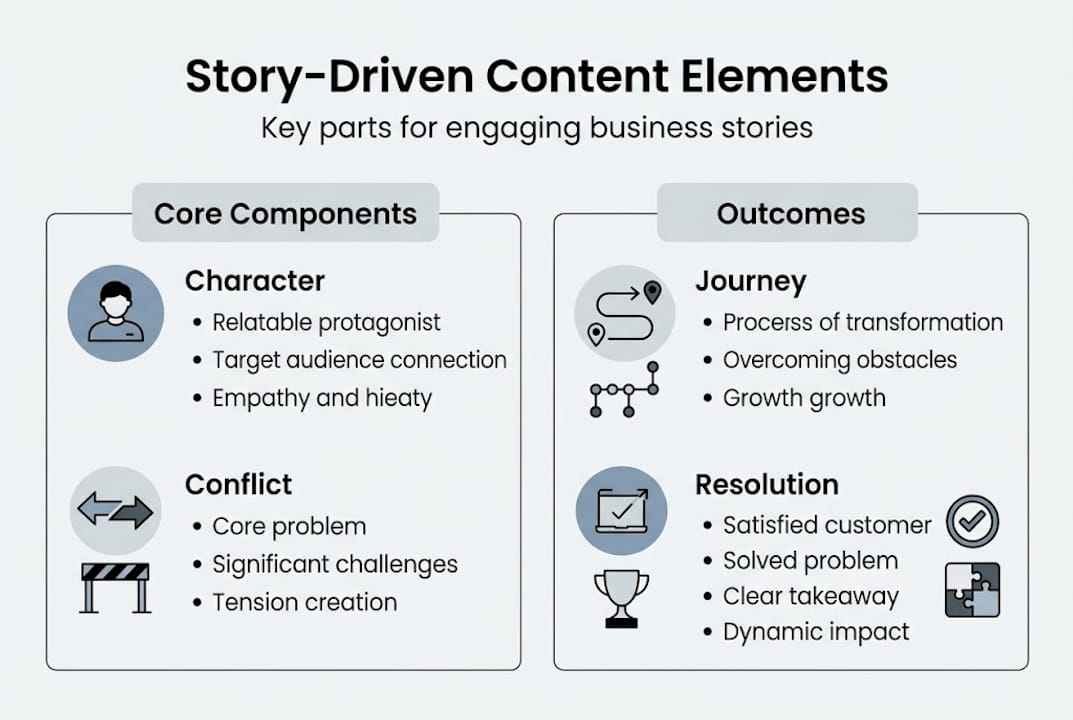
The difference between story-driven and traditional business content is significant. Traditional content leads with the offer. It announces what a business does, lists its services, and asks the reader to get in touch. Story-driven content leads with the reader’s situation. It acknowledges the problem first, shows understanding of the emotional weight behind it, and only then presents the solution. That shift in sequence changes everything about how the reader responds.
Why does this work? Because storytelling helps brands connect deeply with audiences, increasing retention and trust. When someone reads content that reflects their own experience back to them, they feel recognized. That recognition builds credibility faster than any list of credentials. It also makes your message easier to remember, which matters when your reader is comparing you to three other options.
Understanding the mechanics behind this is easier with a clear narrative structure guide and a solid grasp of story structure essentials. Both help clarify how narrative tension and resolution translate directly into business communication that moves people toward action.
Here is a quick comparison of what story-driven content looks like against typical business writing:
| Element | Traditional content | Story-driven content |
|---|---|---|
| Opening | Leads with the offer | Leads with the reader’s problem |
| Tone | Informational, transactional | Empathetic, relatable |
| Structure | Feature list or service overview | Character, conflict, journey, resolution |
| Reader response | Passive reading | Emotional engagement |
| Memorability | Low to moderate | Significantly higher |
The core components of effective story-driven content include:
- A clearly identified character the reader can recognize themselves in
- A conflict that reflects a real, specific frustration (not a vague pain point)
- A journey that shows credible steps toward improvement
- A resolution that is concrete and tied to your specific offer
- Language that reflects how your customer actually describes their problem
Pro Tip: The most effective story foundation is not invented. It comes from real customer conversations. Listen to how your best clients describe their situation before they found you, and use that language almost verbatim. It is more persuasive than anything you could write from scratch. Resources like creating impactful storytelling reinforce how grounding your narrative in genuine experience is what separates forgettable content from content that converts.
Why story-driven content beats traditional marketing
After understanding the basics, let’s see how story-driven content stacks up against what most businesses are doing today. The gap is wider than most people expect, and the evidence is not subtle.
Consider what happens when someone lands on a typical business website. They see a headline announcing what the company does, a short paragraph about experience or values, and a button that says “Contact us.” There is no tension. There is no recognition. There is no reason to feel anything. The visitor scans the page and leaves, often within seconds. Now consider a page that opens with a sentence describing the exact frustration that brought the visitor there in the first place. The dynamic shifts immediately. The reader slows down. They want to know what comes next.

This is not guesswork. Businesses using story-driven content saw up to 22x higher brand recall compared to those relying on fact-based messaging alone. That number is striking, but it makes sense when you consider how memory works. Facts require deliberate effort to retain. Stories are absorbed almost automatically because the brain treats them as experience rather than information.
Here is how story-driven content improves three specific outcomes that matter to small businesses:
- Email open rates improve when subject lines reflect a recognizable situation rather than a promotional announcement. A subject line like “Still struggling to explain what you do?” speaks to an experience. It creates curiosity because the reader wonders if the email holds an answer to something they actually face.
- Sales conversations become shorter because story-driven content does the pre-selling work. When a prospect has already read content that mirrors their journey, they arrive at the conversation already oriented toward your solution. You spend less time explaining and more time confirming fit.
- Referrals increase because people share content that made them feel something. A well-structured story stays with the reader and becomes something they want to pass along. A feature list does not.
For a deeper look at how storytelling analysis tips translate from creative writing into business messaging, the principles around tension and resolution apply directly to how you structure a pitch, a landing page, or an email sequence.
The comparison below shows how the two approaches perform across key marketing metrics:
| Metric | Traditional marketing | Story-driven content |
|---|---|---|
| Audience engagement | Low to moderate | Consistently higher |
| Lead quality | Mixed | More qualified, better fit |
| Conversion rate | Average | Measurably improved |
| Brand recall | Fades quickly | Retained significantly longer |
“The businesses that engage your audience with storytelling are not just more memorable. They are more trusted, more referred, and more likely to close.”
The pattern is consistent. Story-driven messaging does not just perform better in isolated tests. It improves results across every channel where communication matters.
Elements of powerful story-driven content for business
Now you know story content wins. Here is what goes into making story-driven content that actually works for your business, not in theory, but in practice.
Each of the four core elements plays a specific role in the reader’s experience. Understanding what each one does helps you use them deliberately rather than accidentally.
Relatable character. Your reader needs to see themselves in the story. For a small business, this usually means opening with a description of a specific type of customer in a specific situation. Not “business owners” but “a freelance designer who keeps losing clients to cheaper competitors.” Specificity creates recognition. Vague characters create distance.
Specific conflict. The conflict has to be real and named precisely. “Struggling with marketing” is too broad to resonate. “Spending hours on social media with nothing to show for it” is a conflict the reader feels. The more accurately you name the tension, the more the reader trusts that you understand their situation.
Journey and action. This is where you show the path forward. It does not need to be dramatic. It just needs to be credible and sequential. What did the character do? What changed as a result? This section builds momentum and positions your service as the mechanism of change rather than just a product being sold.
Clear resolution. The resolution is not a happy ending. It is a specific, believable outcome. “She now closes three new clients a month without touching social media” is a resolution. “She felt better about her business” is not. Concrete outcomes make the resolution actionable and persuasive.
As story structure clarifies your message for readers and keeps them engaged, each element reinforces the next. Skip one and the narrative loses its shape. For a broader look at how these dynamics play out in more complex scenarios, the ensemble storytelling breakdown and story development essentials both offer useful frameworks.
Story-driven messages retain information 2x longer than dry facts, which means the investment in structuring your content this way pays off every time someone reads it, shares it, or recalls it later.
Pro Tip: Even a short email or a single landing page section can follow a three-part story arc. Open with the problem, move through the action or insight, and close with the resolution or next step. You do not need a long-form piece to use story structure effectively.
Do’s and don’ts for everyday business content:
- Do open with the reader’s situation, not your company’s background
- Do use specific details instead of general claims
- Do show the transformation, not just the outcome
- Don’t lead with credentials before establishing relevance
- Don’t skip the conflict because you think it sounds negative
- Don’t end without a clear, direct next step
How to create story-driven content: a step-by-step guide
Ready to apply this? Here is a practical workflow for building your own story-driven business content, whether you are writing an email, updating a service page, or drafting a social post.
Step 1: Identify the core problem. Before you write a single word, get clear on the specific frustration your reader is experiencing. Not a category of frustration, but the precise moment of tension. What are they thinking about at 11pm? What have they already tried that did not work? Write that down in plain language.
Step 2: Choose a real customer story. Find a client whose situation reflects that problem. You do not need their name or identifying details. You need the arc: what was happening before they found you, what they did, and what changed. Real stories carry a texture that invented ones do not.
Step 3: Highlight the transformation. This is the heart of the piece. Show the shift from before to after with enough specificity that the reader can picture it. Numbers help. Timelines help. Emotional shifts help. The goal is to make the transformation feel real and reachable.
Step 4: End with a clear call to action. Every story-driven piece needs a next step. Not a vague invitation to “learn more,” but a specific action tied to the story you just told. “If this sounds familiar, here is where to start” is more effective than a generic button.
Consistent story frameworks lead to higher conversion rates and audience loyalty, which is why using a repeatable structure matters more than crafting a perfect piece once. The beat sheet workflow is one reliable way to keep your content on track across different formats.
Useful prompts to start each section of your story:
- Problem: “Most [customer type] I talk to are dealing with…”
- Action: “Here is what changed when they…”
- Resolution: “Now they are able to…”
- Call to action: “If you recognize this, the next step is…”
To adapt this workflow for different formats, consider the following. For emails, the problem goes in the subject line and opening sentence. For website copy, the problem anchors the headline. For social posts, the transformation is the hook. The structure stays the same. Only the length and placement shift. Pairing this approach with clear website messaging principles helps ensure the story lands with the right audience at the right moment.
Avoid these common pitfalls: writing the story from your perspective instead of the customer’s, burying the conflict too far down the page, and ending with a weak or absent call to action. Each of these breaks the narrative arc and reduces the chance the reader takes the next step.
Why story-driven content is the missing piece for small business growth
Most advice aimed at small business owners focuses on channels: post more on Instagram, run email campaigns, optimize for search. The channel obsession is understandable. Channels are measurable and concrete. But here is the uncomfortable reality. A better channel with a weak message still produces weak results. The channel is the vehicle. The story is the engine.
We have seen businesses invest heavily in paid advertising, social media scheduling tools, and email platforms, only to generate little return, not because the tactics were wrong, but because the message inside them lacked structure. There was no character the reader could recognize, no conflict that created tension, no resolution that felt earned. Just information delivered into a void.
The conventional wisdom says to be consistent and stay visible. That is not wrong. But visibility without resonance is just noise. What separates businesses that grow through their content from those that plateau is not how often they publish. It is whether their message follows a story arc that the reader can feel.
Every marketing channel works better when the message inside it has narrative shape. An email with a story arc gets opened and acted on. A homepage with a clear character, conflict, and resolution keeps visitors reading instead of bouncing. A social post that captures a real transformation gets shared. The story craft approaches that underpin great screenwriting and great literature are the same ones that make business communication land.
The hard-won insight is this: your audience does not need to be impressed by your cleverness. They need to feel understood. A message that reflects their experience back to them, structured as a story with real tension and a believable resolution, will always outperform a polished list of features. Always.
Start building story-driven content that brings results
If your messaging has felt flat, your emails have gone quiet, or your website is not pulling its weight, the shift toward story-driven content is the most direct path forward.

At Stonington Media, we work with small business owners to identify exactly where communication breaks down and rebuild it with clear, structured messaging that guides readers toward action. Whether you need to update your website messaging, sharpen your narrative structure solutions, or build a content approach grounded in real story structure, we have the tools and frameworks to help. The goal is not more content. It is content that works, that connects, and that converts attention into actual customers. Explore the resources and services available at Stonington Media and take the next step toward messaging that finally reflects the value you deliver.
Frequently asked questions
How does story-driven content increase lead generation?
Story-driven content creates a stronger emotional connection with readers, making them more likely to engage and convert. Because storytelling helps brands connect deeply with audiences, it builds the kind of trust that moves people from passive reading to taking action.
Can story-driven content work for B2B businesses?
Yes, storytelling helps simplify complex B2B offerings and makes messages memorable for decision makers. Businesses using story-driven content saw up to 22x higher brand recall, a result that holds across both consumer and business audiences.
What’s the simplest way to start using story-driven content?
Pick a real customer problem and show how your business helped solve it, structured as problem, action, and result. Story structure clarifies your message for readers and keeps them engaged without requiring lengthy or complex content.
How long should story-driven content be?
Length is secondary to structure. What matters is including all four story elements: character, conflict, journey, and resolution. A two-sentence social post can be story-driven. A 2,000-word article without those elements is not.
Recommended



Additional Reading:
- What is professional screenplay coverage (and do you actually need it?)
- What is professional screenplay coverage, really?
- How to Know If Your Screenplay Concept Is Strong Enough
- Why Most Second Acts Collapse (And How Coverage Detects It)
- How Professional Readers Evaluate Character Arcs
- Is Your Script Marketable?
Indexes: