


Affiliate marketing pros and cons: A practical guide for SMBs
TL;DR:
- Affiliate marketing can boost SMB lead generation and sales with proper management and clear strategies.
- Risks include brand reputation damage, tracking issues, and low-quality leads if not monitored actively.
- Successful programs rely on strong messaging, reliable tracking, active oversight, and treating affiliates as partners.
Many small business owners assume affiliate marketing is a low-effort, high-reward channel where traffic flows in and commissions take care of themselves. That assumption is worth questioning. While the performance-based model is genuinely appealing, the reality for small to medium-sized businesses is more layered. Affiliate marketing can absolutely contribute to lead generation and sales growth, but only when it’s managed with the same rigor you’d apply to any other marketing investment. This guide breaks down how affiliate marketing works, what the real advantages and risks look like for SMBs, and how to evaluate whether it belongs in your strategy at all.
Table of Contents
- What is affiliate marketing and how does it work for SMBs?
- Key advantages: Why affiliate marketing appeals to SMBs
- Hidden challenges: Cons and risks SMBs must weigh
- How to decide: Is affiliate marketing right for your business?
- Practical next steps: Optimizing affiliate marketing programs
- The uncomfortable truth: Why most SMB affiliate programs fail (and how to avoid it)
- Ready to strengthen your lead generation?
- Frequently asked questions
Key Takeaways
| Point | Details |
|---|---|
| Performance-based value | Affiliate marketing lets you pay for outcomes like sales or leads, reducing upfront risk compared to traditional ads. |
| Control and brand risk | Affiliates can impact your brand reputation, so clearly defined oversight and tracking are essential. |
| Conversion rates matter | Most SMB affiliate programs convert traffic at 1%–5%, but downstream metrics tell the real ROI story. |
| Fit requires alignment | Not every business model or offer suits affiliate marketing—evaluate your strengths and oversight capacity first. |
| Optimization is ongoing | Affiliate programs demand continuous testing, partner management, and compliance checks for best results. |
What is affiliate marketing and how does it work for SMBs?
Affiliate marketing is a partnership arrangement where another person or business, called an affiliate, promotes your product or service in exchange for a commission when a sale or lead happens. You are the merchant. The affiliate drives traffic to your offer. The customer completes an action that triggers a payout. Simple in structure, but layered in execution.
For SMBs entering this space, the mechanics look something like this. You set up a tracking system, often through a platform like ShareASale, Impact, or a WordPress plugin such as AffiliateWP. You recruit affiliates who receive a unique link or code. When a visitor clicks that link and converts on your site, the platform records the attribution and logs the commission owed. Affiliate marketing is performance-based: you only pay when a sale or lead happens, which makes the model attractive to businesses with lean marketing budgets.
Here is a simple breakdown of the main actors and what they exchange:
| Role | Responsibility | Example payout structure |
|---|---|---|
| Merchant (you) | Provide product, offer, and tracking | Fixed fee per lead or % per sale |
| Affiliate | Drive traffic via content, email, or ads | $5–$50 per lead; 5–30% per sale |
| End-user | Clicks link and converts | Receives your offer or product |
| Tracking platform | Records attribution and commissions | SaaS fee or revenue share |
Getting started as an SMB typically means four steps. First, you define your offer and set a commission structure that leaves you a workable margin. Second, you select a tracking platform suited to your tech setup. Third, you recruit and vet affiliates, ideally those whose audiences already match your buyer profile. Fourth, you monitor performance against clear KPIs from day one.
A few terms you will encounter regularly: tracking refers to the technology that links a click to a conversion; commission is the payment made to the affiliate; conversion is the action you define as valuable (a purchase, a form fill, a phone call); attribution determines which affiliate gets credit when multiple touchpoints are involved. Understanding affiliate marketing benchmarks across your industry will help you calibrate realistic expectations before you commit.
For businesses already working on their lead generation funnel strategies, adding affiliates can amplify existing momentum. But it only works if your clear website messaging is already converting traffic effectively. Affiliates send visitors; your site does the converting.
Pro Tip: Don’t measure affiliate success by clicks alone. A high click volume with poor conversion rates usually signals a mismatch between the affiliate’s audience and your offer. Focus on conversion quality and customer lifetime value (LTV) from the start.
Key advantages: Why affiliate marketing appeals to SMBs
With the basics in place, let’s look at why so many SMBs give affiliate marketing a serious look.
The most compelling draw is financial risk reduction. You only pay affiliates when a sale actually happens, which means your marketing spend is directly tied to outcomes rather than impressions or reach. For an SMB watching margins carefully, this is a meaningful structural advantage over paid media where budget drains regardless of results.
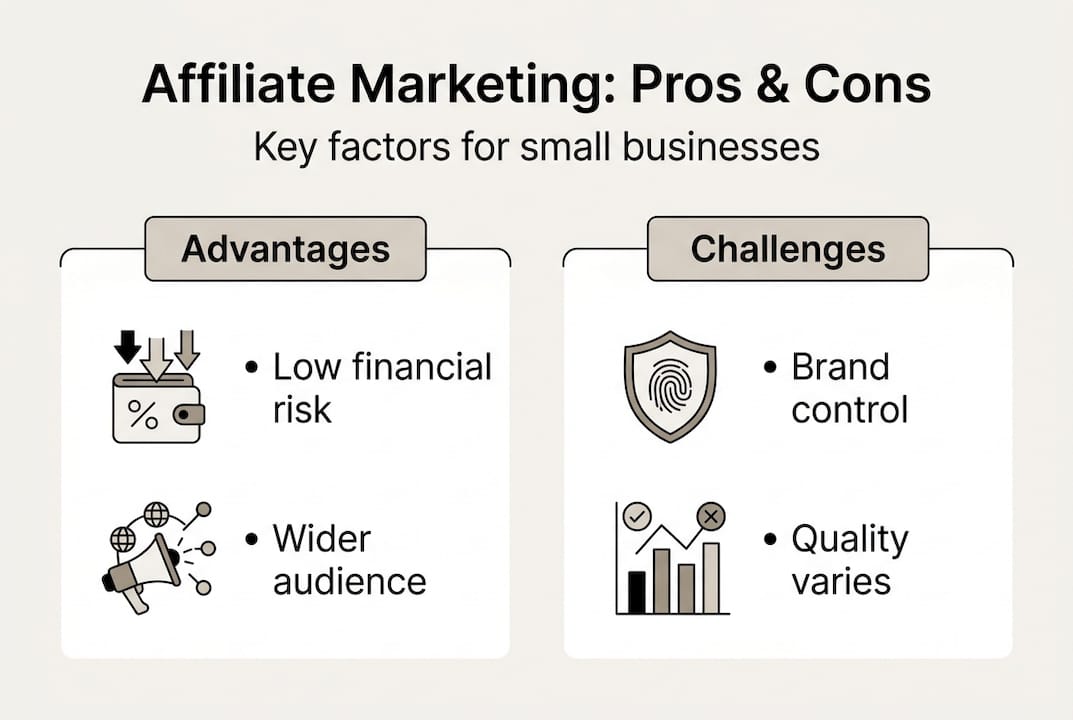
Affiliate marketing also opens doors to traffic sources you might never reach through organic search or your own ad budget. A well-matched affiliate already has the audience you want. Partnering with them is, in effect, renting access to trust they’ve already built. That kind of warm introduction can outperform cold paid traffic on conversion rates.
Scalability is another appeal. In theory, adding more affiliates means more reach without proportionally more overhead. Some programs run with dozens of active partners generating consistent leads. In practice, quality control becomes the real constraint as you scale, but the model does allow for growth without a matching increase in fixed costs.
Here are four practical contexts where affiliate marketing delivers clear value for SMBs:
- Generating qualified leads from niche content sites whose readers already match your buyer profile.
- Driving product sales through review sites and comparison platforms with high purchase intent traffic.
- Expanding content distribution through bloggers and email publishers in adjacent markets.
- Supporting email list building with affiliates who promote your lead magnets to engaged audiences.
A direct comparison helps clarify where affiliate marketing fits:
| Channel | Typical cost model | Control level | Risk level |
|---|---|---|---|
| Affiliate marketing | Pay per result | Low to medium | Low (financial), medium (brand) |
| Paid traffic (PPC) | Pay per click | High | Medium to high |
| Influencer marketing | Flat fee or hybrid | Medium | Medium |
Affiliate conversion rates vary but typically range from 1 to 5%, which means for every 100 referred visitors, expect one to five to convert. That range reflects niche, offer clarity, and landing page quality more than affiliate effort alone.
Pro Tip: Track affiliate campaigns not just for conversions but for actual downstream value. A lead that converts at 3% but never buys again is far less valuable than one that converts at 1% but stays for two years. Measure LTV alongside volume.
Hidden challenges: Cons and risks SMBs must weigh
But for every benefit, there are reality checks. Be aware of these crucial downsides for operators.
Brand reputation is one of the most underestimated risks. Brand reputation can be harmed by affiliate partners’ behavior, and as the merchant, you are accountable for how your brand appears in their content, even if you had no direct involvement. An affiliate making misleading claims or targeting the wrong audience creates cleanup work and potential legal exposure.

Messaging control is another casualty of the affiliate model. When partners write their own content about your product or service, the story they tell may not match the one you’ve carefully crafted. For businesses that have invested in consistent brand voice and offer clarity, this inconsistency can erode trust at the exact moment a prospect is considering conversion.
Attribution complexity is a quieter problem, but it compounds over time. When a customer interacts with multiple affiliates before converting, disputes about credit can surface. Poor tracking setups lead to either overpaying affiliates or missing legitimate conversions entirely. Neither outcome is good for your data or your relationships.
The operational challenges stack up quickly:
- Compliance monitoring: Ensuring affiliates follow your guidelines, FTC disclosure rules, and advertising standards.
- Fraud risk: Click fraud and fake leads are real in affiliate networks, especially at scale.
- Communication gaps: Active affiliates need support, creative assets, and prompt responses to stay motivated and on-message.
- Content quality issues: Not all affiliates produce accurate or brand-consistent material.
“That risk depends on having reliable tracking and partner quality controls; without them, ROI can be overstated and brand damage can accumulate before you even notice.”
Recent data sharpens the concern: affiliate clicks grew 2% year over year while conversion rates fell 6% in 2025, suggesting that raw traffic volume is an unreliable proxy for program health. More clicks with fewer conversions often means affiliate audience quality is declining or offer alignment is weakening.
For SMBs building a content-based growth engine, it’s worth reviewing content strategy risks for SMBs before layering in affiliate partners who may undermine the coherence you’ve worked to establish.
How to decide: Is affiliate marketing right for your business?
Given all the above, it matters how you apply these lessons to your real business. Here’s how to break down the decision.
Affiliate marketing tends to work best for businesses with clearly defined, easy-to-explain offers and sufficient margin to share a meaningful commission. E-commerce and SaaS models tend to fit naturally because the conversion path is measurable and relatively short. Service businesses with longer sales cycles or highly consultative processes face more friction, since attribution gets murkier and affiliate incentives are harder to align with actual revenue.
Here is a four-step checklist to evaluate your fit:
- Define your offer clearly. If a partner cannot explain what you do in one sentence, your messaging likely needs work before affiliates can help. Clarity at the offer level is foundational.
- Check your margins. A commission must be economically viable. Calculate the maximum you can pay per lead or sale while protecting profitability, and confirm there’s room to make the program attractive.
- Assess your tracking infrastructure. Do you have a reliable way to attribute leads back to specific partners? Without this, disputes and wasted spend are inevitable.
- Evaluate your capacity to manage partners. Affiliate programs need active oversight. If you lack the bandwidth to vet, onboard, monitor, and communicate with partners regularly, the risks covered earlier will materialize.
Pro Tip: Use conversion and monetization metrics such as lead-to-MQL rate and LTV rather than just affiliate-driven conversion counts. This tells you whether the leads coming in are actually worth what you’re paying for them.
Red flags worth pausing on: If your brand guidelines are strict and non-negotiable, your tracking setup is underdeveloped, or your sales cycle runs three months or longer, affiliate marketing is unlikely to deliver clean, measurable value in the near term. Address those gaps first. You can also look at story-based conversion techniques to strengthen the conversion layer that any affiliate traffic will land on.
Practical next steps: Optimizing affiliate marketing programs
If you’re ready to experiment, execution makes all the difference. Here’s how to do it well.
The difference between programs that grow and programs that stall usually comes down to process discipline in the first ninety days. Sloppy onboarding leads to off-brand content. Delayed feedback loops let compliance problems fester. And commissions set without strategic intent reward volume instead of value. Each of these outcomes is avoidable with deliberate structure.
Here are the operational priorities to address:
- Affiliate onboarding and vetting: Create a clear application process, review partner content quality before approval, and document your brand rules in writing. Do not assume affiliates will guess what you expect.
- Tracking and reporting dashboards: Implement tools that give you real-time visibility into clicks, conversions, and commission accruals by partner. Blind spots here become costly very quickly.
- Feedback and compliance loops: Build in a regular review cadence, weekly or biweekly early on, to catch messaging issues, low-quality traffic sources, or suspicious conversion patterns before they scale.
- Payout structure design: Customize commissions to reward the behaviors you actually want. Higher payouts for high-LTV customers, lower for low-intent leads. Flat commissions with no quality differentiation train your partners to optimize for volume, not value.
- Ongoing reassessment: Affiliate strategies must adapt with more rigorous KPIs as shopping behavior and traffic patterns shift. Reviewing your partner and offer mix quarterly keeps your program healthy. You can refine your offer presentation further by improving offers for affiliates with clearer positioning.
The programs that perform consistently are the ones where the merchant treats affiliates as real business partners, not just distribution channels. That means communication, shared goals, and mutual accountability.
The uncomfortable truth: Why most SMB affiliate programs fail (and how to avoid it)
With the practical steps covered, it’s worth sharing what most guides and programs don’t tell you.
Most SMB affiliate programs fail not because the model is flawed, but because owners approach it with a set-it-and-forget-it mindset. They set up tracking, post a commission offer, recruit a handful of partners, and expect results to follow on autopilot. They rarely do. Affiliate management is active work. It requires relationship building, consistent enforcement of brand standards, and a willingness to cut partners who are sending the wrong traffic even when the click numbers look good.
There’s also a tendency to over-index on vanity metrics. Clicks and link placements feel like progress, but neither one pays the bills. The programs that generate real business outcomes are the ones measuring high-LTV lead rates, downstream purchase behavior, and actual revenue attribution, not just affiliate-driven conversions.
Commissions alone won’t attract or retain quality partners either. The best affiliates have options. They choose programs where the merchant is responsive, the offer converts well, and the relationship feels collaborative. That requires a functioning holistic lead strategies approach where affiliate traffic has somewhere meaningful to land and a clear path forward.
The parting insight: treat affiliate marketing as one lever in a broader growth system, not a standalone solution. When it’s layered on top of strong messaging, a well-converting site, and a reliable follow-up process, it compounds. When it’s bolted onto a weak foundation, it amplifies the gaps.
Ready to strengthen your lead generation?
Affiliate marketing works best when the traffic it sends has somewhere worth landing. That means your website needs to communicate clearly, guide visitors through a logical path, and build enough trust to prompt action.

If your messaging isn’t converting organic or paid traffic yet, affiliate traffic won’t close that gap on its own. Start by looking at how your site speaks to the people arriving on it. Stonington Media works with SMB owners to sharpen that message, rebuild pages that convert, and set up follow-up systems that turn leads into customers. Explore how to boost your website messaging, apply effective website storytelling to your core pages, and build the kind of grow your email list infrastructure that makes every traffic source work harder for you.
Frequently asked questions
What is a good affiliate marketing conversion rate for SMBs in 2026?
A strong affiliate conversion rate for SMBs in 2026 typically ranges from 1% to 5%, though top programs in specific niches with highly targeted audiences can achieve higher rates depending on offer clarity and landing page quality.
What are the main risks of affiliate marketing for small businesses?
The largest risks include losing control over how your brand is promoted, compliance problems, and paying for low-quality conversions. Brand reputation can be harmed by affiliates, and that exposure is difficult to reverse once it’s out in the market.
How can I ensure a higher quality of leads from affiliates?
Set clear partner guidelines, use strict tracking from day one, and measure lead quality using downstream metrics. Conversion and monetization metrics like lead-to-MQL and LTV will tell you far more about program health than raw conversion counts.
Does affiliate marketing work for service businesses, or only e-commerce?
Affiliate marketing can work for service businesses if the offer is clearly defined and the conversion path is straightforward, but tracking and partnership fit require more attention than in a typical e-commerce setup where attribution is cleaner and sales cycles are shorter.
Recommended


Additional Reading:
- What is professional screenplay coverage (and do you actually need it?)
- What is professional screenplay coverage, really?
- How to Know If Your Screenplay Concept Is Strong Enough
- Why Most Second Acts Collapse (And How Coverage Detects It)
- How Professional Readers Evaluate Character Arcs
- Is Your Script Marketable?
Indexes: