


Hub and spoke content: structure for leads and growth
Most small businesses publish content the same way they pack for a last-minute trip: grab what seems useful, throw it in, and hope it works. The result is a website full of disconnected blog posts that attract occasional visitors but rarely convert them into leads. Businesses using structured content strategies generate significantly more leads than those publishing without a plan. The hub and spoke content model is one of the clearest structural solutions available, and understanding it can change how your entire website communicates.
Table of Contents
- What is hub and spoke content?
- Why hub and spoke content boosts growth for small businesses
- How to build your first hub and spoke content system
- Real-world examples: Hub and spoke content in action
- Common mistakes and how to avoid them
- Level up your content strategy with expert support
- Frequently asked questions
Key Takeaways
| Point | Details |
|---|---|
| Amplifies lead generation | A hub and spoke model guides visitors smoothly to your best offers and calls to action. |
| Boosts search rankings | Organized clusters of content help your site rank higher and attract more qualified web traffic. |
| Improves messaging clarity | Focusing each hub on one core topic makes your value proposition stand out for readers and email subscribers. |
| Scales with your growth | You can add spokes as your business grows, making the system flexible and future-proof. |
What is hub and spoke content?
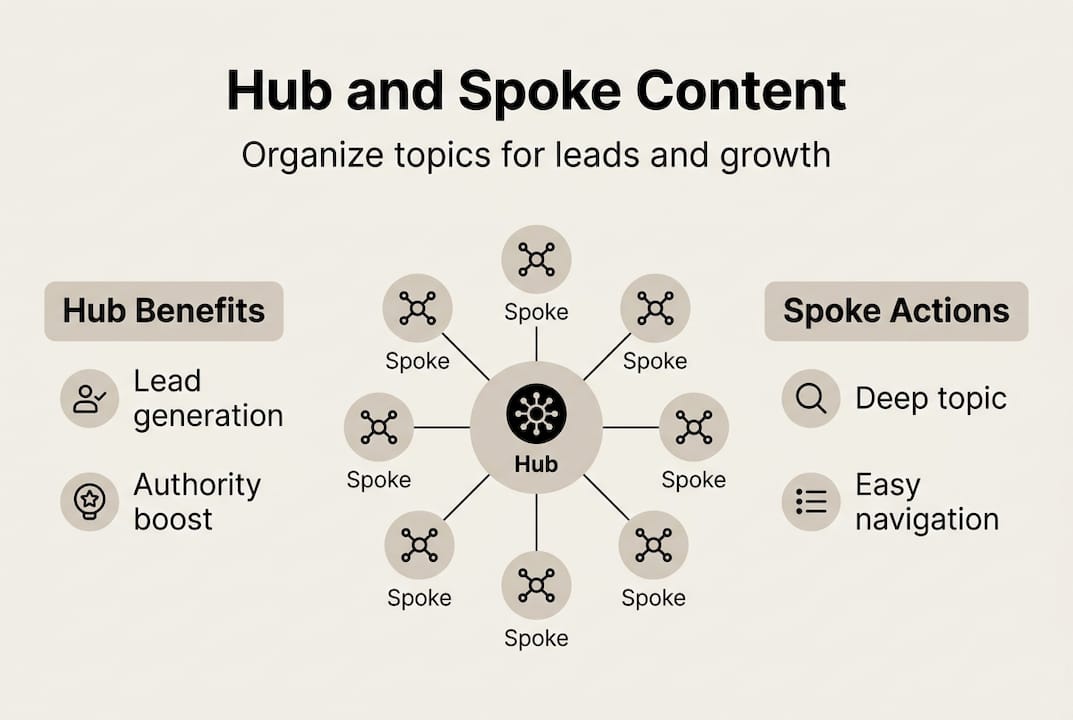
The hub and spoke model borrows its name from a wheel. The hub sits at the center, and spokes radiate outward, each one connected back to that central point. In content terms, the hub is a comprehensive, authoritative page on a broad topic. The spokes are focused, supporting pages that each explore one specific aspect of that topic in depth.

Think of a service business that helps clients with financial planning. The hub page might cover financial planning for small business owners as a broad subject. Each spoke page then addresses a narrower question: retirement accounts for the self-employed, quarterly tax planning, cash flow forecasting, and so on. Every spoke links back to the hub, and the hub links out to each spoke.
This structure does several things at once:
- It organizes your content around themes rather than random topics
- It signals to search engines that your site has genuine depth on a subject
- It guides visitors through a logical path from broad interest to specific need
- It creates natural opportunities for calls to action at every level
“A well-built hub and spoke structure maximizes both discoverability and user experience, making it easier for the right audience to find exactly what they need.”
The hub and spoke strategy works because it mirrors how people actually research decisions. They start with a general question, then narrow down. Your content structure should follow that same path.
Why hub and spoke content boosts growth for small businesses
Structured content is not just a search engine tactic. It shapes how your audience perceives your authority, how clearly your messaging lands, and how effectively your site generates leads.
When your content is organized around themes, your messaging becomes more consistent. Every page reinforces the same core idea from a different angle. Visitors who land on a spoke page immediately understand what your business is about, because the spoke connects to a hub that frames the full picture. SEO for small businesses improves measurably when topic clusters replace scattered publishing, because search engines reward sites that demonstrate focused expertise.
| Business goal | How hub and spoke helps |
|---|---|
| Improve search rankings | Topic clusters signal authority to search engines |
| Strengthen messaging | Consistent themes across pages build brand clarity |
| Generate qualified leads | Focused calls to action on each spoke page |
| Support email marketing | Hub content becomes a resource for targeted campaigns |
| Reduce bounce rates | Internal links keep visitors exploring your site |
The email marketing connection is often overlooked. When you have a hub page on a specific topic, you can send your email list directly to that resource rather than a generic homepage. Effective email campaigns perform better when they point subscribers to content that matches their specific interests, and a hub page is exactly that kind of targeted resource.
Pro Tip: Segment your email list by the hub topics your subscribers engage with most. If someone clicked through to your financial planning hub three times, they are telling you exactly what kind of content they want next.
How to build your first hub and spoke content system
Building a hub and spoke plan does not require a large team or a complex content calendar. It requires clarity about what your business does and what your audience needs to understand before they buy.
Here is a straightforward process to get started:
- Choose a hub topic tied to a real business goal. Pick a subject that your ideal customer actively searches for and that connects directly to a service or product you offer. Avoid topics that are too broad to cover meaningfully or too narrow to support multiple spokes.
- Brainstorm 5 to 8 spoke ideas. Each spoke should answer a specific question or address a distinct subtopic within your hub theme. Validate these ideas by checking what your audience actually asks in search, in emails, or in sales conversations.
- Draft the hub page first. The hub should provide a thorough overview of the topic, introduce each subtopic briefly, and link out to each spoke page. It is the anchor, so it needs to be your strongest, most complete piece of writing on the subject.
- Create spoke content with internal links. Each spoke page should go deep on its specific angle, link back to the hub, and where relevant, link to other spokes. This web of connections is what gives the model its structural strength.
- Map your calls to action. Every page in the system should have a clear next step. The hub might invite visitors to explore a service. A spoke might offer a downloadable resource or a contact form.
Content clustering enables systematic content growth, meaning each new spoke you add increases the authority of the entire hub, not just the individual page. This compounding effect is what separates structured content from isolated blog content fixes that never connect to a larger strategy.
Pro Tip: Before writing a single word of spoke content, write out the internal linking plan on paper. Knowing exactly how each page connects to the others will make the writing faster and the structure tighter.
Real-world examples: Hub and spoke content in action
Seeing the model applied to real business types makes the structure easier to replicate. Here are three common scenarios where hub and spoke content delivers clear results.
An e-commerce business selling outdoor gear might build a hub page around camping for beginners. The spokes cover tent selection, sleeping bag ratings, campfire cooking basics, and navigation tools. Each spoke links back to the hub and includes product recommendations. Visitors who land on any spoke page are immediately drawn into a broader ecosystem of useful content.
A service business, such as a marketing consultant, might build a hub around website messaging for small businesses. Spokes address homepage clarity, call to action writing, service page structure, and lead generation copy. The hub becomes a go-to resource that positions the consultant as an authority before a single sales conversation happens.
An email newsletter brand might build a hub around content strategy resources. Spokes archive past issues by topic, making the newsletter’s back catalog searchable and useful rather than buried in an inbox.
| Business type | Hub topic | Spoke examples | Lead capture method |
|---|---|---|---|
| E-commerce | Camping for beginners | Tent selection, sleeping bags, cooking gear | Product links, buying guides |
| Service business | Website messaging | Homepage clarity, CTAs, service pages | Contact form, audit offer |
| Newsletter brand | Content strategy | Topic archives, how-to guides | Email signup, resource downloads |
Media brands and service firms leverage hub and spoke models for measurable gains in both traffic and lead quality. The pattern holds across industries because the underlying logic is the same: organized content earns trust faster than scattered content.
For those thinking about content planning strategies more broadly, the hub and spoke model offers a replicable framework that scales as your business grows.
Common mistakes and how to avoid them
The hub and spoke model is straightforward in theory, but several predictable errors can undermine it in practice. Recognizing these patterns early saves significant time and effort.
- No clear hub topic. When the hub tries to cover too much ground, it loses focus. Visitors cannot tell what the page is really about, and search engines cannot categorize it effectively. A strong hub has a single, well-defined subject.
- Weak or missing internal links. The model only works if the spokes actually connect to the hub and to each other. Pages that exist in isolation do not benefit from the structure at all.
- Forgetting calls to action. Every page in the system should guide the reader toward a next step. Without this, even well-organized content becomes a dead end.
- Overcomplicating the model. Some businesses try to build five hubs simultaneously before any single hub is complete. Start with one hub and eight spokes. Finish it. Then expand.
- Failing to measure what works. Track which spoke pages drive the most traffic, which ones convert visitors into leads, and which ones have the highest exit rates. This data tells you where to invest next.
“Lack of planning and weak interlinks are the most frequent reasons hub models underperform. Structure without connection is just a list of pages.”
Story structure examples from narrative design offer a useful parallel here. A story without connective tissue between scenes loses its audience. Content without connective links loses its visitors for the same reason. The ensemble content structure principle applies equally: no single page should carry the entire weight of your content strategy.
Level up your content strategy with expert support
The hub and spoke model gives your content a spine. It turns individual pages into a system that builds authority, guides visitors, and generates leads with far more consistency than unstructured publishing ever could.
If you are ready to put this structure to work but want a proven framework to follow, Stonington Media offers practical resources built specifically for small businesses. The Story Craft Index provides structured guidance on content and narrative design. For businesses focused on converting more visitors into customers, the increase sales strategies resource addresses the messaging layer that sits beneath every effective content system. And if you want hands-on support building your content architecture, expert marketing communications from Stonington Media can help you move from scattered pages to a structured, lead-generating system.
Frequently asked questions
How many spokes should a hub and spoke content system have?
Most effective hubs start with 5 to 8 spoke pages for solid topic coverage, and the system can expand as your site grows and your audience’s needs become clearer.
Is hub and spoke content only for large businesses?
Not at all. The model is especially practical for small businesses because it focuses limited resources on structured content that targets specific business outcomes rather than spreading effort across unrelated topics.
Can hub and spoke content help email marketing?
Yes. Hub pages give your email campaigns a focused destination, and centralized resource content consistently strengthens engagement by matching subscriber interests to specific content themes.
What is the difference between a hub page and a blog post?
A hub page is a structured resource center that links to multiple in-depth spoke pages, while a blog post typically covers a single topic and rarely connects to a broader content architecture.
How do I choose my first hub topic?
Start with the core service or product your target audience searches for most often, then build spokes around the specific questions, objections, or related needs that come up in those searches or in your sales conversations.
Recommended



Additional Reading:
- What is professional screenplay coverage (and do you actually need it?)
- What is professional screenplay coverage, really?
- How to Know If Your Screenplay Concept Is Strong Enough
- Why Most Second Acts Collapse (And How Coverage Detects It)
- How Professional Readers Evaluate Character Arcs
- Is Your Script Marketable?
Indexes: