


What is screenplay coverage? A screenwriter’s complete guide
TL;DR:
- Screenplay coverage is a professional report evaluating story elements and market potential.
- It serves as a gatekeeping tool used by studios, agents, and producers to make decisions.
- Interpreting coverage critically and pattern recognition helps writers use feedback effectively.
Most writers assume screenplay coverage is a quick summary someone jots down after skimming their script. That assumption costs them. Screenplay coverage is a professional written report evaluating plot, characters, structure, dialogue, and market potential, and it sits at the center of how studios, producers, and agents decide which scripts ever reach a real decision-maker. It is not a casual read. It is a gatekeeping mechanism with real consequences for your career. This guide breaks down what coverage actually includes, who uses it, how the process works, and how you can extract genuine value from every report you receive. By the end, you will know how to approach coverage with intention, interpret it with clarity, and use it as a tool for forward momentum rather than a source of confusion.
Table of Contents
- What is screenplay coverage and why does it matter?
- Anatomy of a screenplay coverage report: What’s inside?
- How screenplay coverage works: The workflow step by step
- Types of screenplay coverage: Studio vs. development vs. indie
- Making the most of screenplay coverage: Interpreting and applying feedback
- Perspective: What most writers miss about screenplay coverage
- Get feedback that truly strengthens your script
- Frequently asked questions
Key Takeaways
| Point | Details |
|---|---|
| Coverage is industry evaluation | Screenplay coverage provides a professional assessment that can determine whether your script advances in the industry. |
| Understand the report structure | A standard coverage report dissects plot, characters, and marketability, ending with a recommendation. |
| Types and quality vary | Coverage depth and focus shift depending on whether it’s for studios, development, or indie contexts. |
| Actionable feedback matters most | Look for recurring patterns in feedback and use them for targeted script improvements. |
| Choose reputable sources | Industry-experienced readers and clear, detailed reports ensure you get meaningful and trustworthy feedback. |
What is screenplay coverage and why does it matter?
Screenplay coverage has been part of the industry workflow for decades, yet many writers still misunderstand its function. At its core, what screenplay coverage means is a structured evaluation that a trained reader produces after thoroughly reading your script. It is not a personal opinion piece. It is a professional document designed to help busy executives make fast, informed decisions about whether a script deserves more of their time.
“Screenplay coverage is a professional written report evaluating a screenplay’s plot, characters, structure, dialogue, and market potential, used by studios, producers, and agents to decide if a script warrants full executive review.”
Studios receive hundreds, sometimes thousands, of scripts every year. No executive can read them all. Coverage readers act as the first filter, condensing each script into a digestible report that flags strengths, weaknesses, and commercial viability. A strong recommendation can move your script up the ladder. A pass can stop it cold.
Coverage is used across several contexts:
- Studios and production companies use it to triage large volumes of submissions quickly.
- Literary agents and managers use it to assess whether a script is ready to send out.
- Independent producers use it to evaluate projects before attaching themselves.
- Writers themselves use it to get an outside perspective before submitting to the market.
Understanding industry coverage standards also means understanding what coverage is not. It is not the same as script notes. Notes are prescriptive, meaning they tell you how to fix something. Coverage is diagnostic, meaning it identifies what is and is not working without necessarily prescribing a solution. The distinction matters because it changes how you read and respond to the feedback.
Coverage also carries weight because it reflects how a script lands with a fresh, trained reader. That reader represents your first real audience in the industry pipeline. If your premise does not grab them, your structure confuses them, or your characters feel flat, the report will say so. And that information, delivered honestly, is genuinely useful. The goal is not to get a glowing review. The goal is to understand where your script stands before it reaches the people who make real decisions.
Anatomy of a screenplay coverage report: What’s inside?
Knowing why coverage matters is one thing. Knowing what to expect when you open that report is another. A standard coverage report typically runs between four and eight pages and follows a consistent structure that most professional services and studio readers use.
Here is what you will usually find inside:
- Cover page with the script title, writer name, genre, page count, and a logline summarizing the central premise.
- Synopsis running one to three pages, summarizing the major plot beats without editorializing.
- Comments section covering strengths and weaknesses across key craft elements, usually one to three pages.
- Ratings grid scoring individual elements like premise, plot, structure, characters, dialogue, and pacing.
- Final recommendation indicating whether the reader believes the script should be passed on, considered, or recommended.
The ratings and recommendation system is worth understanding in detail. Most reports use a three-tier scale:
| Recommendation | Meaning | What it signals |
|---|---|---|
| Pass | Do not pursue | Significant issues with craft or commercial potential |
| Consider | Revise and revisit | Promising elements but not ready for submission |
| Recommend | Pursue actively | Strong script worth executive attention |
A “Consider” is not a rejection. It is actually a meaningful signal that your script has something worth developing. Many working writers receive a Consider on early drafts and use the accompanying notes to sharpen the script before resubmitting or sending it out.
The comments section is where the real value lives. This is where the reader explains their ratings in plain language, pointing to specific scenes, character arcs, or structural choices that either work or fall short. Strong coverage will reference specific page numbers and scenes. Vague commentary with no specifics is a red flag that the reader did not engage deeply with the material.
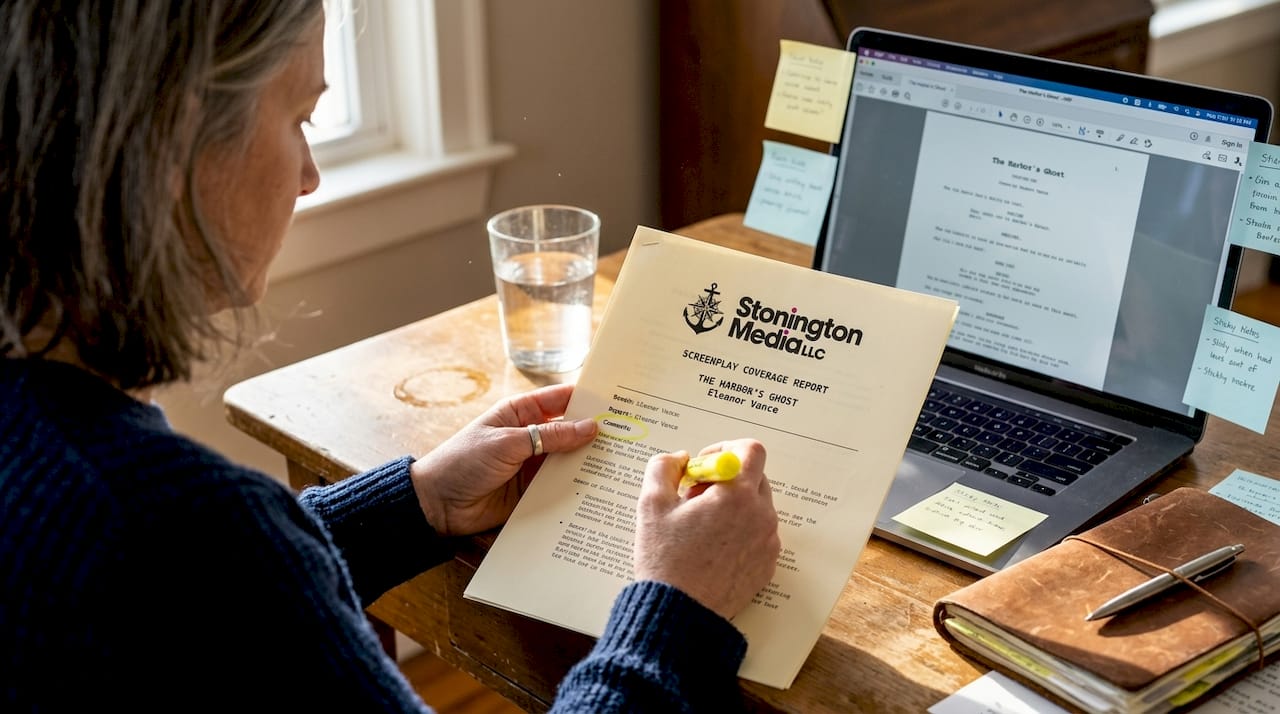
Pro Tip: When you receive your report, read the synopsis first. If the reader misunderstood a key plot point or character motivation, that tells you something important about how clearly your script communicates its story, regardless of what the comments say.
How screenplay coverage works: The workflow step by step
Understanding the report is easier when you also know exactly how it is created. The coverage workflow follows a fairly consistent process across most professional services, and knowing each stage helps you prepare your submission and set realistic expectations.
Here is the typical sequence:
- Submit your script as a PDF. Most services require a properly formatted PDF. Name your file clearly, using your title and last name, not something generic like “final draft v3.”
- The reader performs a full read. A professional reader reads the entire script from page one to the end, without skipping. They are not skimming for highlights.
- The synopsis is written. The reader summarizes the major plot without filling in gaps or correcting logic holes. If your story has a structural gap, it will show up in the synopsis.
- Evaluation is completed using craft and commercial rubrics. The reader scores each element and writes detailed comments grounded in both storytelling craft and market considerations.
- The report is delivered. Standard turnaround is one to two weeks, though this varies by service and script length.
The step-by-step coverage process rewards writers who submit polished drafts. Coverage is not a developmental editing service. It is an evaluation tool. Submitting a rough draft wastes your money and muddies the feedback, because readers cannot always distinguish between intentional stylistic choices and unfinished writing.
Pro Tip: Before submitting, run your script through a final formatting check. Sloppy formatting signals carelessness to a reader before they even reach page ten. Use industry-standard software like Final Draft or WriterDuet, and make sure your page count falls within the expected range for your genre.
Timeline expectations also matter. Rushing a service for faster turnaround often means a less thorough read. If a service promises coverage in 24 hours for a feature-length script, treat that as a warning sign rather than a convenience.
Types of screenplay coverage: Studio vs. development vs. indie
Not all coverage is built the same. The style, depth, and focus of a coverage report shift significantly depending on the context in which it is produced. Understanding these differences helps you choose the right type of feedback for your specific goals.
Studio coverage is built for speed. A studio reader is evaluating commercial potential first. They want to know if the premise is marketable, if the budget implications are manageable, and if the script fits the slate. The comments tend to be brief, and the recommendation is often binary. This type of coverage is less useful for a writer who needs detailed craft guidance and more useful for understanding how your script reads in a high-volume commercial environment.
Development coverage goes deeper. This is the type of feedback a development executive or story consultant produces when they are genuinely interested in a project and want to help shape it. The comments are more detailed, referencing specific scenes and character arcs, and the focus is on rewrite guidance rather than a quick pass or recommend decision.
Indie and contest coverage sits somewhere in between. It tends to focus on narrative clarity, basic structural integrity, and whether the script demonstrates enough potential to place or advance in competition. The feedback is often more accessible for emerging writers.
| Coverage type | Primary focus | Depth | Best for |
|---|---|---|---|
| Studio | Commercial viability | Brief | Market-ready scripts |
| Development | Craft and rewrite | Detailed | Scripts in revision |
| Indie/Contest | Clarity and potential | Moderate | Emerging writers |
Quality varies widely across all three types. Signs of strong coverage include specific page references, craft-based reasoning, and a clear distinction between objective structural issues and subjective reader preference. Signs of poor coverage include vague language, no page references, excessive plot summary in the comments, and feedback that reads more like personal taste than professional analysis.
“Coverage omits minor subplots for brevity and varies by context. Studio coverage tends to be brief and commercial, while development coverage offers detailed craft notes. Poor coverage shows vagueness, no specifics or page references, and feedback driven by taste rather than craft.”
If marketability in coverage is a priority for you, look for services that explicitly evaluate commercial factors alongside craft. Not all services weight these equally.
Making the most of screenplay coverage: Interpreting and applying feedback
Receiving coverage is only the beginning. What you do with it determines whether it actually improves your script. The most common mistake writers make is treating every note as an instruction rather than a data point.
Coverage is diagnostic. It tells you what a trained reader experienced while reading your script. It does not tell you exactly how to fix it. That distinction gives you creative agency, but it also means you need to think critically about the feedback rather than reacting to it emotionally.
Here is how to approach your report constructively:
- Look for patterns, not outliers. One reader disliking your protagonist does not mean your character is broken. But if three separate coverage reports flag the same issue, that pattern is worth addressing.
- Separate craft from taste. A reader saying your dialogue feels unnatural is a craft observation. A reader saying they did not connect with your genre is a taste preference. Weight them differently.
- Use coverage alongside other feedback. Coverage works best when paired with trusted peer readers or a writing group. No single report should drive your revision decisions alone.
- Pay attention to what the synopsis reveals. If the reader’s synopsis misrepresents your story, the problem is likely in your writing, not in the reader’s comprehension.
- Identify actionable feedback. Prioritizing patterns across multiple reports over single opinions is the most reliable way to decide what deserves revision energy.
After receiving coverage, the next step is not always a full rewrite. Sometimes targeted revisions to a single act or a specific character arc are enough to shift the report from a Consider to a Recommend on resubmission. Understanding sample coverage value before you commit to a service can also help you calibrate your expectations and choose a provider whose feedback style actually matches how you process criticism.
Pro Tip: After revising based on coverage, write a brief revision memo for yourself. Note which feedback you addressed, which you consciously rejected, and why. This builds self-awareness as a writer and helps you track your own creative decision-making over time.
Perspective: What most writers miss about screenplay coverage
Here is the uncomfortable truth most coverage guides will not say plainly: coverage is simultaneously one of the most useful tools in a screenwriter’s arsenal and one of the most misunderstood. Writers either dismiss it entirely after one bad experience or treat every report as gospel. Neither approach serves them.
The real skill is learning to read the reader. Every coverage report reflects not just your script but the lens of the person who evaluated it.
Coverage is seen as both an essential tool and a subjective process depending on the reader’s experience and the quality of the service. That does not make it useless. It makes it contextual.
Vetting a coverage service matters more than most writers realize. Look for readers with actual industry credits, not just writing credentials. Ask for sample reports before committing. A strong sample will show specific page references, clear reasoning, and a balance between what works and what does not.
The writers who benefit most from coverage are the ones who approach it as one lens among many. They cross-reference feedback, hold their creative instincts firmly, and revise with purpose rather than anxiety. Coverage is not a final verdict on your talent. It is a snapshot of how one trained reader experienced your story at a specific moment in its development.
If you are still weighing whether you actually need coverage at your current stage, that question is worth sitting with. Coverage works best on polished drafts, not early explorations. Timing your submission well is as important as choosing the right service.
Get feedback that truly strengthens your script
Understanding coverage theory is useful. Getting feedback that actually moves your script forward is better.

At Stonington Media, the approach to screenplay coverage is grounded in the same principles that inform all strong storytelling: clarity, structure, and honest analysis. Whether you are preparing a script for submission or trying to understand why a draft is not landing, the focus is always on what the story is doing and where it loses its grip on the reader. Explore the story structure resources to sharpen your craft foundation, or browse the full story craft resources for deeper guidance on narrative design. If you want to understand how clear storytelling messaging applies beyond the page, that connection is worth exploring too. The next step is simply starting.
Frequently asked questions
What does screenplay coverage cost?
Industry rates for professional coverage typically range from $65 to $200 per script, depending on the provider and the depth of analysis included.
Is screenplay coverage the same as getting script notes?
No. Coverage is diagnostic while script notes are prescriptive, meaning coverage identifies what is not working and notes explain how to fix it.
How do you know if a coverage service is reputable?
Look for experienced readers with industry credits, transparent evaluation criteria, and clear sample reports. Vague, unqualified feedback with no page references is a reliable sign of a low-quality service.
Should you revise your script after getting coverage?
Yes, especially when you see recurring feedback across structure, character, or marketability. Prioritizing patterns across reports rather than reacting to a single opinion leads to stronger, more purposeful revisions.
How long does it take to get screenplay coverage?
Standard turnaround is one to two weeks, though timing varies depending on the service and the length of your script.
Recommended



Additional Reading:
- What is professional screenplay coverage (and do you actually need it?)
- What is professional screenplay coverage, really?
- How to Know If Your Screenplay Concept Is Strong Enough
- Why Most Second Acts Collapse (And How Coverage Detects It)
- How Professional Readers Evaluate Character Arcs
- Is Your Script Marketable?
Indexes: