


Script drafts explained: master every stage of screenwriting
TL;DR:
- A script draft is a meaningful version of a screenplay at a specific stage of development.
- Different draft types serve unique purposes, from showcasing talent to finalizing for production.
- Writers should recognize when to move on, avoiding excessive revisions that can hinder progress.
Most screenwriters have stared at a color-coded script page and felt a quiet panic set in. Pink pages, blue revisions, a title page listing seven different draft dates — it can feel like a bureaucratic maze more than a creative process. Even experienced writers sometimes misunderstand what a script draft actually is, what purpose it serves, and when to move from one stage to the next. This guide cuts through that confusion. We’ll define what a script draft is, break down the major types, walk through the professional workflow, and offer honest perspective on when enough revision is truly enough.
Table of Contents
- The fundamentals: What is a script draft?
- Common types of script drafts and their purposes
- From page to production: The workflow of script drafts
- How many drafts? Timelines and industry benchmarks
- Nuances, edge cases, and digital evolution
- A writer’s reality: When to move on and what really matters
- Take your script—and your process—further
- Frequently asked questions
Key Takeaways
| Point | Details |
|---|---|
| Drafts serve specific purposes | Each script draft helps build, refine, or polish your story at a unique stage. |
| Industry has standard draft types | Spec, first, revised, polish, and production drafts each have clear roles. |
| Color-coding streamlines revisions | Colored pages help track changes and avoid confusion during production. |
| Benchmarks guide your workflow | Expect 5-20 drafts and use realistic timelines based on project scale. |
| Focus on clarity, not perfection | The best draft is the one that clearly communicates your story and intent. |
The fundamentals: What is a script draft?
A script draft is a specific, distinct version of a screenplay produced during the writing and revision process. It is not simply a saved file or a minor edit. Each draft represents a meaningful stage of development, capturing where the story stands at a particular moment in time.
“A script draft serves a distinct purpose in the iterative writing and revision process.”
Think of each draft as a pressure test. You apply heat to the story, and the weak points reveal themselves. Then you revise, strengthen, and test again. The goal is not perfection on the first attempt. The goal is progressive clarity.
Understanding this matters because it changes how you approach your own screenplay revision process. Writers who treat every saved version as a draft often lose track of real progress. Writers who understand the purpose of each stage move with more intention and less anxiety.
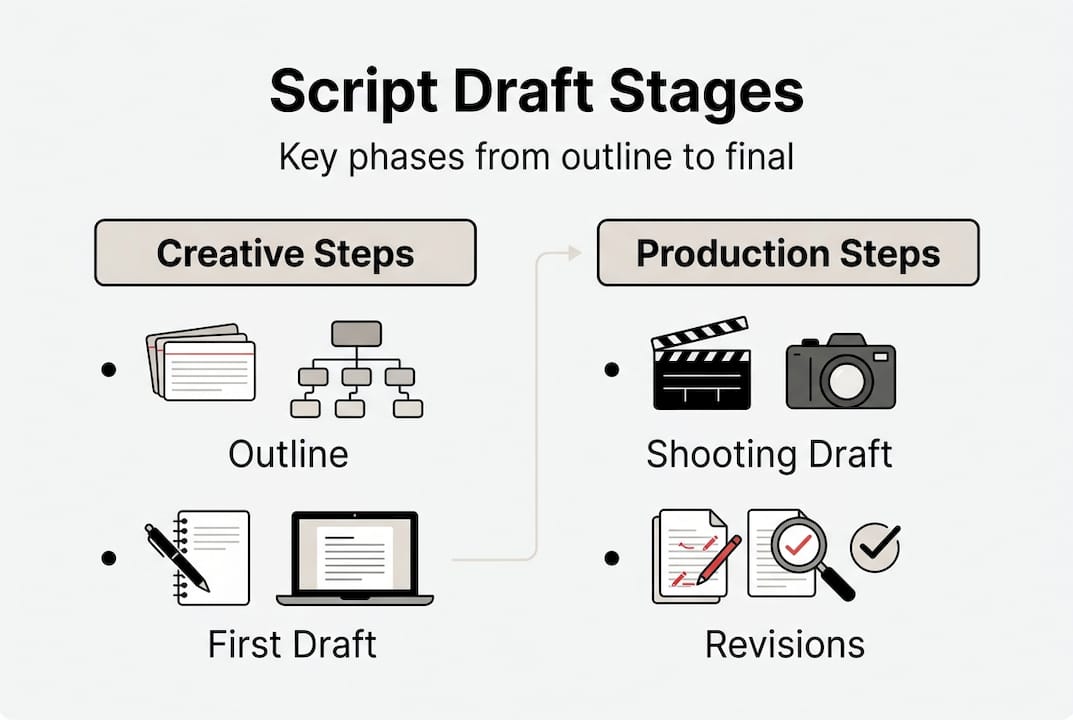
Here is the typical sequence a screenplay follows from concept to production:
- Brainstorm and outline — Develop the core idea, characters, and structure before writing a single scene.
- First draft — Write the story from beginning to end without stopping to perfect it. Get it down.
- Revised drafts — Revisit structure, character arcs, pacing, and dialog based on feedback or self-review.
- Polish — Refine language, tighten scenes, and remove anything that slows the story.
- Shooting script — The final locked version with scene numbers, used by the entire production team.
Each step serves a different creative and logistical function. Skipping stages does not speed up the process. It usually means returning to fix problems that should have been addressed earlier. That is the quiet truth most writing guides skip over.
Common types of script drafts and their purposes
Not all drafts are created equal, and knowing which type you are working on shapes every decision you make. Common pre-production drafts include the spec script, first draft, revised drafts, polish, rewrite, and shooting script. Each has a distinct role.
Here is a breakdown of when to use each:
- Spec script — Write this to showcase your voice and talent. It is written on speculation, without a commission, and is primarily a calling card for agents, managers, and producers.
- First draft — Use this to get the full story on paper. Expect it to be messy. That is its job.
- Revised draft — Return to this after feedback, whether from a reader, a collaborator, or your own critical distance. Understanding why rewrites are essential helps you approach this stage without resistance.
- Polish — Reserve this for late-stage refinement. You are not changing story; you are sharpening execution.
- Rewrite — This is a significant structural overhaul, often requested by producers or studios. It can feel like starting over, and sometimes it nearly is.
- Shooting script — This is the final locked version. Scene numbers are added, and no changes happen without formal documentation.
| Draft type | Primary purpose | Who reads it |
|---|---|---|
| Spec script | Showcase writer’s voice | Agents, managers, producers |
| First draft | Establish full story | Writer, trusted readers |
| Revised draft | Address structural issues | Development executives |
| Polish | Refine language and pacing | Producers, directors |
| Rewrite | Overhaul story or structure | Studio, production company |
| Shooting script | Lock for production | Entire production team |
Familiarizing yourself with the screenplay components that define each draft type will help you recognize which stage your script actually occupies at any given moment.
Pro Tip: Resist the urge to polish before your structure is solid. Polishing a broken story only makes the cracks harder to see.
From page to production: The workflow of script drafts
Once a script moves into active production, the draft process becomes a logistical operation as much as a creative one. Production drafts are shooting scripts with scene numbers, locked page counts, and color-coded revisions to manage updates efficiently.
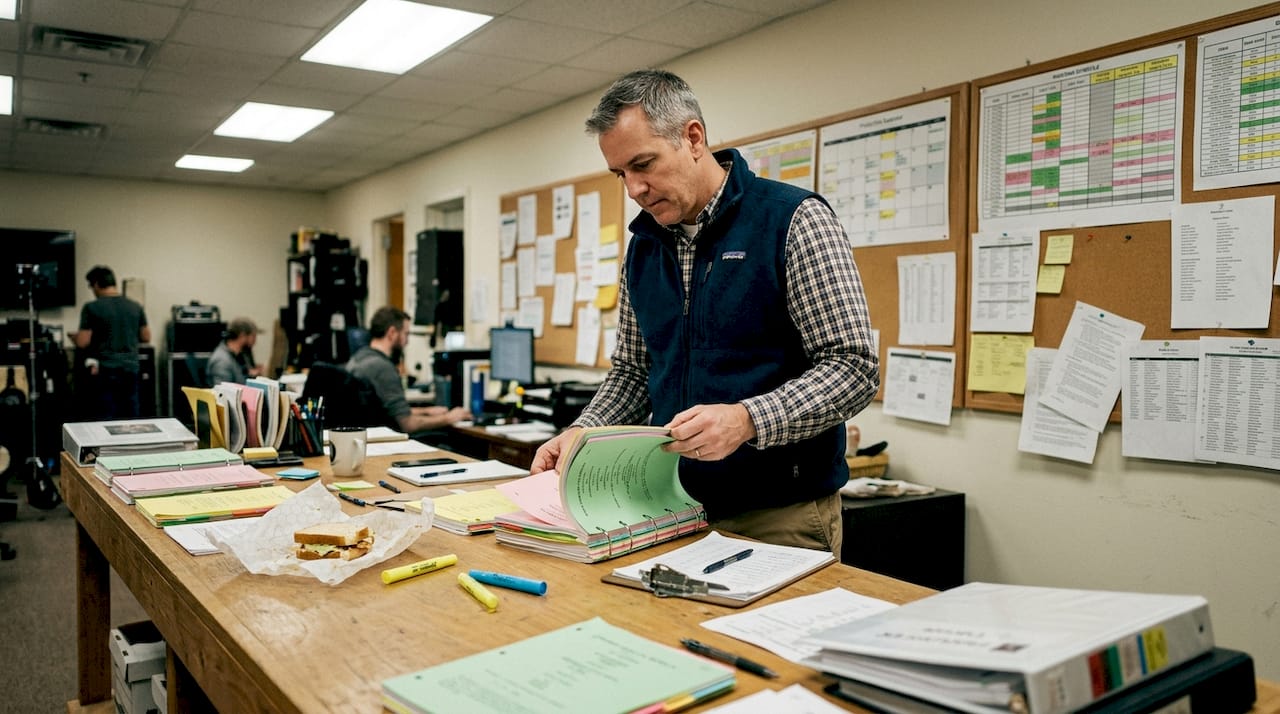
Color coding is one of the most misunderstood elements of professional script management. When pages are revised after the script is locked, those new pages are printed on colored paper and inserted into the existing script. This allows everyone on set to identify exactly what changed and when.
| Color | Revision sequence | Purpose |
|---|---|---|
| White | Original locked draft | Baseline production script |
| Blue | First revision | Initial changes after lock |
| Pink | Second revision | Further updates |
| Yellow | Third revision | Continued changes |
| Green | Fourth revision | Additional modifications |
| Goldenrod | Fifth revision | Late-stage updates |
Here is how the revision and locking process typically works in a professional production:
- Lock the script — Assign scene numbers. These numbers do not change, even if scenes are added or removed later.
- Issue revised pages — Print changed pages on the appropriate color and distribute them to the full team.
- Mark changes — Use asterisks in the margin to flag every line that changed on a revised page.
- Log revisions — Update the title page with the revision color and date so the history is traceable.
- Repeat as needed — Continue through the color sequence for each new round of changes.
Understanding script formatting standards before you reach this stage will save you significant confusion when production begins.
Pro Tip: Keep a master copy with every revision color intact. It is your paper trail and your protection if questions arise about what changed and when.
How many drafts? Timelines and industry benchmarks
This is the question every writer eventually asks. There is no universal answer, but there are useful benchmarks.
Empirical data suggests that indie films typically require 5 to 10 drafts, while studio features commonly demand 10 to 20 drafts before production begins. Professional contracts often allow 1 to 3 months for a first draft and roughly 2 weeks for subsequent rewrites.
Studio films often require 10 or more drafts before a single frame is shot. That is not a sign of failure. It is the standard.
Here is what typical draft timelines look like across different project types:
- Short film — 2 to 5 drafts over 1 to 3 months
- Indie feature — 5 to 10 drafts over 6 to 18 months
- Studio feature — 10 to 20 drafts over 1 to 5 years
- Television pilot — 3 to 8 drafts over 3 to 12 months
The screenplay coverage process can help you identify whether your current draft is ready for the next stage or needs more development before it reaches professional readers.
Stop revising when changes no longer improve the script. That is the real finish line.
The hardest skill in screenwriting is not writing. It is knowing when to stop. Writers who chase an imaginary perfect draft often produce scripts that feel overworked, their spontaneity and voice smoothed away through excessive revision. The goal is not a flawless document. The goal is a story that communicates clearly and moves people.
Nuances, edge cases, and digital evolution
Beyond the standard workflow, there are situations and practices that most writing guides never address. These are the details that separate writers who understand the industry from those who are still learning its rhythms.
Some productions test extremes, use table drafts for reads, and vary color order. For example, the UK industry often uses Pink before Blue, reversing the American standard. Digital tools now handle revision colors efficiently, but physical paper scripts remain standard on many productions.
Here is what most writers miss when it comes to drafting logistics:
- Table drafts are informal versions read aloud by the cast before production begins. They often trigger significant rewrites.
- Post-production changes can require script updates even after filming wraps, particularly for documentary-style projects or films with reshoots.
- Digital screenwriting software like Final Draft and WriterDuet can track changes automatically, but they do not replace the formal color-page system on set.
- Locked scripts are not permanent. A locked script can be unlocked, but doing so resets the revision tracking and requires clear communication with the entire team.
- Regional variation matters. If you are working on an international co-production, confirm which color sequence the production is using before distributing any revised pages.
Before you submit your script anywhere, it is worth reviewing a script marketability checklist to confirm your draft is positioned correctly for its intended audience and market.
The digital evolution of screenwriting tools has made tracking easier, but it has not changed the underlying logic of why drafts exist. Each version is a record of a decision. Treat it that way.
A writer’s reality: When to move on and what really matters
Here is something worth saying plainly: chasing the perfect draft is one of the most effective ways to never finish a script. The revision spiral is real, and it is seductive. Each pass reveals something new to fix, and fixing it reveals something else, and suddenly you have spent two years on a screenplay that has lost the energy it had in its third draft.
The writers who move forward are not the ones who write the most drafts. They are the ones who understand what each draft is actually for. A first draft is for discovery. A revised draft is for clarity. A polish is for precision. When you confuse those purposes, you end up doing the wrong work at the wrong time.
Clear story intent matters more than technical execution at every stage. A script that communicates its emotional core, even imperfectly, will always outperform a technically spotless script that says nothing of substance. Focus your revising for story clarity on what the story is actually trying to say, not just on what sounds better.
The draft that communicates your story clearly is the right draft. Everything else is refinement.
Know when to let a draft go. Trust what you built.
Take your script—and your process—further
Understanding script drafts is one piece of a larger craft. The writers who grow fastest are the ones who study structure, analyze what works in produced scripts, and seek honest feedback before their work reaches decision-makers.
At Stonington Media, we have built resources designed to support exactly that kind of growth. Whether you are mapping your story with a beat sheet guide, sharpening your instincts with script analysis tips, or exploring the full range of story craft resources available to working writers, the goal is the same: help you write with more clarity, more intention, and more confidence at every stage of the process.
Frequently asked questions
What is the difference between a spec script and a shooting script?
A spec script is written to showcase a writer’s talent and is not commissioned, while a shooting script is the final, scene-numbered version used for actual film production. The two serve entirely different audiences and purposes.
How are script revisions tracked in the industry?
Revisions are tracked using colored pages and logs, with asterisks marking changed lines and a title page recording each revision color and date. This system ensures every department knows exactly what changed and when.
How many drafts does a typical movie script go through?
Indie films typically go through 5 to 10 drafts, while studio features usually require 10 to 20 drafts before production begins. The number depends on the project’s complexity and the development process involved.
Do I need to use special software for script drafts?
Digital tools now handle color coding and revision tracking efficiently, but physical paper scripts remain the standard on many professional productions. Software helps, but it does not replace the formal color-page system used on set.
Recommended



Additional Reading:
- What is professional screenplay coverage (and do you actually need it?)
- What is professional screenplay coverage, really?
- How to Know If Your Screenplay Concept Is Strong Enough
- Why Most Second Acts Collapse (And How Coverage Detects It)
- How Professional Readers Evaluate Character Arcs
- Is Your Script Marketable?
Indexes: