


Why use sample coverage: get pro script feedback in 2026
Many screenwriters believe their talent alone will carry their script to success. They polish dialogue, refine scenes, and submit their work, only to face rejection after rejection. The missing ingredient is often professional feedback through sample coverage. Industry readers and producers rely on coverage to evaluate scripts objectively, identifying strengths and weaknesses writers cannot see. This guide explains why sample coverage is essential for screenwriters and producers in 2026, how it transforms scripts, and why investing in professional feedback accelerates your writing career.
Table of Contents
- What Is Sample Coverage And Why Is It Essential?
- How Sample Coverage Improves Your Screenplay’s Quality And Marketability
- What Makes A Quality Coverage Report?
- Why Investing In Professional Sample Coverage Saves Time And Advances Your Writing Career
- Get Industry-Standard Sample Coverage For Your Screenplay
- FAQ
Key takeaways
| Point | Details |
|---|---|
| Coverage is a dual-purpose tool | It helps industry professionals filter scripts and helps writers identify improvement areas. |
| Identifies critical script issues | Coverage pinpoints structural flaws, character inconsistencies, and pacing problems that weaken marketability. |
| Shortens rewrite cycles | Professional feedback prevents months of trial-and-error revisions, accelerating script development. |
| Includes comprehensive analysis | Reports feature loglines, synopses, detailed notes, market assessments, and clear recommendations. |
| Raises script marketability | Scripts with professional coverage perform better in competitions and attract producer attention. |
What is sample coverage and why is it essential?
Sample coverage is a professional evaluation tool that analyzes a screenplay’s story, structure, characters, dialogue, and market potential. Industry professionals use coverage reports to make informed decisions about which scripts deserve further consideration. For writers, coverage provides objective feedback that reveals blind spots and guides revisions toward industry standards.
Coverage serves two critical functions. First, it helps producers and development executives manage the overwhelming volume of script submissions they receive. Script coverage serves as a decision-making tool for industry professionals, helping them prioritize projects and manage the volume of material they receive. Second, coverage educates writers about their script’s strengths and weaknesses from an industry perspective, bridging the gap between creative vision and commercial viability.
A standard coverage report includes four main components. The logline distills your story into one compelling sentence. The synopsis summarizes your plot in one to two pages. Detailed comments analyze story structure, character development, dialogue quality, pacing, and thematic execution. Finally, the recommendation categorizes your script as Recommend, Consider, or Pass, signaling its readiness for production or further development.
These components work together to establish clear expectations between writers and industry gatekeepers. When you understand how readers evaluate scripts, you can craft material that meets professional standards. Coverage transforms subjective storytelling into measurable criteria, giving you actionable targets for improvement. Without this feedback loop, writers often revise blindly, addressing surface issues while missing fundamental structural problems that prevent their scripts from advancing.
How sample coverage improves your screenplay’s quality and marketability
Coverage pinpoints specific weaknesses that diminish your script’s appeal to producers and competition judges. Professional readers identify problems in story structure, character arcs, pacing, dialogue authenticity, and thematic coherence. Script coverage helps writers shape their content to better appeal to the wider entertainment industry. These insights guide targeted revisions that strengthen your screenplay’s core elements rather than superficial polish.

The impact on marketability is measurable. Scripts that undergo professional coverage have a statistically higher chance of advancing in competitions and attracting industry attention. Producers recognize scripts that demonstrate professional craft and structural integrity. When your screenplay reflects industry standards, it stands out in crowded submission pipelines and competition slush piles.
Common script flaws revealed through coverage include:
- Weak or unclear protagonist goals that fail to drive the narrative forward
- Underdeveloped antagonists who lack compelling motivations or sufficient obstacles
- Pacing issues where acts drag or rush, disrupting audience engagement
- Dialogue that sounds artificial or fails to reveal character personality and subtext
- Thematic confusion where the story’s message remains muddled or contradictory
- Plot holes and logical inconsistencies that break audience immersion
Pro Tip: Many writers overlook consistency in character arcs. Coverage highlights these subtle yet critical issues, ensuring your characters evolve logically from opening to resolution. A character who transforms without sufficient motivation or catalyst undermines your entire story’s credibility.
Professional readers provide actionable notes that specify exactly where problems occur and suggest concrete solutions. Instead of vague feedback like “the second act drags,” coverage identifies which scenes lack conflict, where subplots meander, and how to tighten pacing through structural adjustments. This precision allows you to revise efficiently, focusing energy on high-impact changes rather than guessing what needs fixing. By addressing film script analysis fundamentals, you build a stronger foundation for every subsequent draft.
What makes a quality coverage report?
A quality coverage report delivers comprehensive analysis across multiple dimensions of your screenplay. Understanding each section’s purpose helps you extract maximum value from professional feedback. Coverage reports typically include a logline, synopsis, detailed comments, and a rating to gauge the script’s readiness.
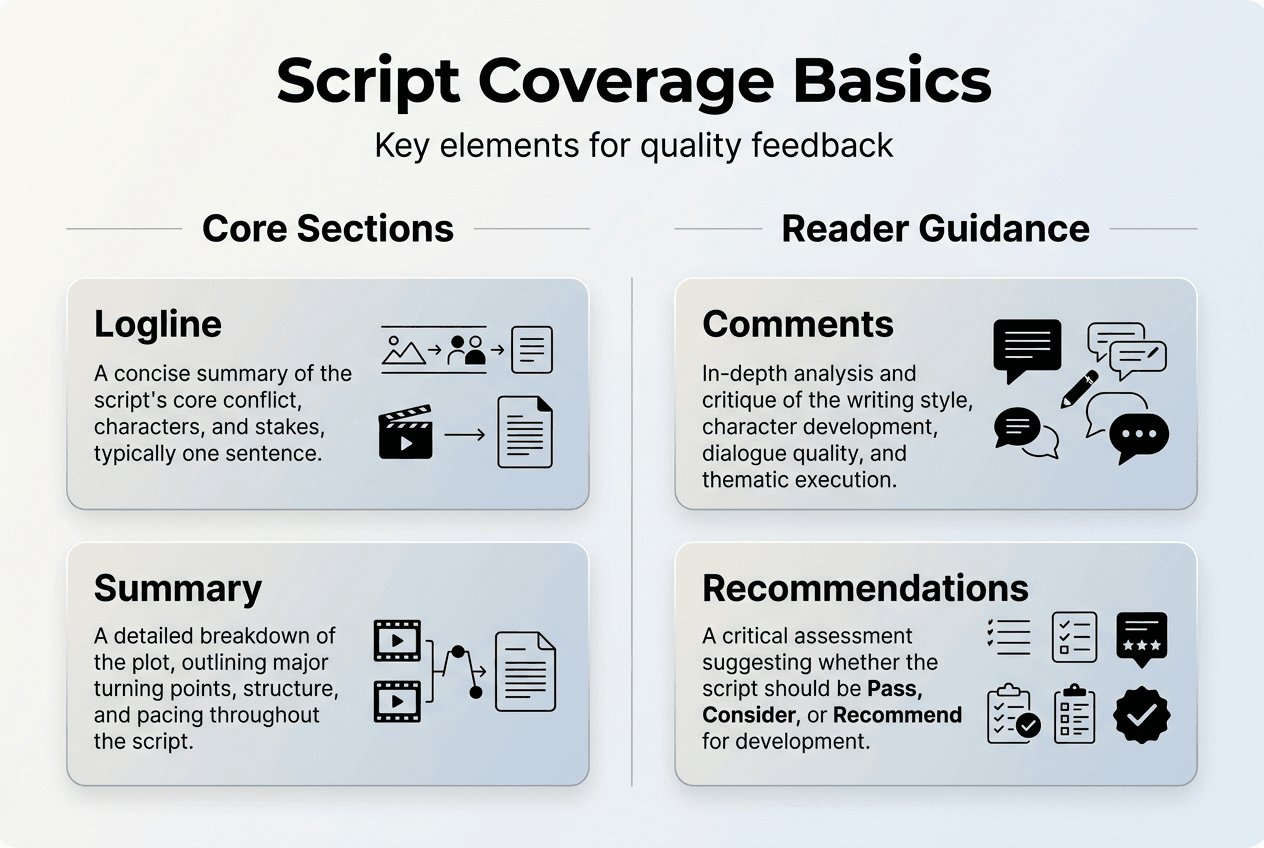
The report structure breaks down as follows:
| Report Section | Purpose | Benefit to Writers |
|---|---|---|
| Logline | Captures story essence in one sentence | Tests if your concept is clear and compelling |
| Synopsis | Summarizes plot beats and character journeys | Reveals structural gaps and pacing issues |
| Story Comments | Analyzes narrative structure and plot logic | Identifies weaknesses in setup, conflict, and resolution |
| Character Comments | Evaluates character development and arcs | Highlights inconsistencies and underdeveloped motivations |
| Dialogue Comments | Assesses authenticity and subtext | Pinpoints stilted or on-the-nose dialogue |
| Market Assessment | Evaluates commercial viability and genre fit | Guides positioning for specific audiences or buyers |
| Recommendation | Provides Pass, Consider, or Recommend rating | Signals script readiness and next steps |
When you receive your report, prioritize feedback strategically. Start with high-level structural notes about story logic, character arcs, and pacing before addressing line-level dialogue polish. Major structural problems undermine any amount of dialogue refinement, so fix the foundation first. Look for patterns in the feedback. If multiple comments mention unclear character motivations, that signals a systemic issue requiring comprehensive revision rather than isolated tweaks.
Key interpretive tips for reading coverage effectively:
- Separate subjective taste from objective craft issues. A reader may not love your genre, but their structural notes remain valid.
- Focus on recurring themes in the feedback. One mention of pacing issues might be minor; three mentions indicate a real problem.
- Use the synopsis to see your story through fresh eyes. If the plot summary feels confusing or dull, your script likely reads that way too.
- Compare the recommendation against the detailed notes. A Pass with fixable issues differs from a Pass due to fundamental concept problems.
Pro Tip: Focus first on high-impact notes like story structure before diving into minor dialogue polish. Restructuring scenes often eliminates dialogue problems organically by placing characters in more authentic dramatic situations. Reviewing a screenplay coverage example helps you understand how professional readers organize feedback and what level of detail to expect from quality reports.
Why investing in professional sample coverage saves time and advances your writing career
Professional coverage prevents costly rewrites by identifying script issues early in your development process. One round of professional coverage can prevent months of rewrites based on trial and error. Writers who skip professional feedback often spend years revising blindly, fixing symptoms while missing root causes. Coverage accelerates your learning curve by compressing feedback that might take dozens of rejections to accumulate into one comprehensive report.
The sequential benefits of investing in coverage include:
- Early identification of fundamental story problems before you invest months in polishing a flawed foundation
- Faster revision cycles because you know exactly what needs fixing and why it matters
- Increased submission confidence from understanding your script meets professional standards
- Higher quality portfolio that demonstrates craft mastery to producers and representatives
- Competitive advantage in contests and pitch sessions where polished scripts stand out immediately
Comparing outcomes reveals the strategic value:
| Aspect | Writing Without Coverage | Writing With Professional Coverage |
|---|---|---|
| Rewrite Time | 6-12 months of trial and error | 2-4 months of targeted revisions |
| Script Quality | Inconsistent, with unidentified flaws | Industry-standard craft and structure |
| Marketability | Frequent rejections, unclear reasons | Stronger competition performance, producer interest |
| Career Progress | Slow learning curve, repeated mistakes | Accelerated skill development, professional credibility |
| Confidence Level | Uncertain about script readiness | Clear understanding of strengths and next steps |
Coverage builds industry credibility by aligning your scripts with professional expectations. When producers see a script that demonstrates structural integrity, authentic characters, and commercial awareness, they recognize a writer who understands the business. This credibility opens doors to representation, meetings, and consideration for assignments. Your improved scripts become calling cards that showcase not just one story but your overall writing ability.
Career advancement accelerates when your scripts consistently attract positive attention. Competitions offer cash prizes, industry exposure, and representation opportunities, but only to scripts that stand out. Professional coverage ensures your work competes at the highest level. Producers receive hundreds of submissions monthly; scripts with obvious structural problems get rejected in the first ten pages. Coverage helps you clear that initial hurdle and earn serious consideration. Understanding the screenplay coverage workflow helps you integrate professional feedback into your regular development process, making coverage a strategic tool rather than a one-time expense.
Get industry-standard sample coverage for your screenplay
You have invested time crafting your screenplay. Now invest in the feedback that transforms good scripts into great ones. Stonington Media offers professional screenplay coverage services designed specifically for writers and producers seeking honest, industry-grade evaluation. Our readers bring extensive production experience, providing the same analysis that studio executives rely on when greenlighting projects.
Explore detailed script coverage examples to see exactly what comprehensive feedback looks like. Review our coverage workflow guide to understand how professional evaluation fits into your development process. Whether you are preparing for competitions, pitching to producers, or simply want to elevate your craft, expert coverage provides the clarity and direction you need to succeed in 2026.
FAQ
Are there different types of sample coverage, and which should I choose?
Yes, coverage services range from basic script notes to comprehensive reports with detailed analysis. Script notes focus on high-level story issues and quick feedback. Full coverage reports include loglines, synopses, detailed comments across all script elements, and market assessments. Choose based on your goals: if you need quick directional feedback, script notes work well. For competition submissions or producer pitches, invest in comprehensive coverage that thoroughly evaluates every aspect of your screenplay. Review coverage service types to determine which option fits your current development stage.
How soon can I expect to receive my sample coverage report?
Typical turnaround times range from a few days to two weeks, depending on the service level you select and the reader’s current workload. Rush services often deliver within 48 to 72 hours for writers facing tight competition deadlines. Standard turnaround usually takes 7 to 10 business days, allowing readers time for thorough analysis. Prompt results help you iterate efficiently, incorporating feedback and revising before submission windows close. Check coverage report delivery timelines when placing your order to ensure the schedule aligns with your needs.
Can sample coverage help if my script is a first draft?
Absolutely. Coverage provides critical early feedback that steers your rewrites in the right direction from the start. Identifying foundational story problems, character inconsistencies, and structural weaknesses in a first draft prevents you from polishing a flawed foundation through multiple revisions. Many writers benefit most from coverage after completing their first draft, when the story is fully formed but not yet refined. This timing allows you to address major issues before investing months in line-level polish. Learn more about using coverage with first drafts to maximize the value of professional feedback early in your development process.
What if I disagree with the coverage feedback I receive?
Disagreement is natural and sometimes valuable. Coverage represents one professional perspective, not absolute truth. However, if a trained reader identifies a problem, there is likely something in your script triggering that reaction, even if the specific note does not resonate. Look for the underlying issue rather than dismissing the feedback outright. Consider getting a second opinion if you strongly disagree, as patterns across multiple readers indicate real problems. Remember that coverage aims to help you see your script objectively, revealing blind spots you cannot identify alone. Approach feedback with openness, then make informed decisions about which notes to implement based on your creative vision and the script’s goals.
Recommended



Additional Reading:
- What is professional screenplay coverage (and do you actually need it?)
- What is professional screenplay coverage, really?
- How to Know If Your Screenplay Concept Is Strong Enough
- Why Most Second Acts Collapse (And How Coverage Detects It)
- How Professional Readers Evaluate Character Arcs
- Is Your Script Marketable?
Indexes: