


Clean up your email list: A how-to guide for higher engagement
TL;DR:
- Maintaining good email list hygiene improves deliverability, engagement, and reduces spam issues.
- Regularly verify and clean contacts to prevent bounce rates, blacklisting, and wasted costs.
- Ongoing list maintenance sharpens your audience, enabling more targeted and effective communication.
Your email list is either working for you or quietly working against you. Many small business owners pour time and money into campaigns without realizing their list is the problem. Outdated addresses, disengaged contacts, and accumulated junk drag down deliverability, inflate costs, and signal to inbox providers that your messages aren’t worth delivering. Poor list hygiene can impact 64.6% of business revenue, which means ignoring this issue isn’t just an inconvenience. It’s a measurable financial loss. This guide walks you through a practical, step-by-step framework for cleaning your list, avoiding common mistakes, and building habits that keep your email marketing performing at its best.
Table of Contents
- Why email list hygiene matters
- What you need to prepare for email list clean up
- Step-by-step: How to clean up your email list
- Common mistakes and how to sustain list health
- A smarter way to think about email list maintenance
- Take the next step: Optimize your email strategy with Stonington Media
- Frequently asked questions
Key Takeaways
| Point | Details |
|---|---|
| Hygiene impacts revenue | A dirty email list can reduce sales and customer engagement dramatically. |
| Preparation saves time | Gathering your data and tools before cleaning makes the process safer and faster. |
| Remove with care | Clean lists by removing truly inactive contacts—not everyone who hasn’t opened recently. |
| Automate regular reviews | Scheduling ongoing clean-up helps maintain deliverability and marketing ROI. |
Why email list hygiene matters
Email list hygiene refers to the ongoing practice of reviewing, verifying, and removing contacts from your subscriber base to ensure your messages reach real, interested people. For small businesses, this isn’t a luxury task. It’s a foundational requirement for any email marketing strategy that’s expected to generate results.
When your list is cluttered with invalid addresses, duplicates, spam traps, and people who haven’t opened an email in over a year, your sending reputation suffers. Internet service providers and inbox platforms use engagement signals to judge whether your emails belong in the inbox or the spam folder. A list full of unresponsive contacts sends exactly the wrong signal.
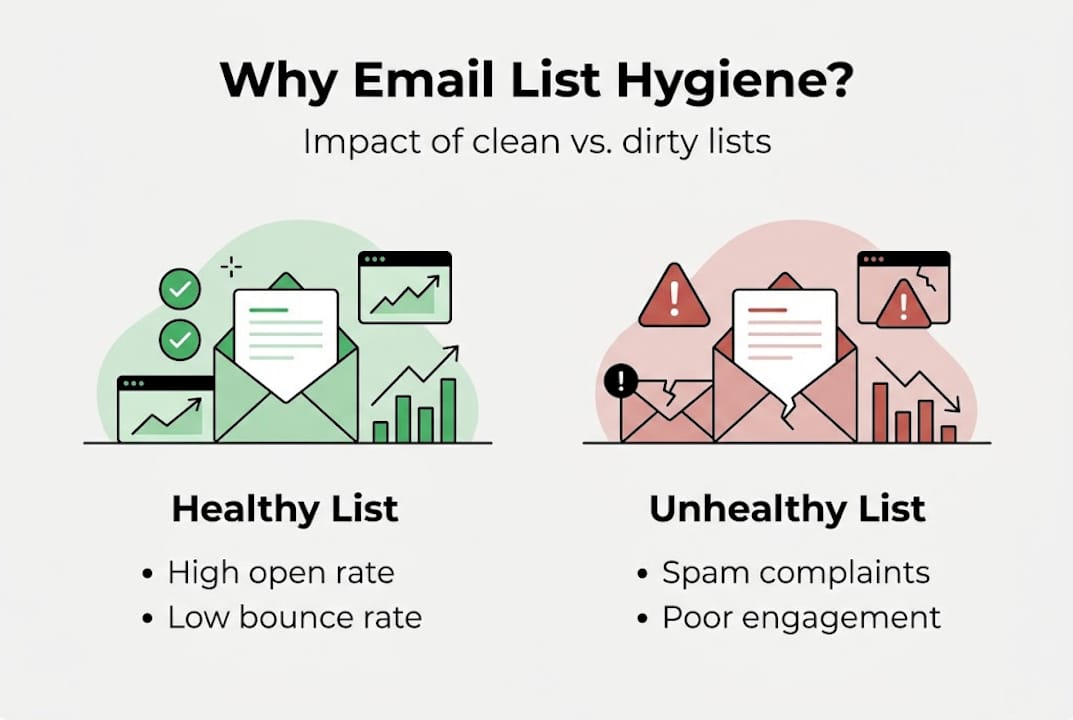
The consequences of poor hygiene compound over time. What starts as a slightly lower open rate can spiral into blacklisting, where your domain or IP address gets flagged and your emails stop reaching anyone at all. That’s a serious setback for any business that relies on email to stay connected with customers.
Here’s a quick look at what poor hygiene typically causes:
- Low open rates caused by sending to contacts who no longer engage
- High bounce rates from invalid or abandoned email addresses
- Spam complaints from recipients who don’t recognize your brand
- Unsubscribe spikes when messaging feels irrelevant or excessive
- Blacklisting when inbox providers flag your sending behavior
- Wasted spend on subscriber tiers in your email platform that include dead contacts
The numbers behind this problem are striking. Only 23.6% of marketers verify their lists before launching campaigns, which means the majority are sending into a fog of uncertainty. The data below illustrates what separates a healthy list from a neglected one.
| Metric | Healthy list | Unhealthy list |
|---|---|---|
| Average open rate | 25% to 35% | Below 10% |
| Bounce rate | Under 2% | 5% or higher |
| Spam complaint rate | Under 0.1% | 0.5% or higher |
| Revenue impact | Positive and measurable | Reduced by up to 64.6% |
| Deliverability score | High | Degraded or flagged |
Think of your list the way you’d think about a customer relationship. If you keep reaching out to people who have moved on, changed their contact information, or simply lost interest, you’re not nurturing a relationship. You’re broadcasting into silence. Learning more about creating effective email newsletters can help you understand how list quality and content quality work together to drive real engagement.
The business case for regular hygiene is straightforward. Cleaner lists mean better deliverability, lower costs, higher engagement, and more accurate data to guide your decisions. It’s not about having the biggest list. It’s about having the right one.
What you need to prepare for email list clean up
Before you start removing contacts or running verification tools, you need to set yourself up properly. Jumping into a clean up without preparation can lead to accidental data loss, compliance problems, or a false sense of progress that doesn’t translate into better results.
Start by gathering everything you’ll need to make informed decisions. Here’s what to review before you begin:
- Your full subscriber export from your email service provider, including sign-up dates, last engagement, and source
- Access to your ESP dashboard so you can review bounce reports, unsubscribe logs, and spam complaint history
- Recent campaign performance data covering at least the last six months of open rates, click rates, and conversions
- A backup of your current list saved securely before any changes are made
- Your opt-in records, which document how and when each subscriber joined your list
Pro Tip: Always export and save a complete backup of your list before making any changes. If something goes wrong during the clean up, you’ll want to restore from a known good state rather than starting over.
Once you have your data organized, the next decision is which tools to use. Only 23.6% of marketers bother verifying their lists before campaigns, but those who do consistently see better results. The right tool depends on your list size, budget, and how frequently you plan to clean.
| Tool | Type | Key features | Best for | Approx. cost |
|---|---|---|---|---|
| NeverBounce | Paid | Real-time verification, bulk upload | Medium to large lists | Pay per verification |
| ZeroBounce | Paid | Spam trap detection, email scoring | Businesses needing deep analysis | Starts around $15/month |
| Mailfloss | Paid | Auto-integration with ESPs | Ongoing automated hygiene | Starts around $17/month |
| Hunter.io | Freemium | Email verification, domain checks | Small lists, occasional use | Free tier available |
| Built-in ESP tools | Free/included | Bounce management, suppression lists | Basic hygiene within platform | Included with platform |
Modern email marketing platforms often include built-in hygiene features like automatic bounce handling and engagement-based segmentation. If your current platform lacks these, that gap itself may be worth addressing. Using a platform that actively supports list health reduces the manual work required and keeps your data cleaner between campaigns.
Preparation isn’t glamorous, but it’s where clean ups succeed or fail. Rushing past this stage is how businesses end up deleting engaged contacts by mistake or missing the root cause of their deliverability problems.
Step-by-step: How to clean up your email list
With your data gathered and your tools selected, you’re ready to move through the actual clean up. This process works best when followed in sequence, since each step builds on the one before it.
Step 1: Export your full list and segment by engagement
Pull a complete export from your ESP and sort contacts by engagement level. Create segments for highly engaged (opened within 90 days), moderately engaged (opened within 180 days), and inactive (no opens or clicks in over 180 days). This segmentation shapes every decision that follows.
Step 2: Identify and remove hard bounces immediately
Hard bounces are permanent delivery failures, meaning the address doesn’t exist or the domain is invalid. These should be removed right away. Keeping them hurts your sender reputation with every campaign you send.
Step 3: Flag soft bounces for monitoring
Soft bounces are temporary failures, like a full inbox. Flag these contacts and monitor them over two to three campaigns. If they continue to bounce, treat them as hard bounces and remove them.
Step 4: Run your list through a verification tool
Use one of the tools from the previous section to check for invalid addresses, spam traps, role-based emails (like info@ or admin@), and duplicate entries. Remove anything flagged as high risk.
Step 5: Launch a re-engagement campaign for inactive contacts
Before removing anyone who simply hasn’t engaged recently, give them a clear, direct reason to reconnect. A well-crafted re-engagement email with a simple subject line like “Are we still a good fit?” can recover a meaningful percentage of lapsed subscribers.

Pro Tip: Run your re-engagement campaign over two to three emails before making any final removal decisions. Some contacts are inactive because your recent content missed the mark, not because they’ve lost interest entirely.
Step 6: Remove unresponsive contacts and update your suppression list
Anyone who doesn’t respond to your re-engagement sequence should be removed from your active list and added to your suppression list. This prevents accidental re-import in the future.
Caution: Avoid purging inactive subscribers too aggressively in a single pass. Removing large segments at once can distort your metrics and eliminate contacts who were simply waiting for the right offer. Pace your removals and review the data at each stage.
Throughout this process, keep compliance in mind. Managing opt-out preferences properly is a legal requirement under CAN-SPAM and GDPR, and your clean up is an opportunity to audit those settings. Also remember that lower engagement from dirty lists leads directly to more emails caught in spam filters, which makes every step here worth the time. Once your list is clean, focus on growing your email list with quality contacts who actually want to hear from you.
Common mistakes and how to sustain list health
Cleaning your list once is a good start. Keeping it clean is the real work. Many small businesses go through a clean up, see improved results, and then let the same problems accumulate again over the next year. Sustainable list health requires consistent habits, not just periodic intervention.
These are the most common mistakes that undermine list quality over time:
- Removing engaged contacts by accident when using overly broad filters or automation rules that aren’t carefully configured
- Ignoring engagement signals like declining open rates or rising unsubscribes, which are early warnings that something needs attention
- Relying on purchased lists that introduce unknown contacts with no genuine interest in your business
- Skipping re-engagement campaigns and going straight to deletion, which wastes recoverable subscribers
- Waiting too long between clean ups, allowing problems to compound until they affect deliverability
- Not updating suppression lists, which allows removed contacts to re-enter your list through new imports or integrations
Poor ongoing hygiene leads to deliverability issues and campaign failures that are difficult to reverse once they take hold. Prevention is significantly easier than recovery.
The most effective approach is to build hygiene into your regular marketing workflow rather than treating it as a separate project. Here’s a simple maintenance schedule that works for most small businesses:
- Monthly: Review bounce reports, check spam complaint rates, and remove any new hard bounces
- Quarterly: Run a full engagement audit, flag inactive segments, and consider a re-engagement sequence
- Annually: Run your full list through a verification tool and review your opt-in sources for quality
Pro Tip: Set a recurring calendar reminder for your quarterly audit. Treating list hygiene like a scheduled appointment rather than a reactive task keeps your metrics stable and your campaigns predictable.
The long-term payoff is real. Clean lists consistently produce higher open rates, better click-through rates, and stronger return on investment from every campaign you send. When your audience is made up of people who genuinely want to hear from you, your content lands differently. It feels relevant rather than intrusive. That shift in perception is exactly what story-driven email sequences are designed to build on, connecting with readers who are already primed to engage.
A smarter way to think about email list maintenance
Most conversations about list hygiene focus on what to remove. That framing misses something important. The real purpose of cleaning your list isn’t to shrink it. It’s to sharpen it.
When you remove contacts who have disengaged, you’re not losing audience. You’re clarifying it. The people who remain are the ones who have, through their behavior, signaled that your content is relevant to them. That’s an extraordinarily valuable signal, and it deserves more attention than most businesses give it.
Conventional thinking treats list clean up as a chore, something you do when your open rates drop or your platform flags a deliverability issue. But that reactive posture keeps you in a cycle of damage control. A cleaner frame is to think of maintenance as an ongoing act of editorial judgment. You’re deciding, on a rolling basis, who your real audience is.
This connects directly to how effective communication works at every level. Whether you’re writing a screenplay or a welcome email sequence, the audience you’re writing for shapes every decision you make about tone, structure, and message. When your list is full of the wrong people, your content instinctively tries to please everyone, and ends up resonating with no one.
A well-maintained list gives you permission to be more specific, more direct, and more human in how you communicate. It makes your effective newsletter strategies sharper because you know exactly who you’re writing for. That specificity is where trust is built, and trust is what turns subscribers into customers.
Take the next step: Optimize your email strategy with Stonington Media
Cleaning your list is the foundation. What you build on top of it determines whether your email marketing actually grows your business. A clean list without a clear strategy is still a missed opportunity.
Stonington Media offers practical resources designed to help small business owners move from a clean list to a high-performing one. Whether you need to compare email marketing platforms to find one that supports better hygiene and automation, or you’re ready to explore proven approaches to monetizing your email list, the guides here are built around real problems and actionable solutions. If your broader communication feels unclear or your website isn’t converting the traffic you’re earning, the work on increase sales with clear messaging shows exactly how to fix that. A clean list paired with clear messaging is one of the most direct paths to consistent, measurable growth.
Frequently asked questions
How often should I clean my email list?
Most experts recommend reviewing and cleaning your list every three to six months for best results. Regular hygiene prevents campaign failures and keeps your sender reputation strong between major sends.
What is the quickest way to identify bad email contacts?
Quickly spot unengaged or invalid contacts by filtering for addresses that consistently bounce or never open your messages. Unengaged contacts harm deliverability even when they don’t actively complain or unsubscribe.
Will cleaning my list hurt my campaign reach?
Removing inactive emails may lower your total list size, but it improves overall engagement and keeps campaigns out of spam filters. Poor hygiene leads to spam problems and deliverability loss that shrinks your real reach far more than a deliberate clean up ever would.
Are there tools that automate email list cleaning?
Yes, many popular email platforms offer built-in automation or easy integrations for list cleaning and verification. Tools like NeverBounce, ZeroBounce, and Mailfloss can run continuously in the background, flagging and removing problem contacts without manual effort.
Recommended


Additional Reading:
- What is professional screenplay coverage (and do you actually need it?)
- What is professional screenplay coverage, really?
- How to Know If Your Screenplay Concept Is Strong Enough
- Why Most Second Acts Collapse (And How Coverage Detects It)
- How Professional Readers Evaluate Character Arcs
- Is Your Script Marketable?
Indexes: