


Why follow screenplay standards: a professional guide
Many aspiring screenwriters pour months into crafting compelling stories only to see their scripts rejected before anyone reads past page one. The culprit is rarely the plot or characters. Unformatted or poorly formatted scripts are often rejected immediately by readers, contests, and industry professionals as amateurish. Proper screenplay formatting is not a bureaucratic hurdle but a critical professional standard that determines whether your work gets a fair evaluation. This guide explains why following screenplay standards matters for professionalism, production planning, and market success, giving you the tools to ensure your script meets industry expectations and reaches the right readers.
Table of Contents
- Key takeaways
- How screenplay standards enhance readability and professionalism
- Screenplay standards as the blueprint for production and budgeting
- Mastering screenplay formatting conventions and common pitfalls
- Why following screenplay standards matters for market success
- Get expert screenplay guidance and coverage from Stonington Media
- Frequently asked questions about screenplay formatting
Key Takeaways
| Point | Details |
|---|---|
| Professional formatting | Proper screenplay formatting makes scripts professional and easy to read for readers, managers, and producers. |
| Industry standard format | Using standard fonts, margins, and scene headings ensures consistency and speeds up production planning. |
| Readability and credibility | Readers and industry professionals reject poorly formatted scripts quickly regardless of quality. |
| Use professional software | Tools like Final Draft or Fade In automate formatting and save time. |
How screenplay standards enhance readability and professionalism
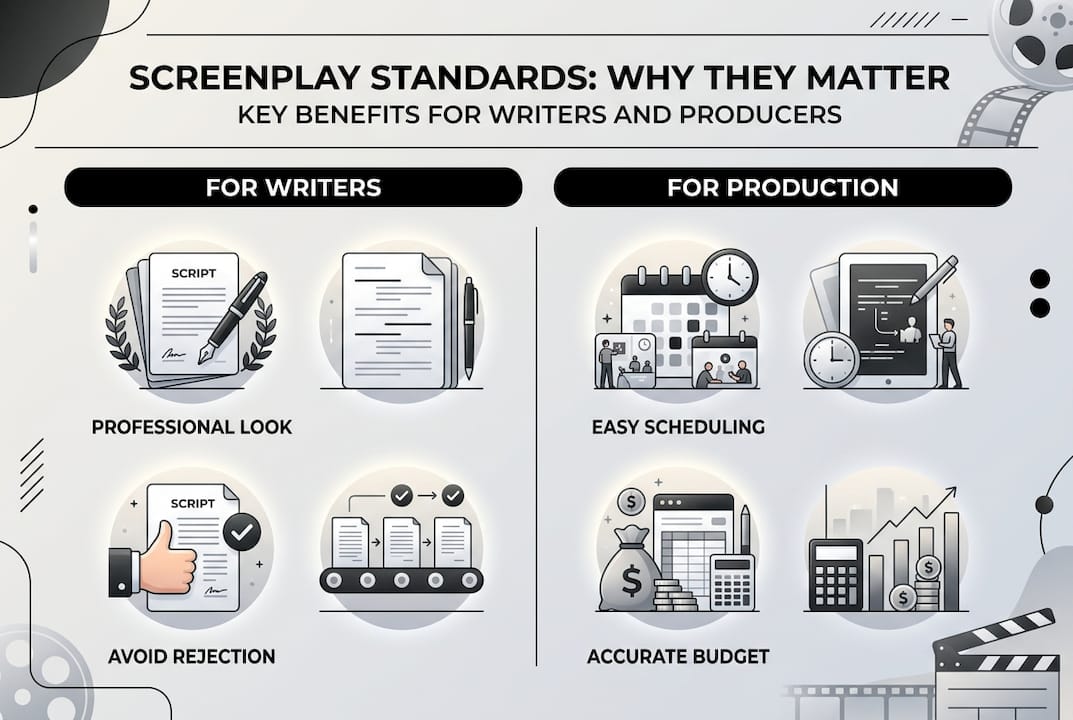
Screenplay formatting exists to create a universal language that every industry professional can read instantly. When you use standard fonts and margins, your script looks identical to every other professional screenplay, allowing readers to focus entirely on your story rather than decoding unusual layouts. Proper screenplay formatting ensures readability and professionalism, making scripts instantly legible to producers, actors, directors, and other professionals who evaluate dozens of scripts weekly.
Scene headings in ALL CAPS serve a practical purpose beyond visual consistency. They allow readers to identify locations and time of day at a glance, essential when producers scan scripts to assess production complexity. Courier 12pt font is not arbitrary nostalgia for typewriters but a deliberate choice that maintains consistent character spacing, ensuring accurate page-to-screen-time ratios. Understanding the parts of a screenplay helps you see how each formatted element contributes to this professional ecosystem.
The consequences of ignoring these standards are immediate and harsh. Contest readers, agency assistants, and production company interns often reject improperly formatted scripts within the first few pages, never reaching your brilliant second act twist or emotional climax. Poor formatting signals inexperience, suggesting you have not invested time learning industry basics. This perception colors how readers approach your entire script, creating skepticism before they encounter your first line of dialogue.
Pro Tip: Use professional screenwriting software like Final Draft, WriterDuet, or Fade In from the start. These tools automate formatting so you can focus on storytelling while ensuring every margin, indent, and spacing rule is correct.
Beyond avoiding rejection, proper formatting demonstrates respect for the reader’s time and expertise. When your script follows conventions, you communicate that you understand the collaborative nature of filmmaking. Directors can visualize scenes quickly, actors can find their dialogue without hunting through dense paragraphs, and production coordinators can begin preliminary breakdowns. Your formatting becomes invisible, allowing your story to shine. Before submitting anywhere, review script marketability tips to ensure both format and content meet professional standards.
Screenplay standards as the blueprint for production and budgeting
Screenplay format is not merely cosmetic but functions as a detailed production document that department heads rely on for planning and resource allocation. One page of a properly formatted script roughly equals one minute of screen time, a ratio that enables producers to estimate runtime and budget before shooting begins. This timing convention depends entirely on consistent formatting: Courier 12pt font, specific line spacing, and standardized margins work together to create this predictable page-to-minute relationship.

Scene headings in ALL CAPS provide instant information about location and time, allowing location scouts to identify how many sets are needed, whether scenes are interior or exterior, and what lighting conditions apply. When a script consistently uses INT. COFFEE SHOP, DAY and EXT. PARKING LOT, NIGHT, production teams can quickly catalog requirements and estimate costs for each setting. This standardized notation streamlines communication across departments, from art direction to cinematography.
Production coordinators use formatted scripts to create breakdown sheets that itemize every element: cast members per scene, props, special effects, vehicles, and extras. Consistent formatting ensures nothing gets overlooked during this critical pre-production phase. When character names appear in ALL CAPS on first mention and dialogue follows precise indentation rules, assistant directors can generate accurate shooting schedules and call sheets. The screenplay coverage workflow mirrors this production logic, evaluating whether scripts provide clear, actionable information.
Consider how formatting details affect budget estimates:
- Page count determines shooting days, with lower-budget productions typically scheduling five to seven pages per day
- Scene heading density reveals location changes, each requiring crew moves and setup time
- Action line length indicates visual complexity, with dense description suggesting elaborate sequences
- Dialogue-to-action ratio helps estimate whether the script is character-driven or action-heavy
- Special formatting like montages or intercut scenes signals post-production editing needs
| Production Element | How Format Provides Info | Budget Impact |
|---|---|---|
| Shooting schedule | Page count and scene density | Crew days and location fees |
| Cast requirements | Character introductions and scene presence | Actor salaries and availability |
| Location needs | INT/EXT scene headings | Set construction or location rental |
| Equipment | Action description complexity | Camera, lighting, and grip gear |
Pro Tip: When writing action lines, be specific but concise. “Sarah races through the crowded market, dodging vendors” gives production teams clear information without micromanaging camera angles or editing choices.
Understanding these production realities helps you write more shootable scripts. When you recognize that every location change costs money and time, you naturally write more efficiently. The film script analysis tips emphasize how format and story structure work together to create producible, compelling screenplays that balance creative vision with practical constraints.
Mastering screenplay formatting conventions and common pitfalls
Screenplay formatting rules are precise and non-negotiable in professional contexts. Courier 12pt is mandatory for correct timing and readability, with character cues positioned at 4.2 inches from the left margin and dialogue blocks centered between 2.5 and 6.0 inches. These measurements are not suggestions but industry standards that screenwriting software enforces automatically, ensuring consistency whether you write in Los Angeles, London, or Mumbai.
Scene headings must always appear in ALL CAPS and follow a strict formula: INT. or EXT., followed by location, then time of day. Common mistakes include lowercase headings, missing time indicators, or vague locations like “SOMEWHERE” that provide no production value. Every scene heading should give clear, specific information: INT. DETECTIVE’S OFFICE, NIGHT tells the production team exactly what to prepare, while INT. OFFICE, ANYTIME creates confusion and suggests amateur work.
Dialogue formatting involves multiple components that work together. Character names appear in ALL CAPS, centered above their dialogue. Parentheticals, when necessary, should be minimal and only clarify delivery or action that cannot be inferred from context. Minimal parentheticals prevent micromanaging actors and keep the read flowing smoothly. Extensions like V.O. (voice over) and O.S. (off screen) must be used consistently and only when the character’s physical presence differs from standard on-camera dialogue.
Common formatting pitfalls that mark scripts as amateur include:
- Using camera directions like “CUT TO” or “CLOSE UP” in spec scripts, which distract readers and overstep the writer’s role
- Inconsistent character naming, such as calling the same person “JOHN,” “JOHN SMITH,” and “SMITH” in different scenes
- Overusing parentheticals to control actor performance instead of trusting dialogue and context
- Writing action lines that exceed four lines without a break, creating dense paragraphs that slow the read
- Including shot numbers, revision marks, or production notes appropriate only for shooting scripts
| Element | Correct Format | Common Mistake |
|---|---|---|
| Scene heading | INT. KITCHEN, MORNING | Int. Kitchen – Morning |
| Character cue | SARAH | sarah or Sarah: |
| Dialogue | Centered block, 2.5-6.0 inches | Full-width paragraphs |
| Parenthetical | (whispers) | (She whispers to him quietly) |
| Transition | FADE OUT. (only at script end) | CUT TO: between every scene |
Pro Tip: Read professional scripts in your genre to internalize formatting conventions. Sites like The Black List and Simply Scripts offer free access to produced screenplays that demonstrate industry standards in action.
Character introductions require special attention. The first time a character appears, their name should be in ALL CAPS within the action line, followed by a brief description that captures essential information: age range, defining characteristics, and relevant context. Avoid lengthy physical descriptions that read like casting notices. “MARCUS (40s), a weary detective with coffee-stained files” is sufficient, while a paragraph detailing eye color and clothing choices wastes space and slows momentum.
The 2026 screenplay writing guide covers these technical elements alongside storytelling craft, showing how proper formatting supports rather than restricts creative expression. When you master these conventions, they become invisible, allowing you to write freely while maintaining professional standards. Professional screenplay coverage evaluates both format and content, recognizing that technical proficiency enables readers to assess your story fairly.
Why following screenplay standards matters for market success
Proper formatting does not guarantee your script will sell, but poor formatting virtually guarantees it will not get a fair reading. No direct empirical data links format alone to success, but poor format disqualifies scripts early while content like premise, plot, and characters drives reader scores. The harsh reality is that gatekeepers use formatting as an initial filter, assuming that writers who have not learned basic standards likely have not invested equivalent effort in craft and storytelling.
Contest readers and agency assistants typically evaluate 50 to 100 scripts monthly, developing quick assessment methods to manage volume. Formatting errors provide an easy justification for passing on a script without reading deeply, allowing readers to move to the next submission. When your formatting is flawless, you clear this first hurdle and earn the opportunity for your story to be judged on its merits. Following standards gets your script read beyond initial gatekeepers, giving your premise, characters, and dialogue a chance to impress decision makers.
Learning formatting software automates mechanics and allows you to focus on story, freeing mental energy for character development, plot structure, and thematic depth. Writers who manually format in word processors waste time adjusting margins and indents, time better spent on rewrites and story refinement. Professional tools like Final Draft, Fade In, and WriterDuet handle technical requirements automatically, ensuring every element appears correctly while you concentrate on creative choices. This efficiency becomes crucial during rewrites, when you need to restructure scenes or add new characters without reformatting manually.
Consistent format signals professionalism and respect for industry norms, communicating that you understand filmmaking as a collaborative process. When producers, directors, and actors receive properly formatted scripts, they recognize a writer who has done the homework and respects their time. This perception creates goodwill before anyone evaluates your story, establishing credibility that carries through the reading experience. The importance of rewrites extends to formatting: each draft should maintain technical precision while improving story elements.
Proper formatting helps judges and readers assess your story fairly by removing distractions and technical barriers. When they do not need to decode unusual layouts or guess at scene locations, they can engage fully with your characters and plot. This fair assessment is what every writer wants: the opportunity for their work to succeed or fail based on storytelling quality rather than technical oversights. Market success requires both excellent content and professional presentation, with formatting serving as the foundation that allows your story to reach its audience.
Key market realities for screenwriters:
- Industry professionals assume formatting competence as baseline, not bonus
- Contests and fellowships often use format compliance as an initial screening criterion
- Producers and directors evaluate dozens of scripts weekly, favoring those that read smoothly
- Proper formatting demonstrates commitment to the craft and understanding of production realities
- Learning standards early prevents developing bad habits that require unlearning later
The relationship between formatting and market success is indirect but significant. Format alone will not sell your script, but format violations will prevent it from being sold. By mastering these standards, you remove obstacles between your story and its audience, ensuring that when your script reaches the right person, nothing technical prevents them from recognizing its value. Review script marketability tips to understand how formatting fits within the larger picture of commercial viability and audience appeal.
Get expert screenplay guidance and coverage from Stonington Media
Mastering screenplay standards is just the beginning of developing a marketable script that captures industry attention and advances your writing career. Stonington Media offers story development expert guidance that goes beyond formatting to evaluate premise strength, character depth, and structural integrity. Our team brings extensive production experience to every script evaluation, providing the honest, industry-grade feedback that helps you identify weaknesses and amplify strengths before submitting to contests, agents, or producers.

Understanding whether your script is marketable requires objective assessment from professionals who know what buyers seek and what red flags cause immediate passes. Our screenplay coverage services deliver detailed analysis from a producer’s perspective, evaluating not just technical format but story logic, pacing, dialogue authenticity, and commercial potential. We help you see your work as industry gatekeepers will, giving you the insights needed to revise strategically and position your screenplay for success in a competitive market.
Frequently asked questions about screenplay formatting
What are the essential formatting rules every screenwriter must follow?
Use Courier 12pt font exclusively, with scene headings in ALL CAPS specifying INT/EXT, location, and time of day. Character names appear centered in ALL CAPS above dialogue, with dialogue blocks indented between 2.5 and 6.0 inches from the left margin. Maintain one-inch margins on top and bottom, 1.5 inches on the left, and one inch on the right.
Does proper formatting actually improve my chances of selling a script?
Proper formatting does not guarantee sales but prevents immediate rejection by gatekeepers who use format compliance as an initial screening tool. Industry professionals assume formatting competence as baseline, allowing them to focus on evaluating your story, characters, and commercial potential without technical distractions.
Should I use screenwriting software or can I format manually in Word?
Professional screenwriting software like Final Draft, WriterDuet, or Fade In automates formatting and ensures industry-standard compliance while you focus on storytelling. Manual formatting in word processors wastes time on technical adjustments and increases error risk, making dedicated software a worthwhile investment for serious writers.
What are the most common formatting mistakes that get scripts rejected?
Common mistakes include using non-standard fonts, inconsistent character naming, excessive parentheticals that micromanage actors, camera directions in spec scripts, and vague scene headings lacking specific location or time information. Dense action paragraphs exceeding four lines without breaks also slow the read and signal amateur work.
How does screenplay format support the production process?
Standard format creates a production blueprint where one page equals roughly one minute of screen time, enabling accurate runtime and budget estimates. Scene headings provide location and lighting information for department heads, while consistent formatting allows production coordinators to create breakdown sheets itemizing cast, props, and equipment needs for every scene.
When should I worry about formatting versus focusing on story?
Learn formatting standards early using professional software so technical elements become automatic, then focus entirely on story development, character depth, and plot structure. Formatting should never distract from creative work but must be correct before submitting scripts to contests, agents, or producers who expect professional presentation.
Recommended



Additional Reading:
- What is professional screenplay coverage (and do you actually need it?)
- What is professional screenplay coverage, really?
- How to Know If Your Screenplay Concept Is Strong Enough
- Why Most Second Acts Collapse (And How Coverage Detects It)
- How Professional Readers Evaluate Character Arcs
- Is Your Script Marketable?
Indexes: