


What is the script coverage process: complete guide 2026
Many screenwriters misunderstand script coverage as a simple pass or fail judgment on their work. In reality, script coverage is a professional summary and analysis used by industry companies to evaluate screenplays systematically. This comprehensive guide walks you through the entire script coverage process, from initial read to final recommendation, helping you understand what happens behind the scenes and how to use coverage feedback strategically to strengthen your screenplay and advance your screenwriting career.
Table of Contents
- What Is Script Coverage And Why It Matters
- The Step-By-Step Script Coverage Process Explained
- Different Types Of Script Coverage And Industry Variations
- How To Use Script Coverage Feedback Effectively To Improve Your Screenplay
- Explore Screenplay Coverage Services To Elevate Your Writing
Key takeaways
| Point | Details |
|---|---|
| Coverage evaluates multiple dimensions | Script coverage assesses plot structure, writing quality, character development, and market potential in a standardized format. |
| Structured feedback system | Reports include synopsis, detailed notes on strengths and weaknesses, and a clear recommendation for decision makers. |
| Rewrite roadmap not rejection | Writers should treat coverage as an objective improvement tool, focusing on structural patterns rather than personal criticism. |
| Industry tracking mechanism | Studios and agencies use coverage to efficiently filter, evaluate, and track hundreds of submitted scripts. |
What is script coverage and why it matters
Script coverage serves as the film and television industry’s primary evaluation tool for screenplays. At its core, coverage is a detailed report that summarizes your script’s plot, analyzes its strengths and weaknesses, and provides a recommendation on whether the project merits further consideration. Production companies, studios, and agencies use coverage to manage the overwhelming volume of script submissions they receive daily.
A typical coverage report contains several essential components. The logline captures your story in one compelling sentence. The synopsis summarizes the plot in one to two pages. The analysis section evaluates writing quality, character development, dialogue, structure, and pacing. Finally, the recommendation tells executives whether to pass, consider, request a rewrite, or recommend the script for development.
Understanding coverage helps you interpret professional feedback more effectively. When you know what readers look for and how they categorize issues, you can address problems systematically rather than feeling overwhelmed by criticism. Coverage also reveals how industry professionals view your work through a commercial lens, balancing artistic merit with market viability.
The main components of a coverage report include:
- Title page with script details and reader information
- Logline and genre classification
- One to two page plot synopsis
- Evaluation grids rating elements like premise, structure, characters, and dialogue
- Detailed written analysis of strengths and weaknesses
- Final recommendation with supporting rationale
Script coverage provides a standardized method for evaluating screenplays, allowing industry professionals to quickly assess a project’s potential and make informed decisions about development.
For screenwriters, coverage offers invaluable perspective. A screenplay coverage example shows you exactly how readers break down your work, revealing blind spots you might miss after months of writing. Professional screenplay coverage delivers honest, industry-grade feedback that friends and family rarely provide, helping you understand where your script truly stands in a competitive marketplace.
The step-by-step script coverage process explained
The coverage process follows a methodical sequence designed to evaluate scripts consistently and thoroughly. Understanding each stage helps you anticipate what readers focus on and how they arrive at their conclusions.
First, the reader receives your script and reviews basic information like title, genre, page count, and writer contact details. They note whether the script meets standard formatting requirements and falls within expected length parameters for its category. Feature scripts typically run 90 to 120 pages, while television pilots vary by format.

Next comes the initial read-through. Professional readers typically complete this in one sitting to experience the script as an audience would. They take notes on first impressions, tracking plot points, character introductions, and any confusion or engagement issues. This reading focuses on overall story flow and emotional impact rather than granular details.
The third stage involves creating the synopsis. Readers summarize your plot objectively, capturing major story beats, character arcs, and the resolution. This synopsis helps executives understand your story quickly without reading the full script. A well-written synopsis reflects clear storytelling, while a confusing synopsis often signals structural problems in the script itself.
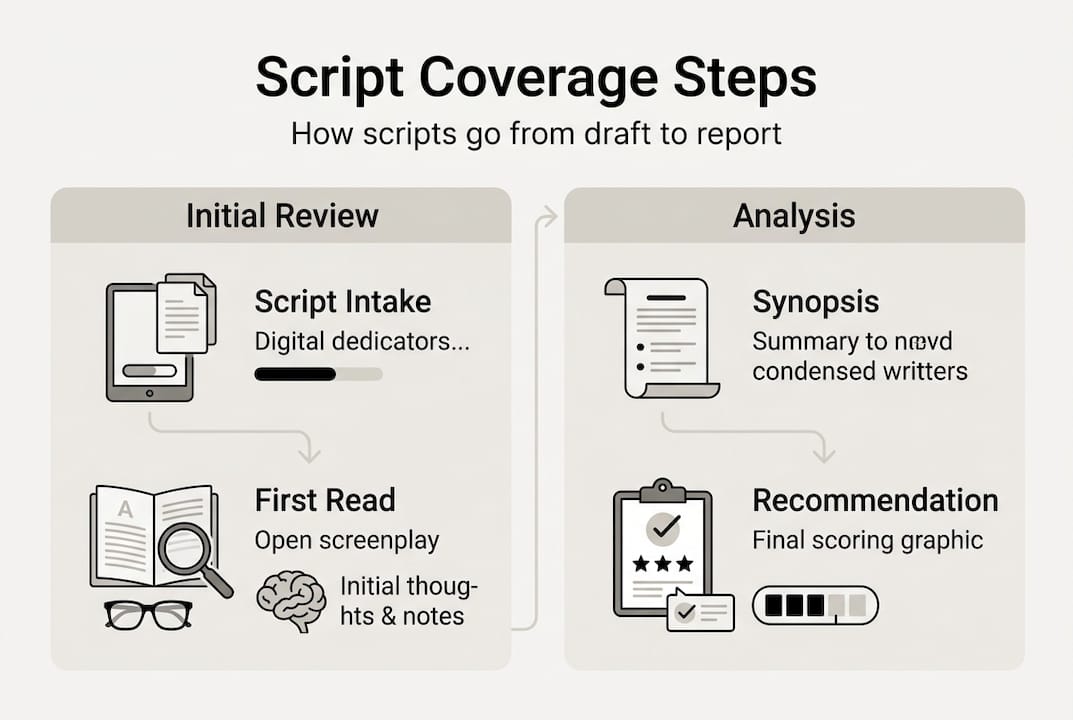
Fourth, readers conduct detailed analysis. They evaluate specific craft elements using standardized criteria. Structure notes should be categorized and prioritized based on patterns, distinguishing fundamental craft issues from subjective taste preferences. Readers assess whether your three-act structure works, if characters have clear motivations and arcs, whether dialogue sounds natural and advances the story, and if pacing maintains momentum.
The evaluation process typically follows these numbered steps:
- Read the entire script without interruption to gauge overall impact
- Create a detailed plot synopsis capturing all major story beats
- Analyze structural elements including setup, conflict escalation, and resolution
- Evaluate character development, motivations, and relationship dynamics
- Assess dialogue quality, authenticity, and efficiency
- Review pacing, tone consistency, and genre execution
- Consider market potential and commercial viability
- Compile strengths and weaknesses into organized notes
- Assign rating scores across evaluation categories
- Write final recommendation with clear supporting rationale
Fifth, readers assign a recommendation. The four standard categories are pass (not viable for production), consider (has potential but needs significant work), rewrite (strong concept requiring revision), and recommend (ready for serious development consideration). Each recommendation includes specific reasoning so executives understand the assessment.
Pro Tip: When you receive coverage, separate structural notes from style preferences immediately. Structural issues like unclear character goals or missing story beats require fixes, while style notes about tone or voice may reflect reader taste rather than fundamental problems. Focus your rewrite energy on patterns that multiple readers identify rather than isolated opinions.
The entire process from script intake to completed report typically takes professional readers four to eight hours depending on script length and complexity. A screenplay coverage workflow guide provides additional detail on timelines and expectations. Understanding film script analysis tips helps you see your work through a reader’s analytical lens.
Different types of script coverage and industry variations
Script coverage is not a one-size-fits-all service. Different industry contexts and purposes generate varied coverage styles, depths, and formats. Knowing these distinctions helps you choose the right coverage type for your specific needs and goals.
Executive coverage differs significantly from professional reader coverage. Executives often write brief, informal notes focused purely on commercial viability and talent attachments. Their coverage might be a few paragraphs rather than a full report. In contrast, professional readers create comprehensive, structured reports following standardized templates. Production companies and agencies use different coverage styles depending on their purpose and budget constraints.
Basic coverage provides essential elements: logline, synopsis, brief analysis, and recommendation. This streamlined version works well for initial filtering when companies receive high submission volumes. Detailed coverage expands analysis significantly, offering scene-by-scene breakdowns, character-specific notes, and extensive craft commentary. Writers seeking developmental feedback benefit most from detailed coverage.
Some services offer written reports exclusively, while others include verbal feedback sessions. Written coverage provides documentation you can reference repeatedly during rewrites. Verbal coverage through phone or video consultations allows real-time discussion, clarifying questions, and exploring solutions collaboratively. Combining both formats maximizes value.
| Coverage Type | Key Features | Best For | Limitations |
|---|---|---|---|
| Basic Coverage | Logline, synopsis, brief notes, recommendation | Initial filtering, budget-conscious writers | Limited developmental detail |
| Detailed Coverage | Scene breakdowns, extensive analysis, craft notes | Serious rewrites, development focus | Higher cost, longer turnaround |
| Executive Notes | Brief commercial assessment, market focus | Pitching, packaging, sales strategy | Less craft-specific guidance |
| Developmental Coverage | In-depth story consulting, solution-oriented | Major revisions, structural overhauls | Requires experienced analyst |
Coverage focus areas vary by reader expertise and client needs. Story structure coverage emphasizes plot architecture, act breaks, and narrative momentum. Character-focused coverage analyzes arc development, motivations, and relationship dynamics. Marketability coverage evaluates commercial potential, comparable titles, and target audience appeal. Some readers specialize in specific genres, providing nuanced feedback on horror conventions, romantic comedy beats, or thriller pacing.
Professional coverage services answer several critical questions for decision makers:
- Does this script demonstrate professional-level craft and storytelling ability?
- Is the premise original, compelling, and commercially viable?
- Are characters well-developed with clear goals and meaningful arcs?
- Does the structure support effective storytelling with proper pacing?
- Is the dialogue authentic, efficient, and character-specific?
- Does the script fit current market trends and audience preferences?
- What specific improvements would elevate this project significantly?
Pro Tip: Match coverage type to your current development stage. If you just completed a first draft, basic coverage identifies major structural issues efficiently. If you have revised multiple times and need granular feedback, invest in detailed coverage. For scripts you plan to pitch soon, consider marketability-focused coverage to refine your positioning strategy.
Exploring best script coverage services 2026 helps you compare options and find readers whose expertise aligns with your genre and goals. Understanding story development principles enhances your ability to evaluate and apply coverage feedback effectively.
How to use script coverage feedback effectively to improve your screenplay
Receiving script coverage triggers an emotional response for most writers. Your natural reaction might swing between defensive rejection and crushing discouragement. Neither response serves your development. Instead, treat coverage as objective data that reveals how professional readers experience your story, then use that information strategically to strengthen your screenplay.
The most common pitfall is reading coverage as personal judgment rather than craft analysis. Readers evaluate your script’s effectiveness, not your worth as a writer. A pass recommendation means this particular draft needs significant work, not that you should abandon screenwriting. Separating your identity from your script’s current state allows you to process feedback rationally and extract maximum value.
Writers should treat coverage as a tool, focusing on structural notes first, identifying patterns across multiple feedback sources, and separating craft observations from taste preferences. This systematic approach transforms overwhelming criticism into an actionable rewrite roadmap.
Start by classifying every note in your coverage report. Create three categories: structure issues, craft refinements, and subjective preferences. Structure issues include problems like unclear protagonist goals, missing story beats, weak conflict escalation, or unsatisfying resolutions. These represent fundamental storytelling problems requiring immediate attention. Craft refinements cover dialogue improvements, pacing adjustments, and character voice distinctions. Subjective preferences reflect reader taste about tone, style, or thematic choices.
Prioritize structural notes above everything else. A script with perfect dialogue but broken structure will always fail. A script with solid structure but rough dialogue can be polished. Fix your foundation before decorating the house. If coverage identifies a weak second act turn or unclear character motivation, address those issues before tweaking individual lines.
Next, look for patterns. If one reader mentions a confusing subplot but praises your protagonist, that subplot might need clarification. If three readers independently note that your protagonist lacks agency, you have a definitive problem requiring a solution. Patterns indicate objective issues rather than individual reader bias.
Best practices for using coverage feedback effectively:
- Read the entire report once without taking notes to absorb the overall assessment
- Wait 24 hours before analyzing specifics to process emotional reactions
- Highlight every concrete, actionable note that identifies a specific problem
- Group similar notes together to identify patterns and prioritize issues
- Distinguish between notes that point out problems and notes that suggest solutions
- Research craft principles related to flagged issues to understand underlying causes
- Create a revision outline addressing structural problems before line-level edits
- Track which notes resonate as true versus which feel like misreadings
- Consult additional resources or mentors on complex structural challenges
- Implement changes systematically rather than randomly jumping between scenes
Use your coverage report as a rewrite roadmap by converting each major note into a specific revision task. If coverage says your protagonist’s goal becomes unclear in Act Two, your task is to clarify and reinforce that goal through dialogue, action, and stakes escalation. If readers find a supporting character one-dimensional, your task is to add complexity through conflicting desires or surprising choices.
Remember that readers sometimes identify problems accurately but suggest solutions ineffectively. Trust the diagnosis more than the prescription. If a reader says your climax feels anticlimactic but suggests adding an explosion, the real issue might be insufficient emotional stakes rather than missing spectacle. Solve the diagnosed problem using your creative instincts rather than blindly following suggested fixes.
The most valuable coverage doesn’t just point out weaknesses. It helps writers understand why certain choices undermine their story and how craft principles can guide more effective solutions. Treat coverage as a learning tool that develops your storytelling instincts over time.
Applying coverage feedback systematically accelerates your growth as a screenwriter. Each report teaches you to see your work more objectively, anticipate reader reactions, and solve storytelling problems independently. Over time, you internalize these analytical skills and write stronger first drafts. For deeper insight into professional evaluation methods, review understanding professional screenplay coverage and study an example screenplay coverage to see how readers structure their analysis.
Explore screenplay coverage services to elevate your writing
Now that you understand the script coverage process and how to use feedback strategically, consider taking the next step toward professional-level screenplay development. Stonington Media offers industry-grade coverage that delivers honest, constructive analysis from experienced readers who understand both craft and commercial considerations.

Explore a detailed screenplay coverage example to see exactly how professional readers break down scripts and provide actionable feedback. Review the screenplay coverage workflow guide to understand turnaround times, submission requirements, and what to expect throughout the process. Browse screenplay coverage FAQs for answers to common questions about services, pricing, and how to prepare your script for evaluation. Investing in professional coverage transforms your revision process from guesswork into targeted improvement, helping you develop scripts that stand out in a competitive industry.
FAQ
What is the standard length of a script coverage report?
Coverage reports typically range from one to five pages depending on the service level and client requirements. Basic coverage might be two pages with essential synopsis and brief notes, while detailed developmental coverage can extend to five pages or more with comprehensive scene analysis. Most professional services provide three to four page reports balancing synopsis length with substantive analytical feedback. Review a screenplay coverage example to see typical report structure and length.
Can I request revisions to my script coverage?
Most professional coverage services provide their initial analysis without offering revision options on the report itself. Coverage represents the reader’s honest assessment based on a single comprehensive evaluation of your submitted draft. Some services offer follow-up consultation calls where you can discuss the feedback and ask clarifying questions, but revisions to the written report are rare in standard coverage packages. Check individual service policies and explore screenplay coverage FAQs for specific provider approaches to follow-up support.
How soon will I get my script coverage report?
Typical turnaround times for professional script coverage range from one to three weeks depending on the service, current volume, and coverage depth requested. Basic coverage often delivers faster, sometimes within one week, while detailed developmental coverage may require two to three weeks for thorough analysis. Many providers offer expedited service options for an additional fee, reducing turnaround to three to five business days. Always confirm expected delivery timelines when submitting your script and review the script coverage turnaround guide for planning your revision schedule effectively.
Recommended



Additional Reading:
- What is professional screenplay coverage (and do you actually need it?)
- What is professional screenplay coverage, really?
- How to Know If Your Screenplay Concept Is Strong Enough
- Why Most Second Acts Collapse (And How Coverage Detects It)
- How Professional Readers Evaluate Character Arcs
- Is Your Script Marketable?
Indexes: