


What is AEO? Boost website visibility and leads
TL;DR:
- Answer Engine Optimization (AEO) structures website content for AI systems to cite and answer directly.
- AEO complements SEO by focusing on clear, question-focused content that improves AI visibility.
- Small businesses can adopt AEO strategies gradually, starting with FAQ pages and structured answers.
You’ve spent real time and money improving your SEO. Keywords are in place, pages are loading faster, and your content calendar is actually running. Yet the leads still feel thin. The phone isn’t ringing the way it should. This is a pattern we see often, and the missing piece is almost always the same: Answer Engine Optimization, or AEO. Search engines and AI tools no longer just rank pages. They extract answers from them. If your website isn’t structured to provide those answers clearly, you’re invisible to the systems that now shape what customers find first. This article explains what AEO is, how it works alongside SEO, and exactly how to apply it so your website starts generating the leads it should.
Table of Contents
- What is AEO? A simple definition and why it matters
- AEO vs. SEO: How they work together to drive business
- Key components of effective AEO for small businesses
- Step-by-step: Applying AEO to your website for more leads
- Perspective: Why AEO is the overlooked advantage for small businesses
- How Stonington Media can accelerate your AEO success
- Frequently asked questions
Key Takeaways
| Point | Details |
|---|---|
| AEO explained simply | AEO helps your website get cited by AI-powered tools and answer engines. |
| AEO and SEO partnership | SEO brings in site visitors and AEO makes your content valuable to AI, enhancing visibility and trust. |
| Quick wins for leads | Improving your site structure and answering key questions raises lead generation and online authority. |
| Easy steps to start | Add structured answers and regularly test your site’s AI extractability for best results. |
What is AEO? A simple definition and why it matters
AEO stands for Answer Engine Optimization. At its core, it’s the practice of structuring your website content so that AI-powered tools and search engines can easily read, understand, and cite it. Think of it less as a ranking strategy and more as a clarity strategy. You’re not just trying to show up in search results. You’re trying to be the source that an AI quotes when someone asks a question your business can answer.
This matters because the way people search has changed significantly. Tools like Google’s featured snippets, Google’s AI Overviews, and conversational platforms like ChatGPT don’t just return a list of links. They pull specific answers from specific pages. If your content is vague, disorganized, or buried in jargon, those tools skip right past you. As AEO is how websites get cited and understood by AI-powered engines, ignoring it means losing ground to competitors who are already writing for these systems.
For small businesses, the consequences are real. Fewer citations mean fewer impressions. Fewer impressions mean fewer inquiries. And when a potential customer asks an AI assistant which local contractor, consultant, or service provider they should contact, your name simply won’t come up if your site isn’t built to answer questions directly.
So what does AEO actually optimize for? Here’s a focused breakdown:
- Structured data: Using schema markup to label your content so search engines understand what it represents, whether that’s a service, a location, a review, or a FAQ.
- Clear messaging: Writing in plain, direct language that gets to the point quickly, without burying the answer in preamble.
- Answerable content: Framing your pages around specific questions your customers are already asking, then answering those questions in a way that’s easy to extract.
- Technical clarity: Organizing your pages with logical headings, short paragraphs, and consistent formatting so AI tools can parse the structure.
- Concise definitions: Defining what you do and who you serve in crisp, unambiguous sentences near the top of each page.
It’s worth pausing on the relationship between SEO and AEO, because they’re not the same thing. SEO for small businesses is fundamentally about discoverability. It’s the work of getting your site to appear when someone types a query. AEO is about what happens after they find you, or more precisely, what happens when an AI finds you on their behalf. SEO brings traffic. AEO earns citations.

The rise of AI-driven answer engines has made this distinction urgent. A business that ranks on page one but gives vague, unstructured answers is increasingly at a disadvantage compared to a business that ranks on page two but answers questions with precision and structure. The second business is the one an AI will quote. That’s the shift AEO addresses.
Now that we understand the importance of getting cited by answer engines, let’s clarify how AEO fits alongside traditional SEO.
AEO vs. SEO: How they work together to drive business
SEO and AEO are not competing priorities. They’re two layers of the same goal: making your website work harder for your business. SEO makes your content discoverable. AEO makes it citable. You need both, and understanding the difference helps you invest your time and budget more intelligently.
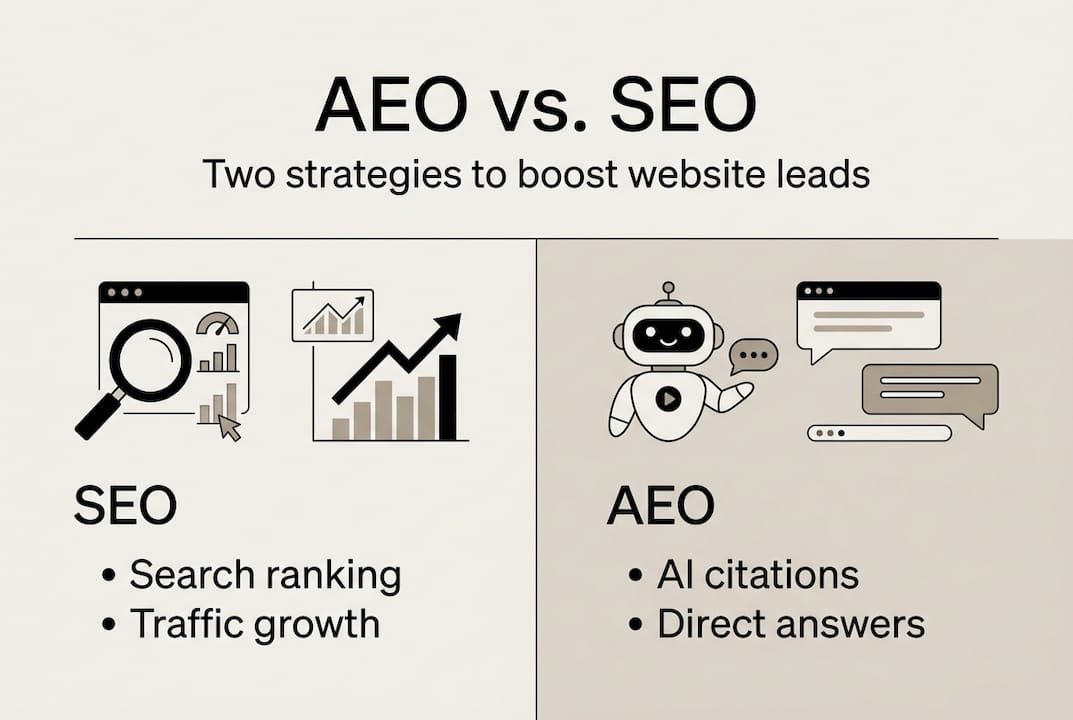
Here’s a side-by-side comparison to make the distinction concrete:
| Factor | SEO | AEO |
|---|---|---|
| Primary focus | Search rankings and traffic | AI citations and direct answers |
| Key enhancements | Keywords, backlinks, page speed | Schema markup, structured Q&A, clear messaging |
| Success metrics | Organic traffic, click-through rate | Featured snippets, AI citations, answer visibility |
| Content style | Keyword-rich, topically broad | Question-focused, concise, structured |
| Target outcome | More visitors to your site | More direct answers attributed to your site |
The tasks involved in each strategy reflect these differences. Common SEO work includes keyword research, building internal and external links, optimizing meta titles and descriptions, and publishing content that covers topics in depth. AEO work looks different. It involves writing direct answers to specific questions, adding FAQ sections to service pages, implementing structured data markup, and simplifying language so AI tools can extract meaning quickly.
Neither strategy replaces the other. A site with strong AEO but no SEO foundation won’t get found. A site with strong SEO but no AEO will get found but not cited. The combination is what drives consistent lead generation.
When it comes to budget and effort, allocate 70 to 80% of your web optimization resources to SEO and 20 to 30% to AEO. This ratio reflects the current landscape, where SEO remains the dominant driver of traffic, but AEO is growing fast as AI tools become the first stop for consumer research.
For small businesses, this means you don’t need to overhaul everything at once. Start with traditional SEO strategies as your base, then layer in AEO improvements gradually. The highest-value pages to start with are your service pages, your homepage, and any existing FAQ content. These are the pages where customers are already asking questions, and where clear, structured answers will have the most immediate impact.
Pro Tip: Review your FAQ pages and service descriptions right now. If the answers are longer than three sentences or start with “It depends,” they probably aren’t AEO-ready. Rewrite them to open with a direct, one-sentence answer, then support it with detail. This single change can improve how AI tools read and cite your content. Pair this with website messaging tips to make every page work harder.
Understanding their differences and synergies gives us a foundation. Now let’s see how AEO works in practice.
Key components of effective AEO for small businesses
Knowing what AEO is and knowing how to apply it are two different things. This section breaks down the practical elements you need to focus on, in a sequence that makes sense for a small business owner working without a dedicated technical team.
The core steps of AEO, in order:
- Know your audience’s questions. Start by listing the ten most common questions your customers ask before hiring you or buying from you. These questions are the foundation of your AEO strategy. If you don’t know them, check your email inbox, your Google reviews, and your sales conversations.
- Answer those questions directly on your site. Each question deserves a clear, structured answer on a relevant page. Don’t bury the answer in a paragraph. Lead with it. Use a question as a subheading and follow it immediately with a one or two sentence answer.
- Use schema markup. Schema is a type of code that labels your content for search engines. FAQ schema, for example, tells Google that a section of your page is a question and answer pair. You don’t need to write the code yourself. Plugins like Yoast SEO or Rank Math handle this for WordPress sites.
- Keep your structure simple. Use clear H2 and H3 headings. Keep paragraphs short. Use bullet points and numbered lists where they add clarity. AI tools parse structured content far more reliably than dense, unbroken text.
- Review and refine regularly. AEO isn’t a one-time task. As AI tools evolve and customer questions shift, your answers need to stay current and precise.
To illustrate the difference AEO makes, here’s a comparison of unoptimized versus optimized content:
| Page element | Unoptimized version | AEO-optimized version |
|---|---|---|
| Service description | “We offer a range of consulting services tailored to your needs.” | “We help small businesses fix unclear website messaging and generate more leads.” |
| FAQ answer | “Pricing varies depending on the scope of the project and timeline.” | “Our website audit starts at $497 and includes a full messaging review with a written action plan.” |
| Homepage headline | “Welcome to our business. We’re here to help.” | “We help service businesses turn website visitors into paying customers.” |
| Contact page | “Feel free to reach out with any questions you may have.” | “Book a free 20-minute call to find out why your website isn’t generating leads.” |
The difference isn’t about being clever. It’s about being clear. As success in AEO depends on clear messaging and structured answers, the businesses that win AI citations are the ones that communicate with precision, not personality alone.
Improving your clear web messaging is the fastest way to close the gap between your current content and what AI tools are looking for. And improving site engagement through better structure reinforces every other optimization you make.
Pro Tip: Paste a key page from your website into ChatGPT and ask it to answer a question your customer would ask. If the AI struggles or gives a vague response, your page isn’t AEO-ready. Use this test to identify exactly where your content needs more structure.
With the building blocks of AEO established, let’s put the concept into action for your own business website.
Step-by-step: Applying AEO to your website for more leads
Applying AEO to your site doesn’t require a developer or a large budget. It requires a clear process and a willingness to rewrite content that isn’t working. Here’s how to move from where you are now to a site that earns AI citations and generates more inquiries.
Step 1: Audit your current content. Go through your five most important pages. For each one, ask: does this page answer a specific question a customer would type into a search engine or AI tool? If the answer is no, that page needs work. Look for vague headlines, long introductory paragraphs that delay the point, and service descriptions that describe features rather than outcomes.
Step 2: Identify your answer gaps. Make a list of questions your business should be answering but currently isn’t. Use Google’s “People Also Ask” boxes, your customer emails, and competitor FAQ pages as sources. These gaps are opportunities. Every unanswered question is a citation you’re missing.
Step 3: Add structured content. Rewrite your service pages and FAQ sections using the question-first format. Open with the question as a subheading. Follow with a direct two to three sentence answer. Then expand with supporting detail if needed. Add FAQ schema markup to signal the structure to search engines.
Step 4: Retest with AI tools. After making changes, use the ChatGPT test described earlier. Also check whether your updated pages appear in Google’s featured snippets or AI Overviews for relevant queries. This feedback loop is how you refine your AEO over time.
To see what this looks like in practice, consider a small accounting firm that updated their services page to directly answer questions like “How much does a small business tax return cost?” and “What documents do I need for my first appointment?” Within two months, they saw a measurable increase in contact form submissions, and their FAQ content began appearing in Google’s AI-generated summaries for local search queries. The change wasn’t technical. It was structural and linguistic.
“Applying AEO improvements leads to increased AI visibility and citations, giving businesses a direct path to more qualified leads.”
A few common mistakes to avoid as you work through this process. Don’t ignore your FAQ pages. They are the highest-leverage AEO asset most small business sites already have. Don’t over-complicate your answers in an effort to sound authoritative. Shorter, clearer answers get cited more often than long, qualified ones. And don’t treat AEO as a one-time project. Review your key pages every quarter and update answers as your services, pricing, or customer questions evolve.
Explore website updates that work to see how structural changes compound over time, and revisit your boosting site leads strategy to align AEO with your broader lead generation goals.
Perspective: Why AEO is the overlooked advantage for small businesses
Here’s something worth sitting with: most small businesses are still treating their websites as digital brochures. They’re focused on how the site looks, whether the brand colors are right, and whether the copy sounds professional. AEO asks a completely different question. It asks whether your site can be understood by a machine that’s trying to help a human being make a decision.
The businesses that figure this out early will have a real advantage. Not because AEO is complicated, but because most of their competitors haven’t heard of it yet. In many local and niche markets, the bar for AEO-ready content is remarkably low. A service page that answers three common questions directly and uses basic schema markup can outperform a competitor’s elaborate, beautifully designed page that never gets to the point.
There’s also something worth noting about who AEO naturally rewards. It favors businesses that communicate simply and directly. That’s actually good news for small businesses. You don’t need a content team or a six-figure marketing budget. You need to know your customer’s questions and answer them without flinching. Large companies often struggle with this because their content goes through layers of approval that sand down every direct, useful claim.
The window for early adoption is open right now. AI-driven search is still evolving, and the norms for what gets cited are still forming. Businesses that invest in improving web messaging today are building a foundation that will compound in value as these tools become even more central to how customers find services. Waiting until AEO becomes mainstream means competing in a much more crowded field. The time to move is before everyone else does.
How Stonington Media can accelerate your AEO success
If you’ve read this far and you’re looking at your own website with fresh eyes, that’s exactly the right response. AEO isn’t a trend to watch from a distance. It’s a practical shift in how your site needs to communicate, and the businesses that make that shift now will see the results first.
At Stonington Media, we work directly with small business owners to identify where their website messaging breaks down and fix it with clear, structured content that both humans and AI tools can act on. Whether you need help with website messaging help, a full site review through our boosting engagement services, or broader strategy from our marketing communications experts, we offer practical, outcome-focused support designed for businesses that are serious about generating leads. The first step is understanding what’s not working. We can help you see it clearly.
Frequently asked questions
How is AEO different from SEO?
AEO focuses on making your answers clear and structured so AI tools can cite them directly, while SEO drives traffic to your website through search rankings. Both matter, but they serve distinct but complementary roles in your overall visibility strategy.
Do small business sites really need AEO?
Yes. As AI-driven citations become a key driver of business visibility, small businesses that structure their content for AEO are more likely to appear in AI-generated answers, which builds trust and increases qualified inquiries.
What’s the first step to improve AEO?
Start by identifying the top questions your customers ask before hiring you, then make sure your website answers each one clearly and directly. A direct, structured Q&A format is the fastest way to improve how AI tools read and cite your content.
Is AEO only for tech companies?
No. AEO applies across all business types, including service providers, local retailers, consultants, and tradespeople. Any business with a website that answers customer questions can benefit from optimizing those answers for AI citation.
Recommended


Additional Reading:
- What is professional screenplay coverage (and do you actually need it?)
- What is professional screenplay coverage, really?
- How to Know If Your Screenplay Concept Is Strong Enough
- Why Most Second Acts Collapse (And How Coverage Detects It)
- How Professional Readers Evaluate Character Arcs
- Is Your Script Marketable?
Indexes: