

Every homepage is a screenplay, yours just has a terrible first act
TL;DR: Your homepage has 50 milliseconds to make a first impression and 10 seconds to communicate value before 50% of visitors bounce. Like a screenplay’s first act, your homepage must immediately answer: What do you do? Can you solve my problem? Do you understand my needs? Poor homepage design destroys trust (75% judge credibility on design alone), wastes marketing spend, and kills conversions before they start. The solution: clarity, speed, mobile optimization, and respect for shrinking attention spans.
Why Your Homepage Fails:
- Visitors form opinions in 50 milliseconds—94% based on design, not content
- You have 10 seconds to communicate value before people leave
- 75% of users judge your credibility solely on website design
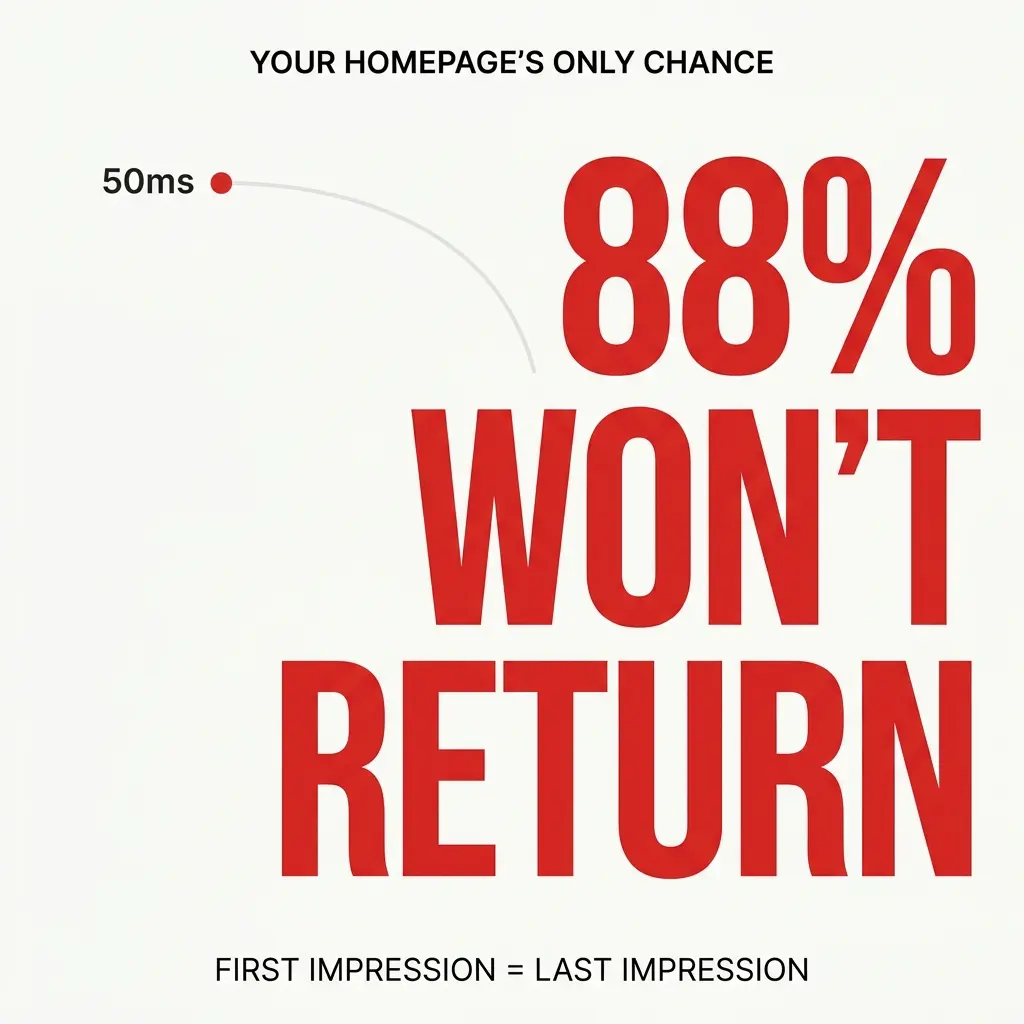
- 88% won’t return after one bad experience
- 50% bounce rate wastes your marketing investment
I’ve spent years watching websites fail before they even get started.
The pattern repeats itself with predictable consistency. A business invests thousands in design, development, and content. They build robust product pages, detailed service descriptions, and comprehensive about sections. Everything looks polished. Everything functions properly.
Then they wonder why bounce rates hover around 50%.
The problem isn’t buried somewhere in the site architecture. It’s staring you in the face the moment someone lands on your homepage. You’ve created a screenplay with a terrible first act, and your audience is walking out before the story even begins.
What Is the 50-Millisecond First Impression Rule?
Here’s what most people don’t realize about their homepage: visitors form an opinion about your website in 50 milliseconds.
Not 50 seconds. Milliseconds.
That’s faster than you can blink. Faster than you can read a single headline. In that microscopic window, people decide whether your site deserves their attention or whether they should hit the back button and try the next search result.
And here’s the part that should concern you: 94% of those first impressions are design-related. Not content-related. Not value-proposition-related. Design.
Your homepage is making promises in those first 50 milliseconds. Promises about credibility, professionalism, and whether you understand your audience. Most homepages break those promises immediately.
Bottom Line: Your homepage makes promises about credibility and professionalism in 50 milliseconds. Because 94% of first impressions are design-related, visual presentation determines whether visitors trust you before they read a single word.
Why Your Homepage Is Like a Screenplay’s First Act
Every successful screenplay follows a three-act structure. The first act establishes the world, introduces the characters, and sets up the central conflict. It answers fundamental questions: Where are we? Who should I care about? Why does this matter?
Mess up the first act, and the audience checks out. It doesn’t matter if Act Two contains brilliant dialogue or Act Three delivers a satisfying resolution. Nobody sticks around to find out.
Your homepage operates under identical constraints.
Visitors land on your site with questions. What does this company do? Can they solve my problem? Do they understand what I need? Your homepage has roughly 10 seconds to answer these questions before people leave.
The Nielsen Norman Group found that you have around 10 to 20 seconds to capture and engage a website visitor. But here’s the catch: to gain several minutes of user attention, you must clearly communicate your value proposition within those first 10 seconds.
Ten seconds to establish your world, introduce your value, and set up why someone should care.
Most homepages waste eight of those seconds on generic hero images and vague taglines.
Critical Insight: Just as a weak first act empties theaters, a weak homepage creates bounce rates that kill your business. You have 10 seconds to answer three questions: What do you do? Can you solve my problem? Do you understand my needs?
How Does Homepage Design Affect Trust?
I need to be direct about something uncomfortable: 75% of visitors judge your company’s credibility based on your website design.
Not your product quality. Not your customer service. Not your years in business. Your design.
This isn’t shallow. It’s practical pattern recognition. When someone encounters a poorly designed homepage, their brain makes a reasonable inference: if this company can’t invest in a professional web presence, what else are they cutting corners on?
The stakes get higher when you consider that 94% of users cite poor design as a primary reason for not trusting a website. Your homepage isn’t just failing to engage people. It’s actively destroying trust before you get a chance to build it.
Think about what happens in those first moments. Someone clicks through from a search result or social media post. They arrive with a specific need or question. Your homepage either validates their decision to click or makes them regret it instantly.
There’s no middle ground in that 50-millisecond window.
Trust Reality: Poor design actively destroys trust before you can build it. When 94% of users cite poor design as a reason for distrust, your homepage becomes a liability, not an asset.
What Captures Attention in 8 Seconds?
The average user attention span in 2025 sits at eight seconds. Down from 12 seconds in 2000.
You’re competing against goldfish-level attention spans, and the trend isn’t reversing. Every year, people get faster at making snap judgments about whether content deserves their time.
This creates a brutal dynamic for homepages. You need to communicate complex value propositions in an environment where people skim rather than read, where scrolling happens at lightning speed, and where the slightest friction triggers an exit.
The response to shrinking attention spans isn’t to cram more information above the fold. That makes the problem worse. The response is to understand what actually captures attention in those critical first seconds.
Clarity captures attention. Specificity captures attention. Relevance captures attention.
Generic statements about being “industry-leading” or “customer-focused” do the opposite. They signal that you haven’t thought carefully about your audience or your message.
Attention Formula: Clarity, specificity, and relevance capture attention in shrinking time windows. Generic corporate language signals you haven’t considered your audience, triggering immediate exits.
What Does a Bad Homepage Actually Cost You?
Let’s talk about what happens when your homepage fails its first-act responsibility.
88% of consumers won’t return to a website after a frustrating experience. That’s not a second chance statistic. That’s a one-strike-and-you’re-out statistic.
38% of users will stop engaging with a website if the content or layout is unattractive. They don’t push through. They don’t give you the benefit of the doubt. They leave.
The financial implications compound quickly. You spend money driving traffic to your site through ads, SEO, content marketing, and social media. That traffic hits your homepage. Half of them bounce immediately because your first act failed to establish why they should stay.
You’re essentially paying to prove that your homepage doesn’t work.
The businesses that understand this invest differently. They recognize that the homepage isn’t just another page in the site architecture. It’s the gatekeeper that determines whether any of your other investment pays off.
Financial Impact: You’re paying to drive traffic that bounces immediately because your homepage fails. When 88% won’t return after one bad experience, every failed first impression represents permanent customer loss.
How Does Page Speed Affect Conversions?
Here’s something that often gets overlooked in homepage discussions: speed kills conversions.
47% of consumers expect a web page to load in two seconds or less. 40% will abandon a website that takes more than three seconds to load.
Your beautiful hero image means nothing if it takes four seconds to render. Your carefully crafted value proposition doesn’t matter if people leave before they see it.
Walmart discovered a 2% increase in conversions for every one-second improvement in load time. That’s not a marginal gain. That’s the difference between a homepage that converts and one that hemorrhages potential customers.
The first act of your screenplay needs to start immediately. Not after a loading spinner. Not after images gradually fade in. Immediately.
Speed-to-Conversion Link: Because 40% abandon sites that take over 3 seconds to load, every second of delay costs conversions. Walmart’s 2% conversion increase per second of improvement proves speed directly drives revenue.
Why Mobile Performance Determines Success
58% to 60% of global web traffic comes from mobile devices. Smartphones drive 78% of retail traffic.
Yet 81% of websites still perform poorly on mobile UX.
Think about what this means for your first act. The majority of your audience experiences your homepage on a screen roughly the size of a playing card. They’re probably standing in line, sitting on a train, or half-watching TV while they browse.
Your desktop homepage might look stunning on a 27-inch monitor. But that’s not where most people see it. They see a compressed, scrollable version where your carefully designed layout collapses into a vertical stack of elements.
If your homepage doesn’t nail the first act on mobile, you’re failing the majority of your audience.
Mobile Majority: With 58-60% of traffic from mobile devices but 81% of websites performing poorly on mobile, most businesses fail the majority of their audience. Your desktop design is irrelevant to most visitors.
What ROI Can Homepage Optimization Deliver?
I don’t want to end on problems without acknowledging solutions.
Businesses that invest in UX see an average ROI of 9,900%. Great UX design can increase conversions by up to 400%.
These aren’t incremental improvements. These are transformational results that come from treating your homepage like what it actually is: the most important real estate in your entire digital presence.
The companies that win this game understand a fundamental truth. Your homepage isn’t a brochure. It’s not a placeholder. It’s not a generic template you fill with stock photos and corporate speak.
It’s a screenplay, and the first act determines whether anyone sticks around for the rest of the story.
When you nail that first act, something shifts. Bounce rates drop. Time on site increases. Conversion rates improve. Not because you manipulated people or used dark patterns, but because you respected their time and answered their questions immediately.
Transformation Potential: UX investment delivers 9,900% average ROI because great design can increase conversions by 400%. These aren’t marginal gains—they’re business-transforming results from treating your homepage as your most critical digital asset.
What Makes a Homepage First Act Effective?
A good first act establishes context instantly. Someone lands on your homepage and knows within seconds what you do, who you serve, and why it matters to them.
It uses specific language instead of generic claims. It shows rather than tells. It removes friction instead of creating it.
A good first act loads fast, looks professional, and works flawlessly on whatever device someone uses. It doesn’t require scrolling to understand the basic value proposition. It doesn’t hide important information behind vague headlines.
Most importantly, a good first act respects the 50-millisecond judgment, the 10-second attention window, and the reality that you don’t get second chances with first impressions.
Your homepage is telling a story right now. The question is whether that story starts with a first act worth watching, or whether you’re losing your audience before the opening credits finish.
I’ve seen too many businesses invest in everything except the thing that matters most. They optimize their product pages but ignore their homepage. They A/B test their checkout flow but never question whether their first impression actually works.
The screenplay analogy holds because the stakes are identical. In film, a weak first act means empty theaters. In digital, a weak homepage means bounce rates that kill your business before it gets started.
Fix your first act. Everything else depends on it.
Essential Principle: An effective homepage respects the 50-millisecond judgment and 10-second attention window by establishing context instantly, using specific language, loading fast, and working flawlessly on mobile. There are no second chances with first impressions.
Frequently Asked Questions About Homepage Optimization
How long do I have to make a first impression on my homepage?
You have 50 milliseconds for visitors to form their initial opinion and 10 seconds to communicate your value proposition before they leave. In that first 50 milliseconds, 94% of judgments are based on design, not content. Therefore, visual presentation determines trust before anyone reads your copy.
Why do visitors judge my business on homepage design?
75% of visitors judge your credibility based on website design because it signals investment and professionalism. When someone sees poor design, they infer that if you cut corners on your web presence, you likely cut corners elsewhere. This is practical pattern recognition, not superficial judgment.
What happens if my homepage loads slowly?
40% of visitors abandon websites that take more than 3 seconds to load. Because 47% expect pages to load in 2 seconds or less, every second of delay directly costs conversions. Walmart proved this by achieving a 2% conversion increase for every one-second improvement in load time.
Is mobile homepage performance really that important?
Yes, because 58-60% of global web traffic comes from mobile devices, and smartphones drive 78% of retail traffic. Yet 81% of websites perform poorly on mobile UX. If your homepage fails on mobile, you’re failing the majority of your audience.
How much should I invest in homepage UX optimization?
Businesses that invest in UX see an average ROI of 9,900%. Great UX design can increase conversions by up to 400%. These are transformational returns because your homepage is the gatekeeper that determines whether any other marketing investment pays off.
What’s the biggest homepage mistake businesses make?
The biggest mistake is treating the homepage like just another page instead of your most critical digital asset. Businesses optimize product pages and checkout flows but ignore the first impression. When 88% of users won’t return after one bad experience, ignoring your homepage wastes all downstream optimization efforts.
Can I recover if visitors have a bad first experience?
No. 88% of consumers won’t return after a frustrating experience. This is a one-strike-and-you’re-out dynamic. Every failed first impression represents permanent customer loss, which is why you’re essentially paying to prove your homepage doesn’t work if you don’t optimize it.
What actually captures visitor attention in 8 seconds?
Clarity, specificity, and relevance capture attention. Generic statements like “industry-leading” or “customer-focused” trigger immediate exits because they signal you haven’t considered your audience. Specific language that directly addresses visitor needs keeps them engaged.
Key Takeaways
- First impressions form in 50 milliseconds: 94% of initial judgments are design-based, determining trust before visitors read anything. Visual presentation is your first and most critical communication.
- You have 10 seconds to communicate value: Your homepage must immediately answer what you do, whether you solve their problem, and if you understand their needs. Generic hero images and vague taglines waste this window.
- Speed directly impacts revenue: 40% abandon sites over 3 seconds, and Walmart gained 2% conversions per second of improvement. Your beautiful design means nothing if people leave before seeing it.
- Mobile performance determines success: With 58-60% mobile traffic but 81% poor mobile UX, most businesses fail most visitors. Desktop design is irrelevant to the majority.
- 88% won’t return after one bad experience: There are no second chances. Every failed first impression represents permanent customer loss and wasted marketing spend.
- UX investment delivers 9,900% ROI: Homepage optimization can increase conversions by 400% because it’s the gatekeeper for all other business investments. Fix your first act—everything depends on it.


Additional Reading:
- What is professional screenplay coverage (and do you actually need it?)
- What is professional screenplay coverage, really?
- How to Know If Your Screenplay Concept Is Strong Enough
- Why Most Second Acts Collapse (And How Coverage Detects It)
- How Professional Readers Evaluate Character Arcs
- Is Your Script Marketable?
Indexes: