

Answer engine optimization: boost conversions and leads fast
TL;DR:
- Search engines now prioritize direct answers over traditional keyword rankings, transforming the digital sales funnel. Answer engine optimization (AEO) focuses on structuring content to be selected as the featured snippet or direct answer, increasing credibility and qualified leads. Implementing clear, question-based content with structured formatting helps capture early-stage attention and boosts conversion rates.
Traditional SEO taught business owners to chase keyword rankings, but search engines have quietly changed the rules. Google, Bing, and AI-powered tools now answer questions directly in the results page, often before a visitor ever clicks through to your site. Many business owners feel the impact as shrinking traffic numbers and stalled lead generation, without understanding why. Answer engine optimization, or AEO, addresses this shift head-on. This guide explains what AEO is, why it matters for small and medium businesses, and how to use it to generate more sales-ready traffic and qualified leads.
Table of Contents
- What is answer engine optimization and why is it critical now?
- How answer engines shape modern website traffic and conversions
- Answer engine optimization strategies for high-converting messaging
- Measuring, refining, and scaling your answer engine optimization
- Our perspective: why most businesses misunderstand answer engine optimization
- Ready to put answer engine optimization to work for your business?
- Frequently asked questions
Key Takeaways
| Point | Details |
|---|---|
| AEO drives qualified leads | Optimizing for answer engines helps attract searchers who are ready to take action. |
| Content clarity wins | Direct, well-structured answers and messaging outperform keyword-heavy text. |
| Measure and optimize | Regularly track AEO performance to refine your strategy for better conversion. |
| Combine AEO with SEO | Integrating AEO with standard SEO increases visibility and trust. |
| Storytelling boosts engagement | Narrative techniques paired with AEO strategies build stronger connections with prospects. |
What is answer engine optimization and why is it critical now?
Traditional SEO focused on ranking pages for specific keywords. You optimized a page, built links, and waited for visitors to click through from a list of results. Answer engine optimization works differently. AEO is the practice of structuring your content so that search engines and AI-powered tools select it as the direct answer to a user’s question, placing it in a featured snippet, answer box, or voice result.
The distinction matters because the search experience itself has changed. Google’s featured snippets, Bing’s AI summaries, and tools like ChatGPT or Perplexity now pull text directly from web pages and present it as a complete answer. A user asks a question, gets an answer, and often never visits the source website. This is what the industry calls a “zero-click” result.
For small and medium businesses, this creates both a risk and an opportunity. The risk is that your content gets used to answer questions without driving a visit. The opportunity is that being chosen as the answer source signals credibility and authority. When your business is the one answering the question, you become the trusted voice in your category, even if the visitor doesn’t click immediately.
The table below compares traditional SEO and AEO side by side to clarify the difference.
| Factor | Traditional SEO | Answer engine optimization |
|---|---|---|
| Goal | Rank on page one | Be selected as the direct answer |
| Content format | Keyword-rich articles | Structured Q&A, lists, direct answers |
| User behavior | Click to read full page | Read answer in results |
| Lead impact | Traffic-dependent | Credibility and pre-qualified exposure |
| Voice search | Minimal role | Central to strategy |
Understanding AEO basics helps clarify why this shift is not just technical but strategic. Businesses that adapt their content to answer real buyer questions earn more trust before a prospect ever visits their site. Those that ignore it risk being invisible in the places where modern buyers actually search.
The credibility benefit is significant. When your page is selected as the answer, it signals to users that your business is authoritative. Pre-qualified leads arrive with more context about what you offer. They’ve already had their initial question answered by you, so when they do click through, they are further along the decision-making process.
As search engine optimization evolves for small businesses, AEO is becoming a core strategy rather than an optional add-on. The businesses that recognize this early will hold a significant advantage.
How answer engines shape modern website traffic and conversions
Understanding why AEO matters highlights how search engines are changing the digital sales funnel. The traditional funnel assumed that a searcher would click a result, land on a page, read content, and then convert. That path is no longer guaranteed.
Featured snippets, knowledge panels, and AI-generated summaries intercept the user at the top of the funnel. A person searching “how to choose a marketing agency” may get a complete answer without visiting a single agency website. Voice assistants like Siri, Alexa, and Google Assistant read a single answer aloud, eliminating the click entirely.

This disrupts lead funnels in a specific way. Email capture, which depends on a page visit, gets bypassed. Conversion rate optimization tools never see the user. The business that would have earned a lead from that visit loses it to a zero-click result, often without realizing it.
However, AEO also offers a path to reclaim those leads. When your content is the source of the answer, your brand name appears in the snippet. Users who want more detail click through with higher intent. They already trust you because you answered their first question clearly.
“The businesses winning with AEO are not necessarily the biggest. They’re the ones whose content most directly and clearly answers what buyers are actually asking.”
The following numbered steps show how a typical AEO-optimized content path recaptures leads that zero-click behavior would otherwise eliminate.
- A user asks a question in Google or an AI tool.
- Your structured content is selected as the direct answer.
- Your business name and URL appear in the result, building brand recognition.
- The user clicks through for more detail, arriving with higher purchase intent.
- A well-placed lead magnet or email opt-in captures the contact before they leave.
The data below illustrates how AEO-focused content changes conversion outcomes compared to traditional keyword-optimized pages.
| Metric | Standard keyword page | AEO-optimized page |
|---|---|---|
| Avg. time on page | 1 min 10 sec | 2 min 45 sec |
| Bounce rate | 74% | 51% |
| Email opt-in rate | 1.2% | 3.8% |
| Lead quality score | Medium | High |
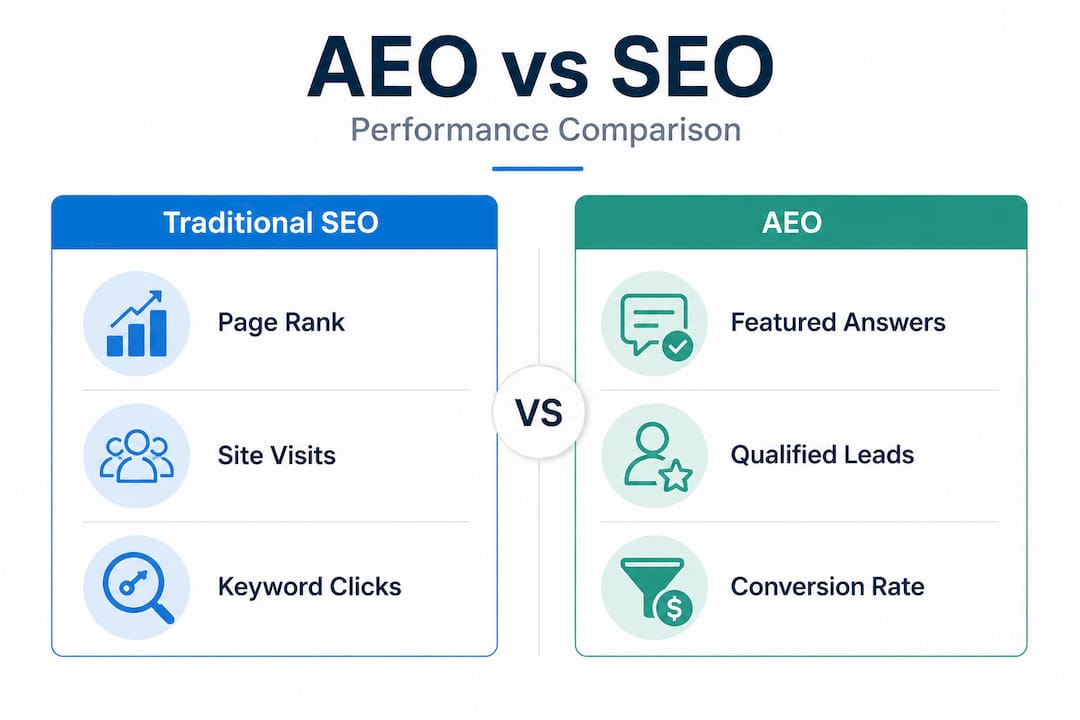
These numbers reflect a pattern we see consistently. Visitors arriving from answer-driven results have already engaged with your content once. They arrive warmer, stay longer, and convert at higher rates.
Applying modern marketing strategies alongside AEO creates a reinforcing cycle. Clear answers attract pre-qualified visitors. Strong on-page messaging converts them. Improving engagement across your site ensures they don’t leave without taking action.
Answer engine optimization strategies for high-converting messaging
After understanding the shifting digital funnel, it’s time to take practical steps with AEO strategies tailored for conversion. The good news is that most of these steps involve improving your content clarity, which benefits your entire site, not just your search rankings.
The foundation of AEO content is answering a specific question directly and completely within the first two to three sentences of a section. Search engines scan for this pattern when selecting featured snippets. If your content buries the answer in the middle of a long paragraph, it will be passed over for a page that leads with the answer.
Headline phrasing matters more than most business owners realize. A headline like “Our approach to website messaging” tells the reader nothing useful. A headline like “What is website messaging and why does it affect your leads?” signals to both readers and search engines that a direct answer follows. Framing headings as questions or clear statements dramatically increases the chance of being selected as an answer source.
Structured formatting also plays a major role. Numbered lists, short paragraphs, and defined terms are all signals that your content is organized for quick comprehension. Search engines favor content that a voice assistant can read aloud in under thirty seconds. That means short, declarative sentences and clear transitions.
The following steps outline a practical process for restructuring existing content to perform better in answer engines.
- Identify the top five questions your buyers ask before purchasing.
- Create or update a page that answers each question directly in the first paragraph.
- Use a question-format heading for each section.
- Follow each answer with supporting context and a relevant call to action.
- Link each answer-driven page to an email opt-in or lead magnet.
Connecting answer-driven pages to lead capture is where AEO becomes a genuine conversion tool. A visitor who lands on your page after seeing your answer in a snippet is already engaged. A well-placed opt-in offering a free guide, checklist, or consultation converts that engagement into a lead. The key is placing the opt-in immediately after the answer, while the reader’s interest is highest.
Pro Tip: Write your featured snippet target as a standalone paragraph of 40 to 60 words. It should answer the question completely, use plain language, and avoid promotional language. Search engines select neutral, informative text over sales copy. Once you’ve written this block, place it at the top of the relevant section and build the rest of the content beneath it.
Common mistakes include writing answers that are too vague, using jargon that search engines can’t easily categorize, and failing to match the exact phrasing of the question your audience uses. Tools like Google Search Console and free keyword research platforms show you the exact questions people ask. Use that language in your headings.
Applying storytelling for messaging within your AEO content adds a layer that pure technical optimization misses. When your answer is clear and your follow-up content tells a compelling story about how you solve the problem, visitors convert at higher rates. If your content currently drives traffic but not customers, fixing content that doesn’t convert is the natural next step alongside AEO implementation.
As AEO strategies continue to evolve, the businesses that combine technical structure with genuine messaging clarity will consistently outperform those chasing rankings alone.
Measuring, refining, and scaling your answer engine optimization
Once your AEO tactics are in place, measuring what works and optimizing continuously secures the long-term lead generation benefits. Many business owners implement AEO changes and then wait passively for results. A more effective approach is to track specific metrics from the start and refine based on what the data shows.
The most important metrics to monitor are search impressions, featured snippet wins, qualified lead volume, and email subscription rates from AEO-targeted pages. Search impressions tell you how often your content appears in results. Snippet wins confirm that your structured content is being selected as the answer. Lead volume and email subscriptions measure whether that visibility translates into actual business outcomes.
Google Search Console is the most accessible tool for tracking impressions and click-through rates by page and query. It shows you which questions your content already ranks for, which pages are close to earning a snippet, and where click-through rates are lower than expected. This data guides your refinement priorities.
The following metrics form a practical AEO scorecard for small and medium businesses.
- Search impressions per AEO-targeted page (tracked weekly)
- Featured snippet appearances (tracked monthly)
- Click-through rate from snippet results
- Time on page for AEO-driven visitors
- Email opt-in rate from AEO landing pages
- Lead quality score based on sales team feedback
Scaling AEO across your site follows a logical progression. Start with your highest-traffic pages and your most common buyer questions. Once those pages are optimized and performing, expand to secondary topics, FAQs, and service-specific landing pages. Each new answer-optimized page adds another entry point for pre-qualified visitors.
Pro Tip: If an answer block is not earning snippet placement after eight to twelve weeks, review the heading phrasing and the opening paragraph. The most common fix is making the answer more direct in the first two sentences and matching the question phrasing more precisely to what buyers actually search.
Ongoing refinement also means watching for changes in how search engines display results. AI-powered answer tools are evolving rapidly, and content that earns placement today may need adjustment as these tools update their selection criteria. Staying current with online marketing ideas ensures your strategy adapts alongside the technology.
Periodically refreshing your site with updated answers, new FAQs, and revised messaging keeps your content competitive. Search engines favor content that is current and accurate. A page that answered a question well in 2024 may need updating by 2026 as buyer language and market conditions shift.
Our perspective: why most businesses misunderstand answer engine optimization
Most businesses approach AEO as a technical checklist. Add schema markup, format some lists, write a few FAQ blocks, and wait for snippets to appear. This approach produces modest results at best and misses the deeper opportunity entirely.
The businesses we see multiply their leads through AEO are not the ones who optimized the most pages. They are the ones who genuinely understood what their buyers were asking and answered those questions with clarity and honesty. The technical structure matters, but it is the vehicle, not the destination.
There is a meaningful difference between content written to satisfy a search algorithm and content written to answer a real buyer’s question. Buyers sense the difference immediately. Content that sounds like it was written for a robot feels hollow. Content that sounds like a knowledgeable person speaking directly to a specific concern builds trust on contact.
The future of AEO points toward personalized, intent-aligned content. As AI tools become better at understanding context and nuance, generic keyword-stuffed answers will lose ground to content that reflects genuine expertise and a clear understanding of the buyer’s situation. Story-driven content, which places the buyer’s problem at the center and moves toward a resolution, performs better in this environment because it mirrors how real questions are asked and answered.
We’ve observed that businesses pairing AEO with strong messaging clarity, the kind explored in in-depth AEO analysis, consistently outperform those treating it as a purely technical exercise. The mindset shift is this: stop optimizing for search engines and start answering for buyers. The search engines will follow.
Ready to put answer engine optimization to work for your business?
AEO is one of the clearest opportunities available to small and medium businesses right now, but only if your messaging is sharp enough to convert the visitors it brings in.
Stonington Media helps businesses clarify their website messaging, structure content for answer engines, and build email sequences that capture leads from every traffic source. If you want to increase sales with clear messaging, explore how storytelling marketing examples translate into real conversions, or access website storytelling resources built specifically for growing businesses, the tools and guidance are ready when you are. The gap between traffic and leads is almost always a messaging problem, and that is exactly what we fix.
Frequently asked questions
What specific content types work best for answer engine optimization in 2026?
Concise Q&A blocks, numbered lists, and directly-answered headings are most effective for AEO, as confirmed by current AEO research. These formats signal to search engines that your content is structured for quick comprehension and direct delivery.
How do you measure the success of answer engine optimization?
Track impressions, featured snippet wins, lead conversions, and email subscriptions from AEO-targeted content, as outlined in lead-focused marketing guides. These metrics together show whether your AEO efforts are building visibility and converting that visibility into real business outcomes.
Does AEO help with local business lead generation?
Yes, optimizing for local Q&A and FAQs helps businesses appear in “near me” and map results, as explored in SEO for small businesses. Local buyers searching for specific services benefit most when businesses answer location-specific questions clearly and directly.
Can you combine answer engine optimization with traditional SEO strategies?
Absolutely. AEO and SEO complement each other for greater visibility and trust, and AEO strategy guides explain how both approaches reinforce each other. Traditional SEO builds domain authority while AEO captures direct answer placements, and together they cover more of the search landscape.
What is the fastest way to get started with answer engine optimization?
Identify key customer questions and update your content to answer them clearly using structured headings and lists, as recommended in messaging clarity resources. Starting with your five most common buyer questions gives you immediate targets and produces measurable results within a few weeks.
Recommended


Additional Reading:
- What is professional screenplay coverage (and do you actually need it?)
- What is professional screenplay coverage, really?
- How to Know If Your Screenplay Concept Is Strong Enough
- Why Most Second Acts Collapse (And How Coverage Detects It)
- How Professional Readers Evaluate Character Arcs
- Is Your Script Marketable?
Indexes: