


Why rewrites are essential for screenwriting success
Many screenwriters believe their work is complete after typing “FADE OUT” on their first draft. This misconception can derail promising projects before they reach their potential. The truth is that rewrites are where professional screenplays truly take shape, transforming raw ideas into polished narratives that meet competitive industry standards. Through strategic revision, you refine character arcs, sharpen story structure, and ensure every scene serves your screenplay’s emotional core. This guide reveals why multiple rewrite passes are non-negotiable for success and how to approach them with clarity and purpose.
Table of Contents
- How Rewrites Refine Screenplay Storytelling And Structure
- The Big-Picture Pass: Focusing On Story Fundamentals First
- Character-Driven Rewrites: Making Protagonists Active And Dynamic
- Applying Structured Rewrite Passes For Professional Screenplay Polish
- Enhance Your Script With Professional Screenplay Coverage
- Frequently Asked Questions About Screenplay Rewrites
Key takeaways
| Point | Details |
|---|---|
| Rewrites fix structural issues | Multiple passes help identify and resolve major story problems that weaken your screenplay’s foundation. |
| Character focus drives engagement | Ensuring protagonists actively shape the narrative creates stronger emotional investment from audiences. |
| Multiple passes increase quality | Professional screenplays typically require five or more rewrites to reach competitive industry standards. |
| Big-picture first saves time | Addressing fundamental story elements before details prevents wasted effort on scenes that may be cut. |
| Professional feedback guides revisions | Industry-grade coverage identifies blind spots and focuses your rewrite efforts on high-impact improvements. |
How rewrites refine screenplay storytelling and structure
Professional screenwriting is built on revision. Successful screenplays often undergo more than five rewrite passes to refine structure and thematic coherence. Each pass targets specific storytelling elements, from plot mechanics to emotional resonance, ensuring your script meets the rigorous expectations of producers, agents, and audiences. Without this layered approach, even brilliant concepts remain buried under first-draft flaws.
Rewrites transform chaos into clarity. Your initial draft captures the raw energy of your story, but it rarely reveals the most effective way to tell it. Through revision, you discover tighter plot connections, eliminate redundant scenes, and strengthen thematic threads that give your screenplay depth. This process isn’t about fixing typos or polishing dialogue. It’s about fundamentally improving how your story unfolds and how audiences experience it.
Structured rewrites prevent overwhelm by breaking massive revision tasks into manageable chunks. Instead of staring at 110 pages wondering where to start, you tackle one element at a time: story logic in pass one, character arcs in pass two, scene-level execution in pass three. This methodical approach keeps you focused and ensures no critical element gets overlooked. Understanding the essential screenplay parts helps you know what to examine in each pass.
Pro Tip: Create a revision checklist before starting each rewrite pass. List the specific story elements you’ll address, from act breaks to character motivations, so you stay focused and avoid getting distracted by unrelated issues.
Focusing on big-picture elements first saves countless hours. Polishing dialogue in a scene you’ll eventually cut wastes creative energy. Early rewrite passes should address fundamental questions: Does your logline still match your script? Are your act breaks landing with emotional impact? Does your protagonist drive the story or just react to events? Answering these questions shapes everything that follows. Evaluating screenplay concept strength early prevents building on a weak foundation.
The competitive landscape demands excellence. Producers and readers evaluate hundreds of scripts annually, and most get rejected within the first ten pages. Your screenplay must demonstrate mastery of craft from page one, which only comes through deliberate revision. Scripts that skip this process feel rushed, with unearned character moments and plot holes that break immersion. Rewrites are your opportunity to close those gaps and deliver a screenplay that stands out. Understanding script marketability tips helps you align your revisions with industry expectations.
The big-picture pass: focusing on story fundamentals first
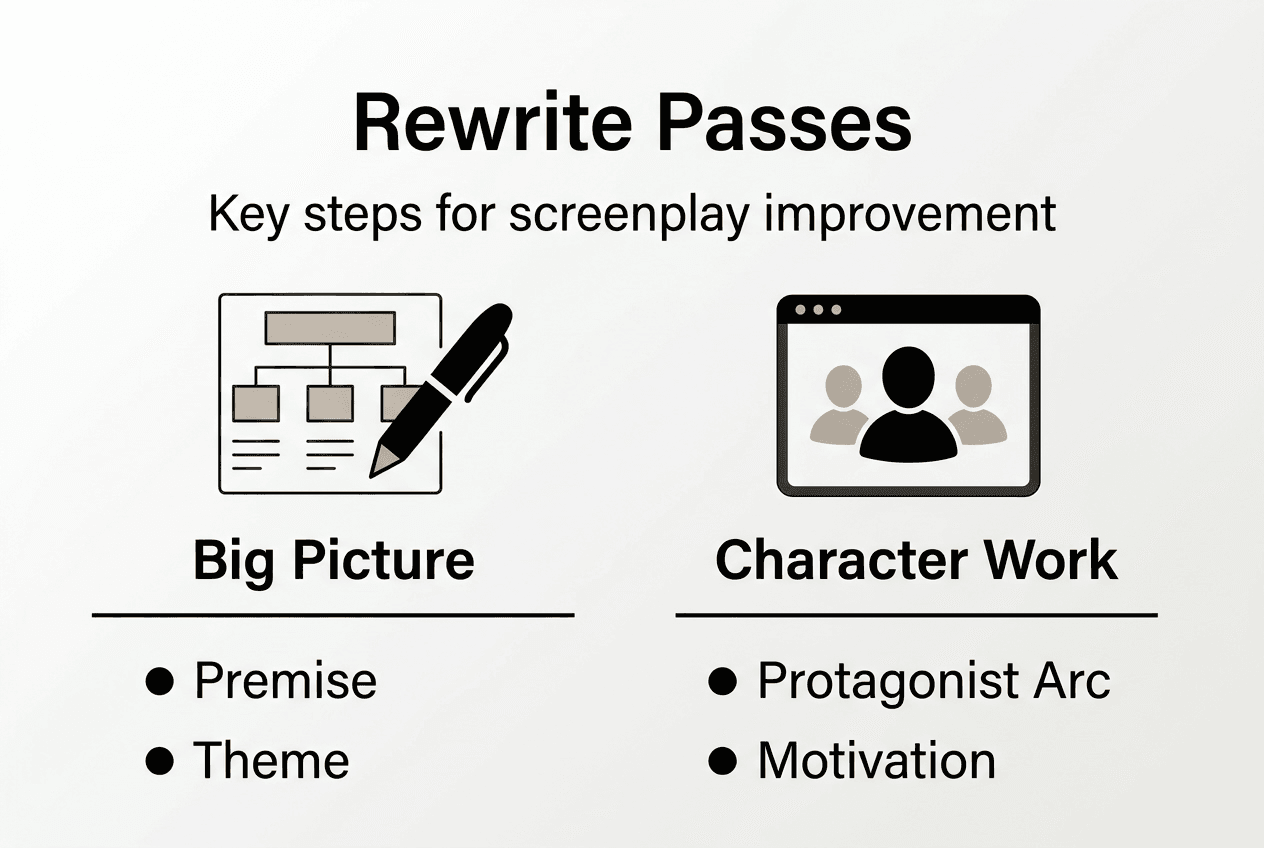
Your first rewrite pass should ignore dialogue, formatting, and scene-level details entirely. Instead, zoom out to examine the structural foundation holding your story together. The big-picture pass focuses on addressing logline, themes, act structure, and plot progression to ensure story coherence. This macro view reveals whether your screenplay delivers on its core promise and whether each major story beat earns its emotional weight.
Start by revisiting your logline. Does it still accurately describe the script you wrote? Many screenwriters discover their story evolved during the first draft, drifting from the original concept. If your logline no longer fits, either revise it to match your script or revise your script to match the stronger version of your premise. A clear, compelling logline should guide every scene and character choice throughout your screenplay.
Thematic consistency separates memorable screenplays from forgettable ones. Examine whether your theme emerges naturally through character actions and story events, or if it feels tacked on. Every major plot point should reinforce your central idea, creating a cohesive emotional experience. If scenes don’t serve your theme, question whether they belong in the script at all. Mastering three-act structure insights helps you position thematic moments for maximum impact.
Pro Tip: Print your beat sheet or outline and highlight every plot point that directly advances your theme. If you see gaps, those are scenes that need rewriting or cutting to strengthen thematic coherence.
Act structure analysis reveals pacing problems and structural weaknesses. Does your first act establish character, world, and conflict efficiently? Does your second act escalate tension through rising complications, or does it meander without clear direction? Does your third act deliver satisfying resolution that feels earned? Understanding beat sheets overview provides a framework for evaluating whether your story hits essential emotional beats at the right moments. Many scripts suffer from second act pitfalls that only become apparent during big-picture analysis.

Emotional beats require special attention during this pass. Map out the emotional journey you want audiences to experience, then check whether your script actually delivers those moments. Are there enough peaks and valleys, or does the emotional tone flatline? Do your highest-stakes moments land with sufficient setup and payoff? Emotional resonance is what transforms a technically sound script into one that moves people.
| Story Element | Questions to Ask | Action if Weak |
|---|---|---|
| Logline | Does it match the script? Is it compelling? | Revise logline or realign script to stronger premise |
| Theme | Does it emerge naturally through action? | Strengthen scenes that embody theme, cut tangents |
| Act Structure | Do acts escalate properly with clear breaks? | Restructure plot points, adjust pacing |
| Emotional Beats | Does the script deliver intended feelings? | Add setup, increase stakes, deepen character responses |
Character-driven rewrites: making protagonists active and dynamic
Character-driven rewrites involve analyzing main characters’ journeys to ensure they actively influence the story through decisions and growth. Passive protagonists who simply react to events create weak narratives that fail to engage audiences. Your characters must make choices that drive plot progression, face consequences that force transformation, and learn lessons that give the story meaning. Without active characters shaping their own destinies, your screenplay lacks the agency that makes stories compelling.
Visualize each main character’s arc using a simple tracking method. Create columns for their wants, needs, internal obstacles, external obstacles, key decisions, and transformation. Fill in what happens to each character across your three acts. This exercise instantly reveals where characters disappear for too long, where they lack clear motivation, or where their arcs feel incomplete. Characters should evolve through the challenges they face, not just witness events happening around them.
Active protagonists make decisions that create consequences. Every major plot turn should stem from a character choice, not random chance or convenient coincidence. When your hero decides to confront the antagonist, betray an ally, or sacrifice something precious, the story moves forward because of their agency. Passive characters who wait for others to solve problems or who stumble into solutions by accident undermine narrative tension. Understanding evaluating character arcs helps you recognize when characters drive versus react.
Pro Tip: For each major plot point, ask “What choice did my protagonist make to cause this?” If the answer is “nothing” or “they got lucky,” rewrite the scene to give them active agency in the outcome.
Internal and external stakes must both escalate throughout your screenplay. External stakes are the plot-level consequences: winning the competition, stopping the villain, surviving the disaster. Internal stakes are the emotional and psychological costs: overcoming fear, learning to trust, accepting responsibility. The most powerful screenplays intertwine both, so that external victories require internal transformation. Track both stake types to ensure they rise together and reach maximum intensity in your climax.
Character transformation separates good scripts from great ones. Your protagonist should be fundamentally different by the final page, having learned something essential through their journey. This doesn’t always mean positive change. Tragic characters may descend into darkness, and static protagonist examples show that some heroes catalyze change in others rather than themselves. What matters is that the transformation feels earned through the specific challenges your story presents.
- List your protagonist’s core belief at the beginning of the script.
- Identify the moment that first challenges this belief.
- Track each subsequent scene that either reinforces or undermines the belief.
- Pinpoint where the character makes a choice based on their new understanding.
- Confirm the final scene demonstrates the completed transformation.
Compare your protagonist’s journey against your supporting characters to ensure everyone serves the story. Secondary characters should illuminate different aspects of your theme or provide contrasting perspectives that challenge your hero’s worldview. If supporting characters feel interchangeable or don’t impact the protagonist’s arc, they need clearer definition or should be cut. Every character who takes up screen time must justify their presence by advancing plot, deepening theme, or revealing character. Exploring character arc insights clarifies the difference between meaningful change and superficial development.
Applying structured rewrite passes for professional screenplay polish
Structured rewrite passes help screenwriters manage complex revisions to improve storytelling and meet industry expectations. Breaking the revision process into distinct phases prevents the paralysis that comes from trying to fix everything simultaneously. Each pass builds on the previous one, creating a systematic path from rough draft to polished screenplay ready for professional evaluation. This approach also makes it easier to incorporate feedback without getting overwhelmed by conflicting notes.
Your first pass addresses big-picture story fundamentals: premise clarity, thematic coherence, act structure, and plot logic. Don’t touch dialogue or worry about individual scene quality yet. Just ensure the skeleton of your story is sound. Your second pass focuses exclusively on character arcs, motivations, and agency. Make sure every main character has clear wants and needs, makes active choices, and transforms through the story. Your third pass examines scene construction: Does each scene have a clear purpose? Do scenes start late and end early? Is conflict present in every exchange?
Professional script coverage provides the external perspective you need to focus revision efforts effectively. After completing your initial rewrite passes, professional screenplay coverage identifies blind spots you can’t see because you’re too close to the material. Readers trained in industry standards evaluate your screenplay against the same criteria used by producers and development executives. Their feedback highlights which elements need the most attention, saving you from wasting time on areas that already work.
- Complete your big-picture story pass, focusing only on structure and plot.
- Do a dedicated character arc pass, ensuring every main character drives the narrative.
- Perform a scene-by-scene pass, tightening conflict and pacing within each unit.
- Get professional coverage to identify remaining weaknesses and confirm strengths.
- Execute a targeted revision pass addressing specific feedback points.
- Do a final polish pass for dialogue nuance, formatting, and technical elements.
Checklists and tracking tools keep you organized during the revision marathon. Create a spreadsheet listing every scene with columns for purpose, conflict, character development, and thematic relevance. As you revise, mark which scenes you’ve strengthened and which still need work. This prevents you from repeatedly polishing the same favorite scenes while neglecting problem areas. It also provides a clear record of your progress, which maintains motivation during the long rewrite process.
Pro Tip: Set specific goals for each rewrite session. Instead of “work on script,” commit to “revise Act Two scenes 45 through 60 for character agency.” Specific targets make sessions more productive and less overwhelming.
Prioritize fixes that strengthen story clarity and emotional impact above all else. A screenplay with minor formatting inconsistencies but a compelling, clear story will advance further than a technically perfect script with a confusing plot. Focus your energy where it matters most: making sure audiences understand what’s happening, why they should care, and what emotional journey you’re taking them on. Everything else is secondary. Evaluating script marketability helps you understand which elements professionals prioritize.
Final polish passes address the details that demonstrate professional craft. Now you can refine dialogue for character voice and subtext, ensure scene headings follow proper format, check that action lines are lean and visual, and verify your page count aligns with genre expectations. These elements matter, but only after you’ve ensured your story foundation is rock solid. Exploring story craft techniques provides additional resources for elevating every aspect of your screenplay.
Enhance your script with professional screenplay coverage
After investing significant time and creative energy into rewrites, you need objective feedback from industry professionals who evaluate scripts daily. Stonington Media offers specialized screenplay coverage that identifies exactly what’s working in your script and what still needs attention. Our readers bring years of production experience and understand what separates scripts that get optioned from those that don’t.

Choose premium screenplay coverage for focused feedback on your screenplay’s core strengths and weaknesses, or select comprehensive screenplay coverage for detailed scene-by-scene analysis that guides your next rewrite pass. Both options provide honest, constructive evaluation aligned with current industry standards. Explore our screenplay coverage FAQs to understand how professional feedback accelerates your development process and positions your script for success in a competitive marketplace.
Frequently asked questions about screenplay rewrites
How many rewrites does a screenplay typically need?
Professional screenplays usually require five to ten rewrite passes before they’re ready for submission. Each pass addresses different elements, from structure to character to dialogue. The exact number depends on your story’s complexity and how much changed from your initial concept, but expecting multiple substantial revisions is realistic and necessary for competitive quality.
What should I focus on during my first rewrite pass?
Your first rewrite should address big-picture story fundamentals: premise clarity, thematic coherence, act structure, and plot logic. Ignore dialogue, formatting, and scene-level polish entirely during this pass. Ensuring your story’s foundation is solid prevents wasted effort on details within scenes you might later cut or restructure. Understanding story structure basics helps you evaluate these fundamental elements effectively.
How can I track character development during rewrites?
Create a simple chart with columns for each main character’s wants, needs, obstacles, key decisions, and transformation arc. Fill in what happens to each character across your three acts. This visual map instantly reveals where characters lack clear motivation, disappear for too long, or fail to drive the plot through active choices. Update the chart after each rewrite pass to track improvements.
Is professional script coverage worth the investment?
Professional coverage provides objective evaluation from readers trained in industry standards, identifying blind spots you can’t see on your own. This focused feedback saves months of aimless revision by highlighting exactly which elements need attention. Professional screenplay coverage is particularly valuable before submitting to competitions, agents, or producers, ensuring your script meets competitive expectations.
When is my screenplay ready to be submitted?
Your screenplay is ready when you’ve completed multiple rewrite passes addressing structure, character, and scene-level execution, incorporated feedback from trusted readers or professional coverage, and can honestly say every scene serves a clear purpose. If you’re still finding major plot holes or character inconsistencies, it needs more work. Most successful screenwriters wait until they’ve exhausted their own revision ideas and received at least one round of professional feedback before submitting.
Recommended



Additional Reading:
- What is professional screenplay coverage (and do you actually need it?)
- What is professional screenplay coverage, really?
- How to Know If Your Screenplay Concept Is Strong Enough
- Why Most Second Acts Collapse (And How Coverage Detects It)
- How Professional Readers Evaluate Character Arcs
- Is Your Script Marketable?
Indexes: