


Master writing character traits for stronger scripts
Many screenwriters believe that complex character traits confuse audiences or slow down story momentum. In reality, well-crafted traits are the foundation of memorable characters and powerful narrative impact. This guide reveals how to write traits that fuel character growth, create meaningful conflict, and elevate your screenplay’s emotional resonance. You’ll learn evidence-backed techniques for selecting flaws, balancing strengths with vulnerabilities, and tailoring trait complexity to character roles, all grounded in professional screenwriting practice.
Table of Contents
- Understanding The Role Of Character Traits In Storytelling
- Why Writing Character Flaws Is Vital And How To Choose Them
- Navigating Character Arc Complexity: Main Versus Supporting Roles
- Practical Techniques For Writing Compelling Character Traits In Your Screenplay
- Enhance Your Scripts With Expert Story Development Support
- What Makes A Character Trait Effective In A Screenplay?
Key takeaways
| Point | Details |
|---|---|
| Traits drive conflict | Effective character traits naturally generate story tension and propel narrative momentum. |
| Flaws enable growth | Characters with meaningful flaws create opportunities for compelling arcs that audiences find engaging. |
| Role determines complexity | Main characters typically require deeper trait layers than supporting characters to sustain full arcs. |
| Simplicity suits comedy | Comedic protagonists often benefit from focused, clear flaws that allow quick resolution and humor. |
| Balance creates authenticity | Mixing strengths with vulnerabilities makes characters feel real and relatable across all genres. |
Understanding the role of character traits in storytelling
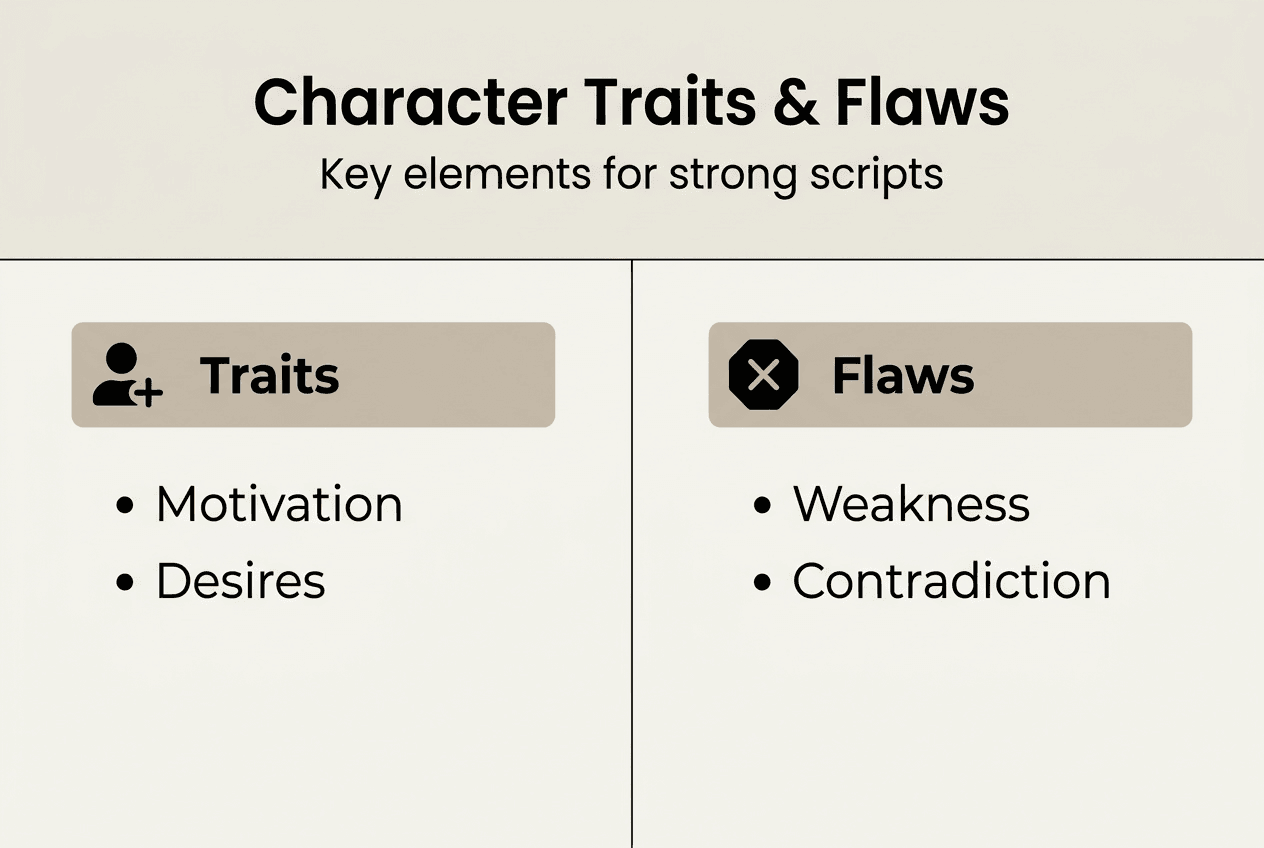
Character traits are the defining qualities, behaviors, and patterns that shape how your characters think, act, and react throughout your screenplay. These traits fall into three essential categories: strengths (skills, virtues, talents), flaws (weaknesses, fears, blind spots), and desires (goals, longings, needs). Each category serves a distinct narrative function, but flaws and desires typically carry the heaviest storytelling weight because they generate conflict and motivation.
Desires push your characters forward, creating the engine that drives plot progression. When you establish what a character wants, you give audiences a reason to invest in their journey. Flaws, on the other hand, create obstacles that make achieving those desires difficult, forcing characters to confront their limitations. This tension between desire and flaw forms the heart of character-driven storytelling.
Stories benefit from a character who changes over the course of the narrative. Traits should align directly with your story goals, meaning every significant character quality you introduce should serve a purpose in the plot. If a trait doesn’t impact decisions, relationships, or outcomes, it’s decorative rather than functional. Functional traits create opportunities for dramatic moments, force difficult choices, and reveal character depth through action.
When developing traits, consider how they interact with your story structure:
- Traits should create obstacles that test your protagonist at key turning points
- Strengths can become weaknesses when pushed to extremes or applied inappropriately
- Desires should conflict with other characters’ goals to generate natural tension
- Flaws work best when they directly oppose what the character needs to succeed
Pro Tip: Map each major character trait to a specific scene or sequence where it will be tested. If you can’t identify where a trait matters dramatically, cut it and focus on qualities that actively shape your story.
Understanding character longing and desire helps you create protagonists whose internal needs drive external action. The most compelling characters want something desperately, but their flaws make obtaining it nearly impossible without fundamental change.
Why writing character flaws is vital and how to choose them
The fatal flaw represents the central weakness or blind spot that prevents your character from achieving their goal until they confront and overcome it. This narrative device creates the foundation for meaningful character arcs because it establishes a clear internal obstacle that must be resolved for external success. Characters with flaws are more likely to undergo growth, which audiences find appealing because it mirrors real human struggle and transformation.

Flaws enable character arcs by creating a gap between who the character is and who they need to become. Without this gap, you have no arc, just a competent person solving problems. Audiences connect emotionally with flawed characters because vulnerability creates empathy. Watching someone struggle with recognizable weaknesses makes success feel earned rather than inevitable.
Choosing the right flaw requires understanding your genre and story needs. Different genres emphasize different flaw types:
| Genre | Effective Flaw Types | Narrative Function |
|---|---|---|
| Drama | Deep psychological wounds, moral compromises, relationship failures | Create sustained emotional tension and complex growth |
| Comedy | Social awkwardness, stubbornness, overconfidence | Generate situational humor while allowing clear resolution |
| Thriller | Paranoia, trust issues, obsessive behavior | Heighten suspense and complicate decision making |
| Romance | Fear of commitment, emotional unavailability, pride | Block connection until overcome through relationship |
When selecting flaws for your character, prioritize qualities that directly oppose their goals. If your protagonist needs to build a team, make them distrustful. If they must make a sacrifice, make them selfish. This opposition creates organic conflict that feels inevitable rather than contrived.
Pro Tip: Test your chosen flaw by asking whether overcoming it requires genuine change or just a single decision. Flaws that demand sustained effort and multiple attempts to overcome create richer arcs than those resolved through one pivotal choice.
The best flaws have logical roots in backstory and manifest consistently in behavior patterns. A character who fears abandonment might sabotage relationships preemptively, push people away through hostility, or cling desperately to unhealthy connections. These behavioral expressions make the flaw visible to audiences without requiring exposition.
Character flaws explained in detail shows how misunderstanding flaw function leads to shallow character work. Effective flaws aren’t just negative traits, they’re specific vulnerabilities that the story will exploit and eventually help the character transcend.
Navigating character arc complexity: main versus supporting roles
A persistent debate in screenwriting circles questions whether main characters should always undergo complete transformative arcs. Some argue that main characters are too complex to arc, while supporting characters, with simpler personas, are easier to develop. This perspective suggests that protagonists in certain genres or story types function better as stable forces around which other characters change.
Supporting characters typically require simpler trait profiles because they serve specific story functions rather than carrying full emotional journeys. A mentor character might embody wisdom without needing to learn humility. A comic relief sidekick can remain consistently optimistic without experiencing doubt. These characters work because their traits serve the protagonist’s arc rather than demanding their own complete transformation.
Han Solo in Star Wars exemplifies the expected protagonist arc. He begins as a self-interested smuggler who cares only about money and survival. Through his journey, he develops loyalty, courage, and commitment to a cause larger than himself. This transformation feels satisfying because his initial selfishness creates clear room for growth, and the story systematically challenges that flaw until he changes.
Static characters can be effective when the story focuses on external conflict rather than internal growth. Action heroes, certain detective protagonists, and ensemble pieces sometimes feature leads who remain fundamentally unchanged while navigating plot complications. James Bond rarely experiences deep personal transformation, yet his stories work because audiences enjoy watching his competence rather than his evolution.
| Character Type | Trait Complexity | Arc Expectation | Example Function |
|---|---|---|---|
| Main protagonist | High, multi-layered | Usually transforms | Carries emotional journey |
| Secondary lead | Moderate, focused | May transform partially | Supports or contrasts main arc |
| Supporting cast | Simple, clear | Minimal to none | Serves specific story role |
| Antagonist | Moderate to high | Rarely transforms | Creates meaningful opposition |
When deciding whether your main character should arc, consider your genre conventions and story focus. Character-driven dramas demand transformation. Plot-driven thrillers can succeed with static protagonists who face escalating external challenges. Understanding static protagonists and arcs helps you make informed choices about when stability serves your story better than change.
The key distinction lies in where your story generates interest. If audiences invest primarily in watching the character overcome internal limitations, you need a clear arc. If they invest in watching the character navigate external obstacles using established skills, a static approach works. Both are valid, but mixing them creates confusion about what the story promises to deliver.
Practical techniques for writing compelling character traits in your screenplay
Crafting balanced character traits requires systematic attention to how strengths, flaws, and desires interact throughout your screenplay. Follow this method to develop traits that serve your story:
- Identify your character’s primary goal and the specific internal obstacle preventing easy achievement
- Select one major flaw that directly opposes the goal, ensuring it will create repeated conflict
- Add two to three strengths that make the character competent but not invincible
- Establish a deep desire that motivates pursuit of the goal beyond surface-level wants
- Test each trait by mapping it to specific scenes where it influences decisions or outcomes
Connecting character flaws with plot events creates organic storytelling where internal and external conflicts reinforce each other. Your protagonist’s trust issues should complicate the moment when they must rely on others. Their pride should make accepting help painful at the exact point when independence becomes impossible. This alignment makes every plot beat feel like it emerges naturally from character rather than imposed by structure.
Main characters in comedies often have simplified issues, making them easier to arc. Comedy benefits from clarity because audiences need to quickly grasp the flaw to appreciate how situations exploit it for humor. A socially awkward character creates immediate comedic potential in any social setting without requiring complex psychological exploration.
Drama allows and often demands trait complexity. Layered protagonists with competing desires, contradictory behaviors, and ambiguous motivations create the rich texture that sustains longer emotional journeys. You can explore how childhood trauma influences adult relationships, how professional ambition conflicts with personal values, or how cultural identity shapes individual choices.
Pro Tip: Avoid the common pitfall of introducing traits that never impact the story. Every significant character quality should create at least one moment of conflict, choice, or revelation. If you mention a character is claustrophobic, trap them in a confined space. If they’re fiercely independent, force them into dependence.
Common trait writing mistakes include:
- Creating flaws that don’t genuinely challenge the character or create meaningful obstacles
- Overloading characters with so many traits that they become inconsistent or unfocused
- Relying on stereotypical traits that feel borrowed rather than specifically tailored to your story
- Telling audiences about traits through dialog instead of showing them through behavior and choices
Evaluating character arcs from a professional perspective reveals how industry readers assess whether your trait work succeeds. They look for clear establishment of flaws early, consistent behavioral patterns that demonstrate those flaws, escalating challenges that test the character, and satisfying resolution that shows genuine change.
Balance creates authenticity because real people contain contradictions. Your ambitious executive can also be a devoted parent. Your tough detective can harbor surprising vulnerability. These contrasts make characters feel dimensional rather than one-note, giving actors material to create nuanced performances.
Enhance your scripts with expert story development support

Mastering character traits transforms good scripts into compelling screenplays that capture industry attention, but refining these elements often benefits from experienced professional guidance. Expert story development provides the objective analysis and industry insight that helps you identify where your character work succeeds and where it needs strengthening. Professional script evaluation examines whether your traits create sufficient conflict, support meaningful arcs, and align with genre expectations that influence script marketability. At Stonington Media, we offer comprehensive screenplay coverage that delivers honest, producer-perspective feedback on character development, helping you craft protagonists and supporting characters that resonate with audiences and industry professionals alike.
What makes a character trait effective in a screenplay?
Effective traits reveal motivation while creating natural conflict that drives story progression. The best character qualities force difficult choices at crucial moments, making your protagonist’s journey feel earned rather than convenient. Traits work when they generate obstacles that can’t be solved through simple action but require internal growth or change. Look for qualities that oppose your character’s goals while connecting logically to their backstory, creating behavioral patterns that audiences recognize and anticipate. Understanding character arc nuances helps you distinguish between traits that enable transformation and those that merely decorate.
How do I decide which flaws suit my main character?
Choose flaws that directly challenge your character’s core desires and create barriers to achieving their primary goal. The most effective flaws make success nearly impossible without confronting and overcoming that specific weakness, ensuring your arc feels necessary rather than arbitrary. Consider what internal obstacle would create the most dramatic tension in your particular story, then work backward to establish that flaw early through behavior rather than exposition. Your flaw should have clear roots in backstory and manifest consistently in decisions, relationships, and reactions throughout the screenplay. Exploring choosing character flaws reveals how specificity and story relevance separate compelling flaws from generic weaknesses.
Can supporting characters have complex character traits?
Supporting characters can absolutely possess nuanced, layered traits, though they typically follow simpler arcs than protagonists because they serve specific story functions. Complex traits in supporting roles enrich your screenplay’s depth and make secondary characters memorable without requiring full transformative journeys. The key is ensuring their complexity serves the main character’s arc or thematic exploration rather than competing for narrative focus. A mentor with unresolved trauma, a sidekick with hidden ambitions, or an antagonist with sympathetic motivations all add texture without demanding equal screen time for their personal growth. Understanding supporting character complexity through examples shows how depth differs from arc necessity.
What common mistakes should I avoid when writing character traits?
Avoid introducing traits that never impact your story’s events, decisions, or relationships, as they waste space without adding value. Don’t overload characters with conflicting qualities that make their behavior unpredictable or inconsistent, confusing audiences about who the character fundamentally is. Steer clear of clichéd traits borrowed from stereotypes rather than tailored specifically to your character’s unique circumstances and your story’s particular needs. The most damaging mistake is telling audiences about traits through exposition instead of demonstrating them through choices, actions, and consequences that reveal character organically. Every trait you establish should create at least one moment where it matters dramatically, forcing the character to confront that quality’s limitations or advantages.
Recommended
- Character craft, examined: static protagonists (and when transformation isn’t the point)
- Character craft, examined: longing (and why desire is stronger than plot)
- Character craft, examined: character arc (and why change isn’t always growth)
- Character craft, examined: flaws (and why they’re often misunderstood) | Stonington Media LLC



Additional Reading:
- What is professional screenplay coverage (and do you actually need it?)
- What is professional screenplay coverage, really?
- How to Know If Your Screenplay Concept Is Strong Enough
- Why Most Second Acts Collapse (And How Coverage Detects It)
- How Professional Readers Evaluate Character Arcs
- Is Your Script Marketable?
Indexes: