

SEO success through smart messaging and email strategy
TL;DR:
- Successful SEO relies on clear, human-centered messaging that addresses actual buyer needs.
- Integrating email marketing with SEO amplifies traffic and improves search rankings through behavioral signals.
- Focus on optimizing service pages and quarterly updates, rather than volume-based content, for better results.
Most business owners assume SEO is a rankings game. Get to page one, get the traffic, get the leads. That belief is understandable, but it misses a significant part of the picture. Human-first content built around genuine experience and clear messaging consistently outperforms generic, keyword-stuffed pages, and when you pair that with a smart email strategy, the results compound in ways that rankings alone never could. This article walks through what SEO actually requires, how messaging shapes every part of it, and how email marketing becomes the multiplier that most small businesses overlook entirely.
Table of Contents
- Why SEO isn’t just about keywords
- Clear messaging: The core of SEO and lead generation
- Choosing the right keywords for your business
- Integrating email marketing with SEO for exponential gains
- SEO and content workflow: What to prioritize for maximum impact
- The uncomfortable truth: Most small business SEO advice is backwards
- Take your SEO and email to the next level with proven guides
- Frequently asked questions
Key Takeaways
| Point | Details |
|---|---|
| SEO goes beyond keywords | Effective SEO involves messaging, user experience, and content repurposing, not just keyword placement. |
| Clear messaging drives leads | Strong, targeted website messaging increases trust and action, boosting SEO and lead generation together. |
| Email and SEO amplify each other | Repurposing SEO content in email marketing grows your lists and delivers powerful behavioral signals for rankings. |
| Prioritize buyer intent and updates | Spend most effort on service pages, use intent-driven keywords, and update content quarterly for best results. |
Why SEO isn’t just about keywords
Search engine optimization has a branding problem. The phrase sounds technical, even intimidating, which leads many business owners to hand it off to someone who promises rankings without explaining the mechanics underneath. The truth is that SEO covers a much wider territory than keywords and backlinks.
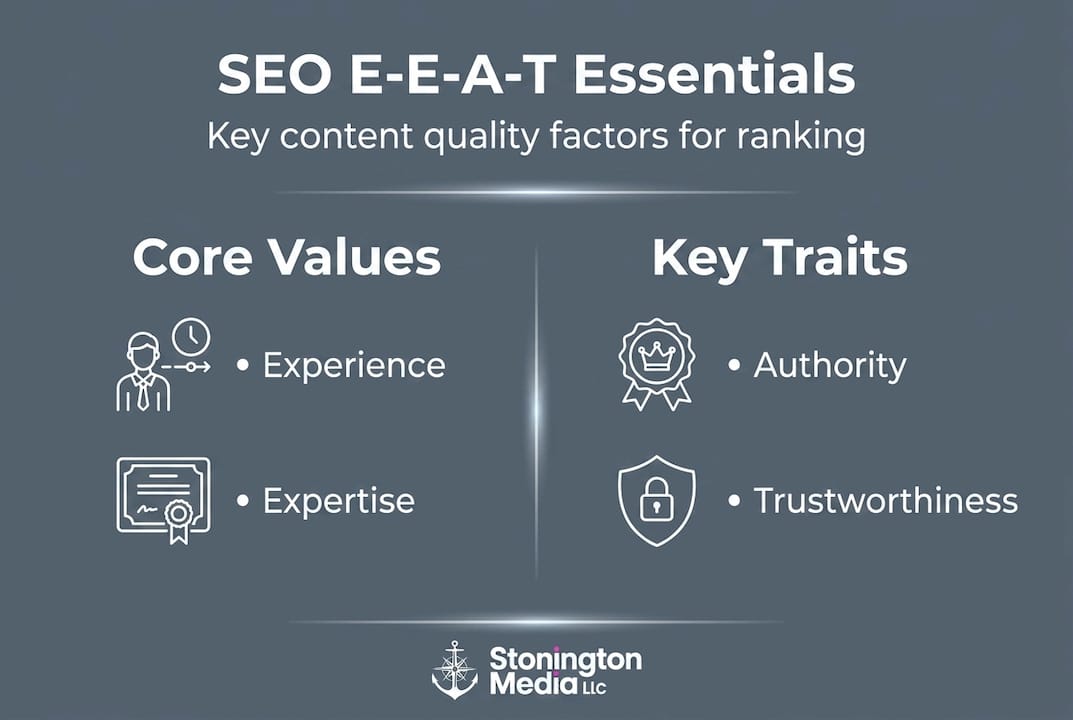
Google’s own guidelines now emphasize E-E-A-T content standards, which stands for Experience, Expertise, Authoritativeness, and Trustworthiness. That shift means search engines are increasingly rewarding content that reflects real human knowledge and genuine business credibility, not content that simply repeats a phrase enough times to trip a ranking algorithm. If you want to understand the full scope, a clear look at SEO basics for small businesses reveals just how much of it comes down to communication rather than technical tricks.
What actually shapes SEO performance is a combination of factors: the clarity of your website messaging, the structure of your pages, the relevance of your content to what buyers actually need, and the experience visitors have once they arrive. Keywords matter, yes, but they are one input in a much larger equation.
Consider website messaging clarity as an example. A service page that speaks directly to what a buyer needs, uses language they recognize, and answers the questions they bring to a search will naturally include the right phrases. That page will also keep visitors engaged longer, reduce bounce rates, and generate the behavioral signals that tell search engines the content is worth ranking. None of that requires keyword stuffing. It requires good communication.
“The businesses that win at SEO are the ones that make their content genuinely useful to real people, not the ones that engineer their way to rankings.”
Here is a clearer way to think about the landscape of what SEO actually includes:
- Website structure and how easily search engines can read and index your pages
- Service page content aligned with what buyers search for at different stages of their decision
- Blog and article content that builds topical authority over time
- Technical elements like page speed, mobile responsiveness, and clear URL structure
- Off-page factors like backlinks and business directory listings
- Behavioral signals from visitors, including time on page, click-through rates, and return visits
The common misconception is that addressing one or two of these is enough. It is not. Real SEO performance for a small business comes from addressing the full picture, with the heaviest investment going where buyers actually convert.
With this clarity on SEO’s broader scope, let’s explore how messaging sets the foundation.
Clear messaging: The core of SEO and lead generation
If SEO is the house, messaging is the foundation. Without it, everything else shifts. Clear, specific, buyer-focused messaging makes your content relevant to both the people reading it and the search engines indexing it. Vague language, meanwhile, performs poorly on both fronts.
Human-first content with real data and genuine experience outperforms AI-generated generics precisely because it answers the real question a buyer is asking. A homepage that says “We deliver exceptional solutions for your needs” tells no one anything useful. A homepage that says “We help independent accountants stop losing clients to larger firms through stronger digital messaging” speaks directly to a person with a specific problem.
The difference in SEO impact is significant. Specific language naturally incorporates the phrases buyers use in searches. It creates relevance signals that generic content cannot replicate. And it builds the trust that turns a visitor into a lead.
Here is a framework for evaluating your own messaging. Ask three questions about every major page: Is it immediately clear what you offer? Is it obvious who it is for? Does it explain the specific result a buyer can expect? If any answer is uncertain, the messaging needs work.
A practical comparison shows how this plays out:
| Page element | Weak messaging | Strong messaging |
|---|---|---|
| Headline | “Welcome to our website” | “Email sequences that book 20% more consultations” |
| Subheading | “We offer a range of services” | “For coaches and consultants ready to convert more leads” |
| Call to action | “Learn more” | “See how it works for your industry” |
| Body copy | “Our team has years of experience” | “We’ve helped 40+ service businesses rewrite their email funnels” |
Strong messaging connects the story-driven messaging tips that move buyers emotionally to the specific, factual claims that earn their trust. Both elements need to be present.
For the buyer intent funnel specifically, think about how the language shifts depending on where someone is in their decision. A person researching a problem uses different words than a person ready to buy. Informational searches (“why is my website not generating leads”) look different from commercial searches (“website messaging service for consultants”) and transactional searches (“hire messaging copywriter”). Your headlines and calls to action should reflect those stages explicitly.
Pro Tip: Review your five most important pages and read the headlines aloud. If a stranger could not tell exactly what you do and who you help within ten seconds, rewrite those headlines before touching anything else on your SEO strategy.
There are also online marketing clarity ideas worth exploring if you want a broader set of frameworks for bringing your messaging into sharper focus. The principles overlap significantly with what drives both SEO relevance and lead conversion.
With messaging as your strategic base, selecting the right keywords is the next lever.
Choosing the right keywords for your business
The word “keyword” implies simplicity, as if finding the right term is all it takes. But the real skill is understanding what a keyword signals about the buyer’s mindset and matching your content accordingly.
Commercial and local keywords drive more business results for small companies than broad terms ever will. A plumber optimizing for “plumbing” is competing against national brands, directories, and industry giants with enormous content budgets. A plumber optimizing for “emergency pipe repair in Hartford” is speaking directly to someone ready to hire today.
The buyer intent funnel breaks down keyword types into three levels. Transactional keywords signal the buyer is ready to act now (“hire,” “buy,” “get a quote,” “book a call”). Commercial keywords signal comparison and evaluation (“best,” “review,” “vs,” “top”). Informational keywords signal research (“how to,” “what is,” “why does”). Each level represents a different stage of the buying journey, and your content needs to address all three, with the heaviest emphasis on transactional and commercial.
Here is a practical example of how that looks across different intent levels:
| Intent type | Example keyword | What it signals | Best page type |
|---|---|---|---|
| Transactional | “book email marketing consultant” | Ready to hire | Service page with strong CTA |
| Commercial | “best email platform for small business” | Comparing options | Comparison or review page |
| Informational | “how does email marketing work” | Early research | Blog article or FAQ page |
| Local | “marketing agency in New London CT” | Geographic intent | Local service page |
The practical steps to find and apply buyer-intent keywords follow a logical sequence:
- List the specific services you offer, not categories, but the actual deliverables (email sequence setup, landing page rewrite, messaging audit).
- Pair each service with location terms if your business serves a defined geography.
- Add qualifier words that signal intent: “hire,” “cost,” “near me,” “best,” “reviews.”
- Use free tools like Google Search Console or the “people also ask” section in search results to find variations buyers actually type.
- Assign one primary keyword to each service page and write the content around the buyer’s intent at that stage.
Keyword targeting tips can sharpen this process further, particularly for businesses that offer multiple services across different buyer segments.
The data is clear on where effort should concentrate: service pages demand 70% of your SEO effort, not blog posts. Blog content builds authority over time, but service pages are where buyers convert. That distinction drives how you allocate your keyword strategy.
Now, see how email marketing integrates with SEO to amplify results.
Integrating email marketing with SEO for exponential gains
Most businesses treat SEO and email marketing as separate channels managed by different people with different goals. That separation leaves real results on the table. When these two channels work together, the gains compound in ways that neither delivers alone.

The core mechanism is repurposing. An article or service page that ranks well for a valuable keyword represents real authority. That same content, reshaped for an email campaign with a UTM tracking link embedded, drives targeted traffic back to the page. The return visits generate behavioral signals like extended time on page and low bounce rates that reinforce the page’s ranking. You get double value from a single piece of content.
Integrating email and SEO produces measurable results when done with intention. EasyJet ran a segmentation campaign that generated a 25% lift in click-through rates and doubled open rates by tailoring content to specific subscriber behaviors. That level of engagement sends powerful signals about content quality, and those signals extend beyond the email to influence how pages are perceived across digital channels.
Here are the most actionable ways to connect the two channels:
- Embed UTM parameters in every link you send from email campaigns so you can track exactly how much SEO content traffic comes through email referrals.
- Use your email subject line A/B tests as a research tool for meta title optimization; the subject lines with the highest open rates often translate directly into compelling page titles.
- Place strategic opt-in prompts on your highest-ranking pages to capture email subscribers from your most visible organic traffic.
- Segment your email list by behavior, interest, or buyer stage, and send tailored content to each group for higher engagement rates.
- Optimize both email templates and landing pages for mobile viewing, since mobile optimization standards affect SEO rankings and email deliverability simultaneously.
“Email segmentation is not a nice-to-have. It is one of the most reliable ways to improve both the perceived quality of your content and the behavioral metrics that search engines use to evaluate your pages.”
Pro Tip: Look at your top five organic traffic pages right now. If none of them have an email capture mechanism, you are converting visitors into anonymous traffic instead of subscribers you can nurture. Add a simple, contextually relevant opt-in to each one this week.
The resources on email list growth tips and email list cleaning advice complement this integration well. A growing list of engaged subscribers amplifies your SEO content’s reach, while a clean list ensures your behavioral signals reflect real engagement rather than inactive accounts skewing your data.
With email and SEO amplifying each other, optimizing your workflow becomes easier.
SEO and content workflow: What to prioritize for maximum impact
Knowing the strategy is one thing. Building a repeatable workflow around it is what creates sustained results. For small businesses with limited time and resources, the workflow has to be simple enough to actually execute without a full marketing team.
The starting point is the 70% rule. Service pages deserve roughly 70% of your total SEO content effort. That means writing, refining, updating, and optimizing your core service pages should take priority over producing weekly blog posts that dilute your focus. One excellent service page that converts visitors consistently outperforms ten generic articles that nobody reads.
The quarterly update cycle is the mechanism that keeps those service pages performing over time. Markets shift. Buyer language evolves. Competitors improve their own content. A service page written eighteen months ago may still rank, but its conversion rate may have fallen because the messaging no longer reflects how buyers talk about their problems today. Reviewing and refreshing each major page every quarter keeps the content alive and relevant.
Here is a practical workflow for small businesses to follow:
- Audit your five to eight core service pages and identify the primary keyword and buyer intent for each one.
- Rewrite or refresh any page where the headline does not clearly match what a buyer in that intent stage would search for.
- Add first-person experience, case examples, or specific outcomes to each page to strengthen E-E-A-T signals.
- Identify your highest-ranking pages and create one email campaign per quarter that drives traffic back to those pages with relevant, segmented content.
- Review the performance of each page and email campaign at the end of the quarter, then adjust the messaging based on what engaged visitors and what did not.
The email growth workflow connects naturally to this cycle. Every time you update a service page, that update becomes content worth emailing to your list. You create a feedback loop where your SEO efforts produce email content, and your email campaigns strengthen your SEO performance.
Pro Tip: Document your own experience, outcomes, and client results in a simple shared document before writing or updating any content. First-person data and specific anecdotes are the most defensible form of E-E-A-T content because no AI can replicate your actual experience. Use those details to open every service page.
This workflow does not require a large budget or a dedicated marketing hire. It requires consistency and the discipline to prioritize the pages that actually drive business over the content that simply fills a publication calendar.
Now, see how expert perspective reimagines these strategies for real-world success.
The uncomfortable truth: Most small business SEO advice is backwards
Here is something worth saying plainly. The vast majority of SEO advice that reaches small business owners focuses on the wrong things. It obsesses over keyword density, backlink counts, and posting frequency. It treats content as a volume game and expects rankings to follow. That approach worked in 2012. It does not work the same way now.
The businesses that consistently generate leads through search are not the ones publishing the most content. They are the ones that have taken the time to understand what their buyers actually need, written service pages that speak to those needs clearly, and built email systems that extend the reach of their best content to the right audiences.
Website storytelling perspective reveals something most SEO guides miss entirely: people do not convert because they found your page. They convert because your page told them something that felt true to their situation. That emotional resonance is the result of good messaging, not good keyword selection.
The synergy between email and SEO is where we see some of the most significant real-world results. Email keeps your audience returning to your best content. Return visits signal quality to search engines. Higher quality signals lead to stronger rankings. Stronger rankings bring in new organic visitors who can join your email list. The loop is self-reinforcing when you build it intentionally.
The hard-won lesson from working with service businesses is this: quarterly, user-focused content updates to existing pages consistently outperform the strategy of starting a new blog series every January. Buyers do not care how much content you have. They care whether the one page they land on actually answers their question and makes it easy to take the next step. That is a messaging problem, not a volume problem.
Most small businesses do not need more content. They need clearer content on the pages that already exist, connected to an email system that keeps the right people coming back. That reframe changes how you allocate your time, your budget, and your creative energy.
Take your SEO and email to the next level with proven guides
You now understand that SEO success is really a messaging and strategy problem, not just a rankings puzzle. The real work happens when you clarify your service pages, connect them to a smart email system, and update them with genuine experience and data on a consistent cycle.
If you are ready to move from understanding to execution, Stonington Media has resources built specifically for businesses in this position. The clear messaging guide walks through how to rewrite your website so buyers immediately understand what you offer and why it matters to them. The website storytelling resources take that further by showing how narrative structure builds trust and drives action. And if you are evaluating which email platform fits your business, the email platform comparison gives you a clear, honest breakdown of your options. Each resource is designed to help you take the next practical step.
Frequently asked questions
How can email marketing improve SEO?
Email marketing amplifies SEO by driving targeted return traffic to your highest-performing pages, generating behavioral signals like time on page and low bounce rates that reinforce search rankings, and helping you grow a subscriber list from your existing organic visitors.
What is E-E-A-T in SEO?
E-E-A-T stands for Experience, Expertise, Authoritativeness, and Trustworthiness, and it represents the quality framework Google uses to evaluate whether content is genuinely useful and credible, favoring pages with real first-person experience and specific data over generic or AI-generated content.
How often should small businesses update their website content for SEO?
Quarterly content updates are the recommended standard for keeping service pages fresh, relevant, and aligned with how buyers currently search, which sustains rankings and improves conversion rates over time.
What keywords should small businesses target for SEO?
Commercial and local keywords that align closely with buyer intent deliver the strongest results for small businesses, while broad, highly competitive terms tend to attract traffic that is too early in the research phase to convert reliably.
Recommended


Additional Reading:
- What is professional screenplay coverage (and do you actually need it?)
- What is professional screenplay coverage, really?
- How to Know If Your Screenplay Concept Is Strong Enough
- Why Most Second Acts Collapse (And How Coverage Detects It)
- How Professional Readers Evaluate Character Arcs
- Is Your Script Marketable?
Indexes: