

Why Your Website Isn’t Generating Leads (And What’s Actually Breaking)
I used to think the problem was traffic.
When a business owner told me their website wasn’t generating enough leads, my first instinct was to look at visitor numbers. Low traffic meant low conversions. Simple math. But after working with dozens of small and medium-sized businesses, I realized something uncomfortable: most of the time, traffic wasn’t the issue at all.
The issue was what happened after someone arrived.
Here’s what I mean. On average, only 2% of B2B website traffic converts into leads. That means 98% of your visitors disappear without leaving a trace. They land on your site, look around for a few seconds, and leave. You don’t know who they were, what they wanted, or why they didn’t reach out.
Most business owners normalize this. They assume it’s just how websites work. But it’s not inevitable. It’s structural failure.
The Problem Happens Before Anyone Reads a Word
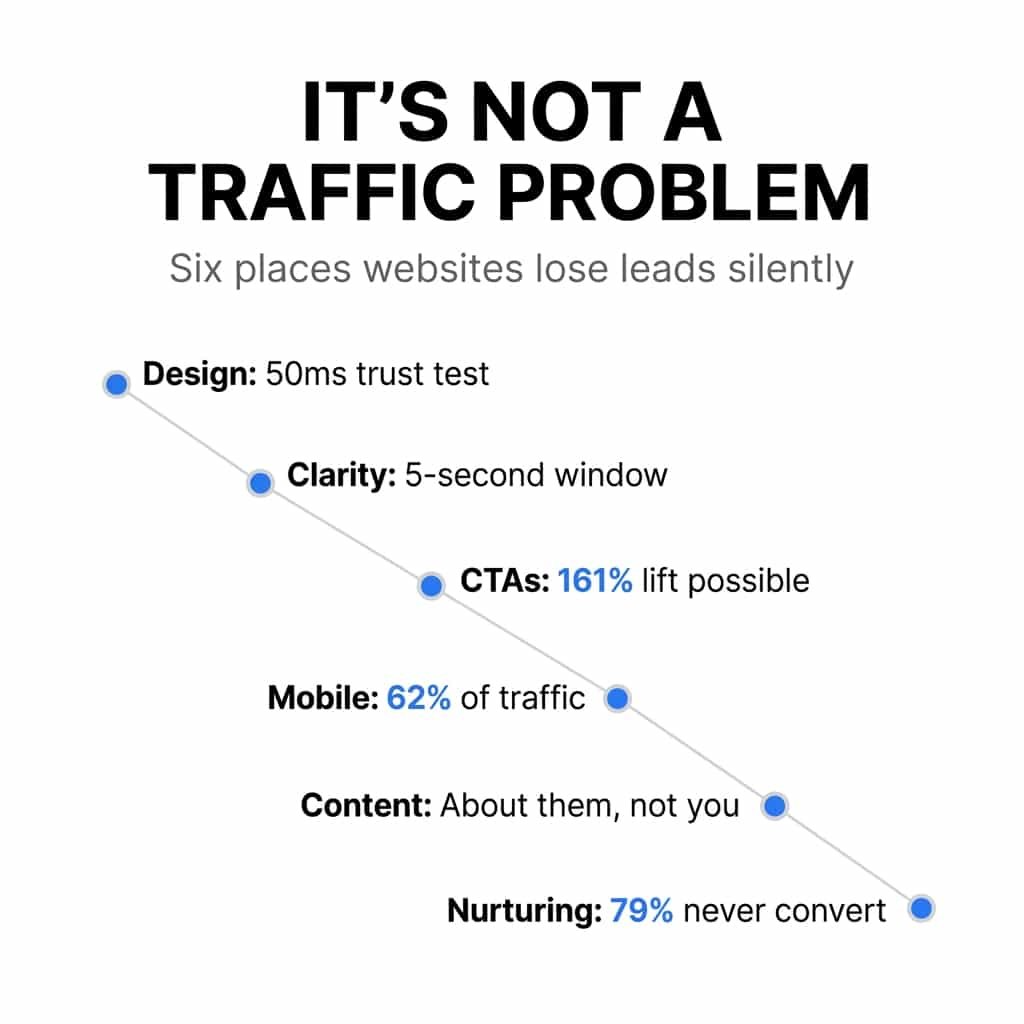
Visitors make trust judgments about your business in 50 milliseconds. That’s faster than it takes to read a single sentence. Before they process your headline, your value proposition, or your call to action, they’ve already decided whether your site looks credible.
If your website looks dated, cluttered, or cheap, that’s what they think about your business. It doesn’t matter how good your actual work is. The first impression isn’t about your services. It’s about whether they trust you enough to keep reading.
94% of first impressions are design-related.
This isn’t about aesthetics for the sake of looking modern. It’s about whether the structure holds together visually. When design breaks down, trust breaks down. When trust breaks down, people leave.
I’ve seen businesses invest heavily in SEO, content marketing, and paid ads to drive traffic to websites that were actively repelling visitors the moment they arrived. The traffic showed up. The site just didn’t hold them.
Clarity Breaks Faster Than You Think
Even if your design passes the trust test, you have about five seconds before the next breakdown happens.
61% of website visitors say they’ll switch to a different site if they can’t find the information they’re looking for within five seconds. Not five minutes. Five seconds.
When someone lands on your homepage, they’re asking a simple question: Is this for me?
If your messaging doesn’t answer that question immediately, they’re gone. They’re not going to dig through your About page or scroll to the bottom to figure out what you do. They’re going to leave and find a competitor whose site makes sense faster.
The breakdown isn’t about being unclear in some abstract sense. It’s about failing to orient the visitor quickly enough. When people don’t know where they are or what to do next, they drift. Always.
I’ve watched this happen in real time during user testing sessions. Someone lands on a homepage, pauses for three seconds, scrolls once, and closes the tab. When I ask them why, they say something like, “I didn’t really get what they did.” The business owner thinks their messaging is clear because they’ve been staring at it for months. But the visitor experiences it the way a stranger does. And strangers don’t have context.
Your Call to Action Is Probably Invisible
Let’s say your visitor makes it past the design test and the clarity test. They understand what you do. They’re interested. Now what?
This is where most websites go silent.
A well-crafted call to action can increase conversion rates from 2.4% to 11.5% or higher. But most sites either bury their CTAs, make them too vague, or skip them entirely.
I see this constantly. A homepage with great copy, solid design, and no clear next step. The visitor reads everything, nods along, and then… leaves. Because they don’t know what you want them to do.
“Contact us” isn’t enough. “Learn more” doesn’t tell them what happens next. “Submit” could mean anything. When the CTA is generic, people hesitate. And hesitation kills conversion.
Using a specific, clear CTA can increase conversion rates by 161%.
The difference between “Get a Free Website Audit” and “Submit” isn’t just semantic. It’s the difference between giving someone a reason to act and asking them to guess what happens if they click.
Personalized CTAs convert 202% better than generic ones. When the message speaks directly to what the visitor needs, engagement transforms. But most business owners write CTAs from their own perspective, not the visitor’s. They say what they want instead of what the visitor gets.
Mobile Is Where Half Your Leads Disappear
Almost 62% of all online users access websites through mobile devices. If your site isn’t optimized for mobile, you’re actively turning away more than half of your potential leads.
But here’s the thing most people miss: mobile optimization isn’t just about responsive design. It’s about speed, readability, and friction.
Mobile conversion rates sit at 1.8%, compared to 3.9% on desktop. That gap exists because most mobile experiences are slow, unresponsive, or frustrating. Buttons are too small. Forms are too long. Pages take forever to load.
A page that takes five seconds to load has a 90% higher bounce rate than a page that loads in one second. Slow pages lose visitors before your offer is even seen. Page speed isn’t a technical issue. It’s a lead generation issue.
I’ve audited sites where the desktop experience was flawless but the mobile version was a disaster. The business owner had no idea because they only ever looked at their site on a laptop. Meanwhile, half their traffic was bouncing because the mobile experience felt broken.
Content That Talks About You Doesn’t Generate Leads
Most business websites are built around what the company wants to say, not what the visitor needs to know.
The homepage talks about the company’s history, values, and team. The services page lists features without explaining why they matter. The blog posts are announcements about internal milestones. None of it answers the question the visitor actually has: Can you solve my problem?
Educational content in B2B blogs generates 52% more organic traffic than company-focused content. When you stop talking about yourself and start addressing what the visitor needs to know, the structure starts working.
Content marketing generates three times more leads than traditional outbound marketing while costing 62% less. Sites that publish valuable, educational content generate 68% more leads than those without active blogs.
But valuable doesn’t mean long. It means relevant. It means answering the questions your prospects are already asking. It means showing them you understand their problem before you pitch your solution.
I’ve seen businesses write dozens of blog posts that generate zero leads because every post was about their own services. They weren’t creating content for their audience. They were creating content for themselves.
Lead Nurturing Is Where Most Businesses Go Silent
79% of marketing leads never convert into sales due to ineffective lead nurturing. The breakdown isn’t in traffic volume. It’s in what happens after someone shows interest.
Someone fills out a contact form. You send them a generic “Thanks for reaching out” email. Then nothing. No follow-up. No value. No reason for them to stay engaged.
61% of marketers say generating quality leads is their top challenge. But the real issue isn’t getting visitors. It’s knowing what to do with them once they arrive.
Lead nurturing isn’t about sending more emails. It’s about maintaining relevance over time. It’s about showing up with value at the moments when someone is ready to move forward. Most businesses treat lead generation like a one-time event. But buying decisions happen over weeks or months, not seconds.
The businesses that win are the ones that stay present without being pushy. They send helpful resources. They answer questions before they’re asked. They build trust incrementally instead of demanding commitment upfront.
What Actually Fixes This
The pattern I see over and over is this: business owners focus on what’s easy to measure instead of what’s actually broken.
They obsess over traffic numbers because traffic is visible. But traffic doesn’t matter if the experience doesn’t hold together. They add more content without fixing the clarity problem. They redesign the homepage without rethinking the call to action. They invest in ads without optimizing for mobile.
The fixes aren’t complicated. But they require honesty about what’s not working.
Start by experiencing your site the way a stranger does. Open it on your phone. Pretend you don’t know what your company does. Can you figure it out in five seconds? Is the next step obvious? Does the design make you trust the business?
If the answer to any of those questions is no, that’s where you start. Not with more traffic. Not with more content. With the structure that’s supposed to hold everything together.
Because if the message doesn’t land, nothing else matters.
What would change if you fixed the experience instead of chasing more visitors?


Additional Reading:
- What is professional screenplay coverage (and do you actually need it?)
- What is professional screenplay coverage, really?
- How to Know If Your Screenplay Concept Is Strong Enough
- Why Most Second Acts Collapse (And How Coverage Detects It)
- How Professional Readers Evaluate Character Arcs
- Is Your Script Marketable?
Indexes: