

The essential parts of a screenplay pros use to get noticed
A screenplay isn’t a novel that happens to have a lot of dialogue. It’s a technical document. A blueprint. The core parts of a screenplay—the scene heading, action lines, character name, and dialogue—are the load-bearing walls of that blueprint, and they’re formatted in a very specific way for a very good reason.
Why screenplay formatting is more than just rules

Ever wonder what separates a script that gets passed on from one that gets a real look? A lot of the time, it’s the small stuff. It’s the quiet, fundamental understanding of how all the parts of a screenplay work together. A script isn’t literature. It’s a practical tool used by dozens of people to build a movie.
Think of it this way: handing a producer a poorly formatted script is like giving a master carpenter a crayon sketch on a napkin and expecting a house. They might see an interesting idea in there, but they can’t build from it. The instructions are missing, the measurements are a mess, and it just signals more work for them, not less.
Speaking the language of film
Learning screenplay format isn’t about memorizing arbitrary rules. It’s about learning to speak the working language of the film industry. When a reader—an agent, a manager, a producer—opens your file and sees clean, professional formatting, it sends an instant signal: this writer knows what they’re doing.
It shows you respect their time and understand that a script is the starting point for a huge collaboration. Every single element on the page is there for a reason.
- Clarity: Good formatting removes all guesswork. It tells the crew exactly where we are, what we’re seeing, and who’s talking. No ambiguity allowed.
- Pacing: The white space on the page, dictated by format, is a pacing tool. Short, sharp action lines make the read feel fast. Denser blocks slow it down. You’re controlling the reader’s rhythm.
- Professionalism: A script that looks right proves you’ve done your homework. It suggests you’re serious about the craft and won’t be a liability on a production.
A professional reader can tell within the first five pages if a writer understands the job. Formatting is usually the first and most obvious giveaway. It’s the handshake, the first impression you make before your story even gets a chance to breathe.
This guide isn’t another list of rules to follow. The goal here is to get you to stop thinking about “writing a story” and start thinking about “building a film on paper.” We’re going to break down each of the parts of a screenplay, not just to define them, but to show you why they exist and how they work as tools to get your vision from your head onto the screen.
Laying the blueprint with scene headings and action
If a screenplay is the blueprint for a film, then the first marks on that plan are the Scene Heading and the Action Line. These two elements are the absolute bedrock of your script. They answer the ‘where and when’ and the ‘what happens’ of your story, and getting them right isn’t just a good idea—it’s non-negotiable.
Think of the Scene Heading as a quick GPS coordinate for the reader. It’s the first thing they see before a new scene, and its only job is to ground them instantly. There’s no time for confusion; it has to be clear, concise, and brutally consistent.
The anatomy of a scene heading
Every scene heading, sometimes called a slugline, contains three specific pieces of information. They always appear in the same order, and they are always in all caps. This isn’t about creative expression; it’s a simple, rigid formula that removes all guesswork for the production team.
- INT. / EXT. This tells us if we’re inside (Interior) or outside (Exterior). Simple as that.
- LOCATION: Where are we? A COFFEE SHOP, A MOVING CAR, THE SURFACE OF MARS. Be specific but brief. “JOHN’S APARTMENT – KITCHEN” is much better than just “APARTMENT.”
- TIME OF DAY: This is almost always just DAY or NIGHT. You can occasionally use DUSK or DAWN if it’s truly meaningful to the story, but stay away from anything poetic like “LATE AFTERNOON.”
A correctly formatted scene heading looks like this:
INT. COFFEE SHOP - DAY
Or maybe this:
EXT. CITY STREET - NIGHT
The format is so rigid for a reason. A producer breaks a script down using these exact headings to create shooting schedules and budgets. They need to know at a glance how many “INT. DAY” scenes they have versus “EXT. NIGHT” scenes, because the latter are often far more expensive to light and shoot.
Getting this wrong is one of the quickest ways to signal that you’re an amateur. Thankfully, screenwriting software automates this. All that precision matters. Minor errors here can cause major confusion on set, and in a competitive market, you don’t want to give a reader any reason to stop reading.
Painting the picture with action lines
Right after you’ve set the location, you have to show us what’s happening. That’s the job of the Action Line, and it is always, always written in the present tense. You’re not telling a story that happened; you’re describing an event as it unfolds for the audience, right now.
Action lines are where you direct the movie in the reader’s mind without ever using a camera direction. The trick is to write only what the audience can see or hear. This is not the place for a character’s internal thoughts or backstory.
Bad:
John thinks about the argument he had with his boss earlier.
Good:John stares at his phone, his jaw tight. He types a furious text, then deletes it.
The first example is unfilmable. The second gives the actor something to perform and reveals the character’s internal state through observable action. That’s the entire game.
Good action writing is an exercise in economy. It’s about picking the most powerful verbs and evocative details to paint a picture with as few words as possible. Long, dense paragraphs of description are a cardinal sin. On the page, they look like a wall of text and make the read feel slow and laborious.
Break your action into short, punchy paragraphs—ideally no more than three or four lines each. This creates white space on the page, which does a funny thing: it visually quickens the pace of the read. A single, isolated line can deliver a powerful punch.
For example:
The door creaks open.
No one is there.
That use of white space is a powerful tool for controlling rhythm and building suspense. Each new paragraph can almost feel like a new camera shot, guiding the reader’s eye exactly where you want it to go. The goal is to make reading your script feel like watching the movie. You can also learn more about what makes a scene work in our article on scene design.
By mastering these two simple but essential parts of a screenplay, you’re laying down a clear, professional foundation. It’s on this foundation that the rest of your story—your characters and your dialogue—can truly come to life.
Action lines and scene headings are the blueprint. They build the world, lay out the space, and block the movement. But a script doesn’t have a pulse until people start talking. This is where characters and dialogue come in, and it’s often the place where a promising script either finds its soul or goes completely flat.
But before anyone can say a word, you have to introduce them.
First impressions on the page
When a new character walks into your story, their name gets a one-time-only treatment: ALL CAPS within an action line. Think of it as a quiet flag for the entire production team, from the casting director to the costume designer. It’s a simple, standardized signal that a new player has just entered the game.
After that first moment, their name goes back to normal in all subsequent action lines.
The format is clean and direct:
The cafe door swings open. ANNA (30s), a whirlwind of nervous energy, scans the room. She spots her target.
From here on out, she’s just Anna. That initial description isn’t her life story; it’s a quick, filmable snapshot of her essence. It’s just enough to get an image in the reader’s head.
The voices of the story
When a character speaks, their name appears centered above their lines. This is the Character Cue (or Character Name), and it’s always in ALL CAPS. Consistency here is non-negotiable. If you introduce “JIMMY” on page 10, don’t call him “JIM” on page 40. That’s a simple mistake that creates real headaches during a script breakdown.
Beneath the name sits the dialogue itself—the words that show us who these people really are. Writing good dialogue is a tightrope walk. It needs to feel natural, like something a person might actually say, but it’s doing an immense amount of work beneath the surface.
Great dialogue doesn’t just pass along information. It reveals character, drives the plot forward, and builds tension—often all at once. The best lines are loaded with subtext, where what a character isn’t saying speaks volumes.
A classic amateur mistake is writing “on-the-nose” dialogue, where people announce their feelings and intentions perfectly. Real people rarely do that. We hint, we deflect, we talk around things. Your characters should, too.
That little dash of direction (The Parenthetical)
Sometimes you need to clarify how a line is delivered or what a character is doing while they speak. That’s the job of the Parenthetical. It’s a short, specific descriptor tucked in parentheses right under the Character Cue.
It looks like this:
ANNA
(forcing a smile)
It’s so good to see you.
The key word here, though, is sparingly. Leaning too heavily on parentheticals is a sign of an insecure writer. It reads like you’re trying to micromanage the actor’s performance, and it clogs up the page, slowing the read to a crawl.
Only use a parenthetical when the action or tone isn’t already obvious from the context.
- (sarcastically): Use this only if the sarcasm isn’t already baked into the words.
- (to herself): This is useful in a group scene to clarify who a line is intended for.
- (beat): This indicates a deliberate, meaningful pause in speech.
Trust your writing. If you’ve built a strong scene, the emotion is already there in the words. An actor will see the line “I hate you” and know how to play it without you adding (angrily) underneath. When used with precision, these elements—Character Cues, Dialogue, and Parentheticals—give your story its distinct and unforgettable voice.
The invisible architecture of act structure and sequences
If you’ve mastered the physical pieces of a script—scene headings, action, dialogue—you know how to build the rooms. But a story isn’t just a collection of rooms. It needs a foundation and a floor plan. This is the invisible architecture that holds it all together: act structure and sequences.
The framework you’ll hear about most is the three-act structure. It’s not a rigid formula that guarantees a great story. Think of it as a psychological map that has guided audiences on journeys for centuries, from ancient plays to modern blockbusters, simply because it works.
The rhythm of three acts
At its core, the three-act structure is a basic promise you make to the audience. You show them a world, you turn that world upside down, and then you clean up the mess. Each act has a specific job to do in managing the story’s momentum and the audience’s investment.
-
Act One (The Setup): This is the “before” picture. We meet the characters in their ordinary world, learn the rules, and get a feel for what’s missing in their lives. The act closes with the Inciting Incident, the moment that shatters the status quo and shoves the protagonist onto a new, unavoidable path.
-
Act Two (The Confrontation): This is the long, messy middle where the real story lives. The protagonist tries to solve their problem, but every attempt just makes things worse. This act is all about rising stakes, failed plans, and new obstacles, all driving toward the Midpoint—a major pivot that often changes the goal or raises the stakes to an intensely personal level.
-
Act Three (The Resolution): After hitting rock bottom at the end of Act Two, the protagonist finds the will for one last showdown. This is where the story’s central question gets its answer, the climax pays off everything that came before, and we get a glimpse of the character’s “new normal.”
The table below offers a simplified look at how these acts function across a typical script.
Three-Act Structure Breakdown
| Act | Typical Page Count (for 105 pages) | Core Function | Key Story Beats |
|---|---|---|---|
| Act One | Pages 1-25 | Establish the world and the problem | Normal world, introduction of characters, Inciting Incident |
| Act Two | Pages 26-85 | Escalate the conflict and raise the stakes | Rising action, Midpoint, false victories, lowest point |
| Act Three | Pages 86-105 | Resolve the central conflict | Final push, Climax, aftermath, new normal |
This structure is so baked into the business that it affects the entire production pipeline. It’s why modern scripts tend to be a bit leaner, and it helps explain why familiar story rhythms feel so satisfying to an audience. The market for screenwriting software is built around helping writers manage this very architecture. You can read more about these storytelling fundamentals in our comprehensive guide to story structure.
Breaking it down with sequences
Staring at a blank page and thinking about filling a 60-page Act Two is enough to give anyone paralysis. This is where thinking in sequences will save you. A sequence is just a string of scenes—usually running about 10-15 pages—that works like a “mini-movie” inside your script.
Each sequence has its own clear goal, a cluster of conflicts related to that goal, and a resolution that cleanly pushes the story into the next sequence. It has a beginning, a middle, and an end.
Take a heist movie, for instance. A sequence might be “Recruiting the Team.”
- Beginning: The leader realizes they need a master safecracker.
- Middle: They find the best one, but she refuses. They have to persuade, blackmail, or outsmart her to get a “yes.”
- End: The safecracker is in. The team is now stronger, and we’re one step closer to the main goal.
This is the macro-level view. It’s how you assemble big narrative chunks. On the page, however, it’s still built from the micro-level elements we’ve already discussed.
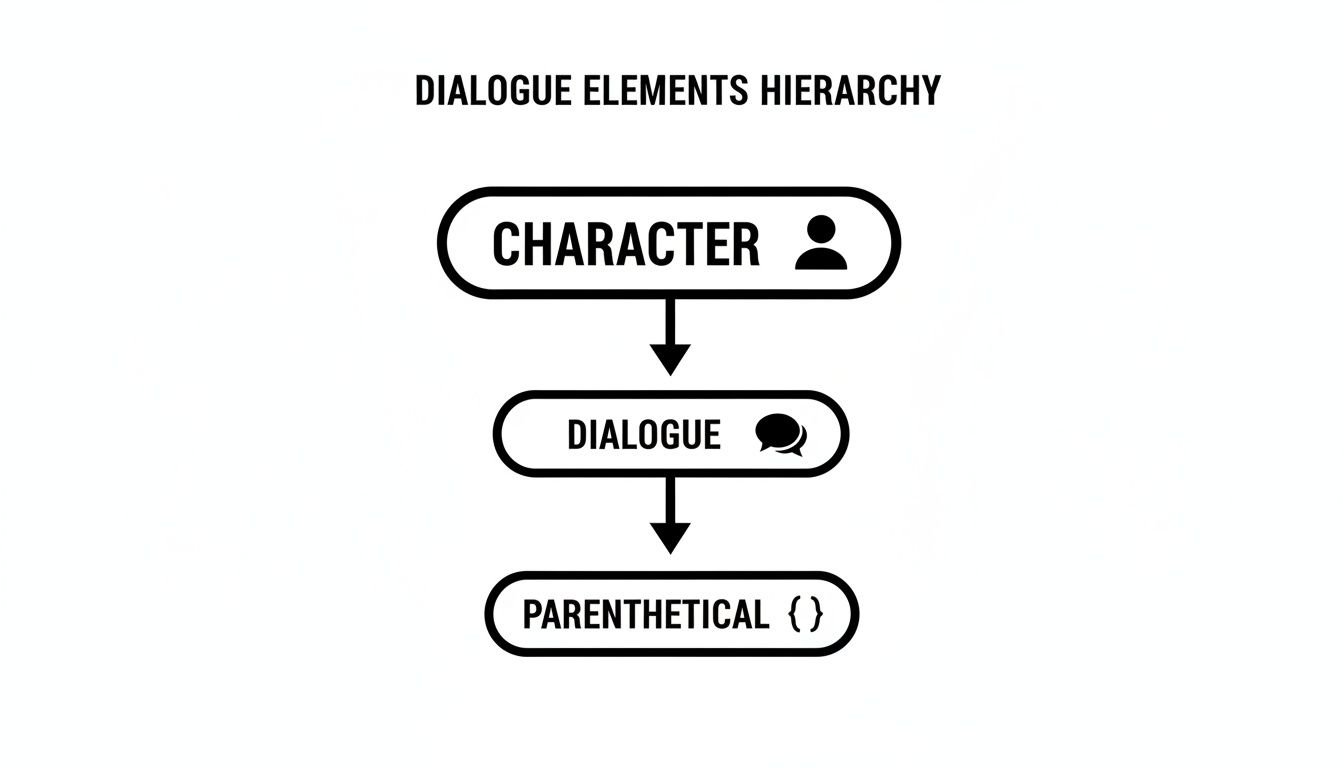
The diagram above shows how those tiny pieces—who is speaking, what they say, and how they say it—fit together. These are the bricks you use to build scenes, and scenes are what you use to build sequences.
Thinking in sequences helps you manage pacing and build momentum. Instead of writing a wandering collection of scenes, you start creating a focused narrative where each part builds on the last, pushing your story relentlessly toward its conclusion.
Special formatting for transitions, montages, and more

Once you have a handle on scenes, action, and dialogue, you start getting into the more specialized tools. These are the formatting tricks you won’t need on every page, but knowing when to pull them out shows you’re thinking visually and controlling the pace of the read.
Think of them like a film editor’s techniques. Most of the time, a simple cut from one shot to the next does the job. But sometimes, you need a slow dissolve or a rapid-fire montage to create a specific feeling. That’s what these elements are for.
The most common—and most frequently misused—of these is the Transition. You know them when you see them: CUT TO:, DISSOLVE TO:, or FADE OUT. on the right side of the page, always in ALL CAPS.
Here’s the thing, though: in modern screenwriting, the default is to use them almost never. A new scene heading implies a cut. That’s it. In 99% of cases, the reader’s brain makes the jump without any help.
Overusing transitions like
CUT TO:is one of the fastest ways to signal you’re an amateur. It clutters the page and feels like you don’t trust the reader. Save them for when the type of transition is a storytelling choice, like a slowDISSOLVE TO:to signal a meaningful passage of time.
Handling time and technology on the page
Sometimes you need to show a process or a series of events happening over time without writing five different scenes. That’s what a Montage is built for. You just write MONTAGE as its own line, then list a series of quick, distinct shots.
It’s basically a highlight reel embedded in your script.
MONTAGE
A) A half-built treehouse, splintered wood everywhere.
B) ANNA reads a “Woodworking for Dummies” book, frustrated.
C) She hammers a nail, smashing her thumb.
D) The finished treehouse, crooked but standing. Anna smiles, exhausted.
In a handful of lines, you’ve told a complete mini-story of struggle and success.
But what about the technology that fills our lives? Phone calls and texts have their own simple conventions.
-
Phone Calls: If you’re cutting back and forth between two people on the phone, you can use an INTERCUT. Establish both locations once, then use the INTERCUT heading. After that, you can just alternate character names without new scene headings until the call ends.
-
Text Messages: The cleanest method is to just describe it in the action line. For example:
CLOSE ON CHLOE'S PHONE. A new text from MARK. It reads: "We need to talk."No fancy formatting needed. -
On-Screen Text: For things like a location graphic, just use a simple slug.
CHYRON: Paris, Francetells the reader exactly what to picture on screen.
Mastering these isn’t about showing off your formatting knowledge. It’s about using every tool you have to direct the movie inside the reader’s head. Knowing when to deploy a Montage and when to just let a scene change do the work shows you’re not just typing a script—you’re crafting a film on the page.
Putting it all together for a professional polish
So, you typed FADE OUT. You’ve wrestled every act, scene, and sequence into place. Your characters have arcs. The dialogue is on the page. For a moment, there’s relief. And then a familiar, quiet panic sets in: now what?
This is where the real work begins. The old saying is true—writing is rewriting. For a screenwriter, that means shifting your perspective. You’re no longer the architect drawing the blueprint; you’re the inspector walking the site, checking for cracks in the foundation.
Beyond just typos
The first pass of a polish isn’t about running spellcheck. It’s about rooting out the tiny inconsistencies that kill a professional read. These are the little things that seem trivial but add up, creating friction and pulling a reader right out of your story.
A character named “SGT. MICHAELS” on page 20 can’t suddenly become “SERGEANT MIKE” on page 60. A scene heading can’t be INT. JIM'S APARTMENT - DAY in one scene and INT. APARTMENT - DAY in another. You have to pick one and stick with it.
A professional reader is trained to spot these errors. Every inconsistency, no matter how small, is a crack in the illusion you’re trying to build. The more cracks they find, the faster their confidence in the writer disappears.
Next, you have to read your entire script out loud. Every line. This isn’t about performance; it’s a stress test. It’s the single best way to catch dialogue that looks fine on the page but sounds clunky, unnatural, or simply impossible for a human to say. You’ll hear instantly where a character’s voice doesn’t ring true.
The first and final impression
Before your script goes anywhere, you need a perfect title page. It feels like a small detail, but it’s the very first impression you make. A clean, industry-standard title page signals you know the rules of the game from the moment the file is opened.
All it needs:
- The script’s title
- Your name
- Your contact information
That’s it. No loglines. No illustrations. No clever fonts. Anything else looks amateur.
Ultimately, polishing is about seeing if all the individual parts you’ve built are working in harmony. This is why getting experienced feedback is so valuable. A good script reader isn’t a proofreader; they’re a structural engineer.
They’re checking to see if your Act One setup gets a satisfying payoff in Act Three. They’re tracking character arcs to make sure the emotional journey feels earned. They’re making sure that brilliant montage you wrote isn’t just a cool sequence, but something that actually pushes the story forward.
This final stage isn’t just about cleaning up a draft. It’s about elevating your work from something that is merely competent to something that feels professional, polished, and ready.
A few lingering questions about formatting
Once you get the hang of the big pieces—action, character, dialogue—it’s the smaller, more specific questions that start to bubble up. These are the details that can feel maddening when you’re just trying to get the story on the page, but they’re also the details that separate a clean, professional read from an amateur one.
Here are a few of the most common hurdles I see writers struggle with, and how to think about them.
What’s the difference between TV and film formatting?
On the surface, TV and film scripts look pretty similar. You’ve still got scene headings, action, and dialogue. The real difference isn’t in the individual elements, but in the architecture holding them all together.
A feature film script is built to be a single, uninterrupted experience, usually running between 90 and 120 pages. It has a beginning, a middle, and an end.
Television, on the other hand, is built around interruptions. A one-hour network drama script is shorter, typically 45-60 pages, but it’s sliced into a four- or five-act structure. Those act breaks are literally designed for commercial breaks, and you’ll see them written right on the page, like END OF ACT ONE.
Multi-cam sitcoms are their own thing entirely. The formatting is completely different, often with double-spaced dialogue and action lines written in all caps. The only reliable rule here is to find a recent, professionally made script for the specific kind of show you want to write and copy its format exactly.
How much description is too much?
This one’s simple: less is more. Always. Your job isn’t to be an interior decorator or a costume designer. It’s to guide the reader’s eye to what matters for the story.
Your focus should be on details that reveal character or advance the plot. Everything else is noise.
A good rule of thumb is to keep your action paragraphs to a maximum of 3-4 lines. This isn’t just about saving ink; it creates white space on the page, making the script feel faster and more inviting to read. It’s a psychological trick that works.
Don’t tell us about a character’s entire outfit unless that worn leather jacket is a clue from their past. Stick to the action, the emotion, and the momentum. Trust the director, the actors, and the design departments to do their jobs.
Can I use camera directions like ‘ZOOM IN’?
The standard advice for a spec script is a hard no. It’s the director’s job to decide where the camera goes, and peppering your script with camera directions can come off as you telling them how to do their job. It reads as amateur.
But rules are made to be bent, not broken. If a specific camera move is the only way to reveal a critical piece of story information—a CLOSE UP on a name scratched into a tabletop, for example—you can get away with it. Sparingly.
If you find yourself using camera directions more than a handful of times in an entire script, you’re leaning on a crutch. Use them with surgical precision, and only when the story would break without them.
At Stonington Media, we believe mastering these details is what elevates a script from good to professional. Our coverage goes beyond just the plot, giving you a clear, practical assessment of your script’s structure, character, and formatting. We’ll show you exactly where your story stands and what to do next. Get the actionable feedback your script deserves by visiting us at https://stoningtonmedia.com.



Additional Reading:
- What is professional screenplay coverage (and do you actually need it?)
- What is professional screenplay coverage, really?
- How to Know If Your Screenplay Concept Is Strong Enough
- Why Most Second Acts Collapse (And How Coverage Detects It)
- How Professional Readers Evaluate Character Arcs
- Is Your Script Marketable?
Indexes: