

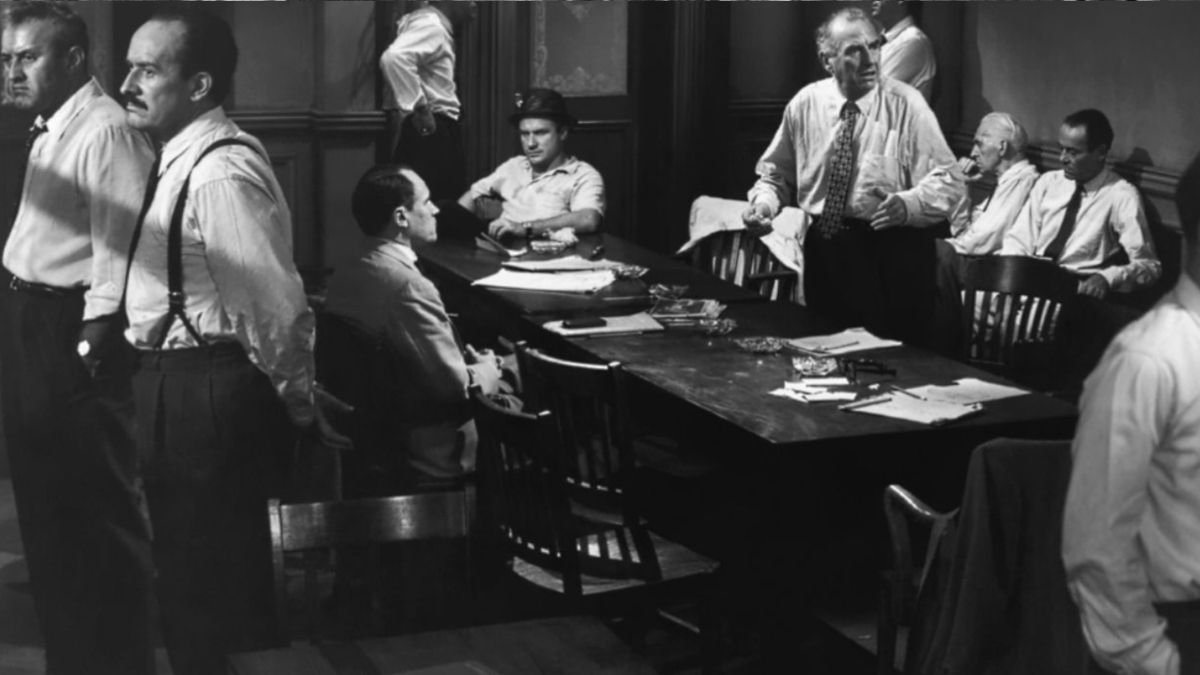
Scene design, examined: confined spaces (and how restriction increases tension)
Twelve men. One room. A single table. A buzzing fan that barely works.
That’s it.
No car chases. No swelling score. No dramatic lighting shifts. Just heat, sweat, and a boy’s life hanging in the balance.
If you want to study how restriction can sharpen tension instead of flatten it, 12 Angry Men is a masterclass. It’s not flashy. It doesn’t try to dazzle you. It simply traps you in the room and refuses to let you leave.
And somehow, that feels bigger than most action films.
Why confinement raises the stakes
It seems counterintuitive at first. Wouldn’t more space mean more possibility? More movement? More excitement?
Not here.
When you limit the physical environment, you magnify everything else. Tone of voice. A raised eyebrow. The scrape of a chair. The subtle shift of allegiance across a long wooden table.
I’ve found that confined scenes force writers to stop hiding behind spectacle. There’s nowhere to run. The tension must come from people.
In 12 Angry Men, the room becomes pressure. The windows don’t open easily. The air feels thick. The clock ticks. The outside world fades. You feel the hours dragging, even though the film rarely leaves that space.
Restriction isn’t a limitation.
It’s compression.
Juror #8 and the power of stillness
Juror #8 doesn’t storm the room.
He doesn’t shout at the beginning. He doesn’t accuse anyone of moral failure. He simply asks for time.
That’s his first move.
In a room where eleven men are ready to declare a guilty verdict in minutes, he introduces hesitation. Not certainty. Doubt.
And doubt spreads.
What fascinates me about this scene design is how persuasion replaces action. Every shift in the film is verbal. Logical. Emotional. Juror #8 doesn’t dominate physically. He leans back. He listens. He lets others talk themselves into contradictions.
In a larger space, that might feel passive.
In a locked room, it feels seismic.
Escalation without movement
One of the most impressive aspects of the film is how escalation happens without changing location.
No new setting resets the energy. No external event interrupts. The heat builds inside the same four walls.
At first, the arguments are procedural. Did the old man really hear what he claims? Could the woman have seen clearly through a passing train?
Then something shifts.
Personal biases leak into the open. Frustrations surface. One juror projects his anger at his own son onto the defendant. Another clings to pride rather than logic.
The room doesn’t change.
The temperature does.
I’m not entirely sure modern films trust audiences enough to let tension build this slowly anymore. But here, the slowness is the weapon. Each vote changes the atmosphere. Each reconsideration tightens the emotional stakes.
The confinement forces confrontation.
No one can escape the argument.
Space as silent antagonist
The room in 12 Angry Men isn’t just background.
It’s adversarial.
When the fan breaks, tempers flare. When the rain finally begins and the air cools, the tone softens. The environment mirrors the emotional climate without announcing itself.
The blocked exits matter too. These men can’t leave until they reach unanimity. That rule transforms debate into endurance.
You feel it in their posture. In their pacing. In the way some sit rigidly while others lean forward, desperate to move things along.
The confinement isn’t symbolic in a heavy-handed way. It’s practical. But practicality can carry theme without saying a word.
A justice system built on deliberation traps individuals inside collective responsibility.
That’s not a speech.
That’s architecture.
Why limitation sharpens persuasion
There’s something almost surgical about how the film dismantles certainty.
Juror #8 doesn’t prove the boy innocent. He proves the case uncertain.
And that’s enough.
In an open setting, someone could storm out. Avoid discomfort. Shut down. In this room, avoidance is impossible. The conversation must continue.
That’s the craft lesson.
When characters cannot physically leave, they must emotionally engage.
Confined spaces eliminate distraction. They strip away subplots. They force clarity.
Every line matters because there’s nowhere else to look.
The courage of restraint
It takes nerve to build a film almost entirely inside one room.
But it takes even more nerve to trust dialogue as action.
No explosions. No plot twists. Just incremental shifts in belief.
I’ve always admired how the film refuses to oversell its drama. The stakes are enormous, yet the storytelling remains controlled. Measured. Patient.
And because of that restraint, the tension feels honest.
By the final vote, when the last dissenting juror lowers his resistance, it doesn’t feel like victory. It feels like exhaustion. Relief earned through friction.
The door finally opens.
But the room has already done its work.
What confined spaces teach about scene design
Limitation is not weakness.
It’s focus.
When you restrict movement, you amplify choice. When you reduce spectacle, you highlight psychology. When you trap characters together, you force truth into the open.
12 Angry Men proves that tension doesn’t require scale.
It requires pressure.
One room.
Twelve men.
A single doubt.
And the slow, deliberate reshaping of certainty into something more careful.
That’s not just courtroom drama.
That’s scene design at its most disciplined.



Additional Reading:
- What is professional screenplay coverage (and do you actually need it?)
- What is professional screenplay coverage, really?
- How to Know If Your Screenplay Concept Is Strong Enough
- Why Most Second Acts Collapse (And How Coverage Detects It)
- How Professional Readers Evaluate Character Arcs
- Is Your Script Marketable?
Indexes: